

No doubt you’ve been asked how likely you are to recommend a product. That’s a survey in action — and your answer is doing way more than you think.
Surveys might seem simple on the surface, but behind every well-crafted question is a business chasing smarter decisions.
From shaping product roadmaps to fine-tuning marketing messages, survey research helps companies listen, learn and lead.
Below, we’ll break down survey fundamentals: what they are, how they work and how to use them to unlock insights that move your business forward.
TL;DR
- Surveys provide structured insights that guide smarter business decisions.
- The right survey should match your goal, whether that’s testing an idea, tracking brand health, improving customer experience or understanding your audience better.
- Strong surveys use the right mix of question types, including rating scales, open text, demographic questions and matrix tables to gather actionable insights.
- Good survey design matters. Keep it focused, make it easy to complete, test it before launch and choose the right distribution method for your audience.
- The real value comes after launch, when you analyze the results, spot patterns across groups and turn the findings into clear next steps.
What is a survey?
A survey is a structured way to collect information from a defined group of people, usually by asking a series of questions. Businesses use surveys to understand what customers think, feel and do.
For example, you might run a survey to test demand for a new product or understand how new customers perceive your brand. Instead of relying on assumptions, surveys give you direct input from the people you want to understand.
Most surveys fall into two broad categories.
Quantitative surveys
Quantitative surveys collect structured data (such as interval and ratio data) that you can measure and compare. These types of surveys rely on closed-ended questions, such as multiple choice, rating scales, ranking questions, or yes/no responses.
Because every respondent answers from the same set of options, the results are easier to analyze. This makes quantitative surveys useful for identifying trends, comparing groups, and measuring changes over time.
Qualitative surveys
Qualitative surveys ask open-ended questions to collect feedback in respondents’ own words.
These answers take more time to review, but they add meaning that numbers alone cannot provide.
Qualitative qualitative market research questions are especially useful when you want to understand motivations, concerns, decision-making or the language customers use to describe a problem.
Quantitative vs qualitative surveys?
You’re probably wondering, which is better? The best approach is to use a mix of both; quantitative questions will give you the “what” while qualitative questions will help you understand the “why.”
ℹ️ Here’s a simple example:
- “How likely are you to recommend this product to a friend?” (quantitative data)
- “What’s the main reason for your score?” (qualitative data)
Together, the answers give you a mix of data you can measure and insight you can act on to make confident business decisions.
Types of surveys
As mentioned above, there are many different types of surveys, and each one is designed to answer a different kind of business question. The right choice depends on your goal.
Below are some of the most common survey types and how businesses use them to turn feedback into better decisions.
Customer satisfaction surveys (CSAT, NPS)
Customer satisfaction surveys are designed to measure how happy customers are with your product, service or brand.
Two common formats are Customer Satisfaction Score (CSAT), which asks customers to rate satisfaction with a specific interaction, and Net Promoter Score (NPS), which gauges overall loyalty by asking how likely someone is to recommend you.
Try this survey method when you want to:
- Identify friction points in the customer journey
- Track how satisfaction changes over time
- Improve retention by acting on negative feedback
Product feedback surveys
These surveys help you gather direct input on your product — whether you’re exploring a new idea, rolling out a feature or improving what already exists. They’re a fast way to validate assumptions and shape your roadmap based on real user needs.
Product feedback surveys assist with:
- Prioritizing product development based on customer needs
- Reducing the risk of failed features or launches
- Discovering unmet needs or usage patterns
Brand awareness surveys
Brand awareness surveys take stock of how recognizable your brand is to your audience and how well they understand it.
They typically include unaided awareness (“Which brands come to mind?”) and aided awareness (“Which of these have you heard of?”), along with questions about perception and sentiment.
Use this type of survey when:
- Tracking campaign impact on awareness and perception
- Benchmarking against competitors
- Understanding gaps between brand intention and audience perception
Employee engagement surveys
These internal surveys give you a read of how employees feel about their roles, teams and the wider company culture. They help flag issues early and show where to focus if you want to improve retention and performance.
Use these in the workplace to:
- Identify drivers of motivation and burnout
- Shape HR and management strategies
- Improve retention through targeted interventions
Consumer profiling surveys
Consumer profiling surveys are used to build a clearer picture of your audience, including how different groups think, behave, and make decisions.
Use consumer profiling surveys when you want to:
- Build meaningful audience segments
- Understand what matters to different groups
- Tailor messaging for different audience groups
Market analysis surveys
Market analysis surveys help you assess a market before making a strategic move, such as entering a new region, launching a product or targeting a new audience.
These surveys help you to evaluate demand, understand where opportunities exist, and reduce the chances of investing in the wrong market, audience or idea.
Use market analysis surveys when you want to:
- Validate demand and willingness to buy
- Understand competitors and alternatives in the category
- Identify gaps or unmet needs to inform your positioning
- Decide which markets, audiences or opportunities to prioritize
The questions that drive results
Once you know which type of survey you need, the next step is choosing the right question formats.
This matters because the question format you use directly impacts the survey responses you receive.
In turn, this affects the quality of insights from your survey data. Too many open-ended questions? You risk drop-off. Too many rating scales? You may miss the nuance behind the numbers.
There’s no one-size-fits-all question format. Each question type serves a specific purpose, whether you’re looking for hard metrics, directional sentiment or layered feedback.
The trick is to choose formats that align with your goal. Then, strike the right balance between ease of response and depth of insight.
Here are some survey question types and when to use them.
Multiple choice
Use multiple choice questions when respondents should pick one answer from a list. It works well for clear, straightforward questions and gives you results that are easy to compare and analyze.
Multi-select
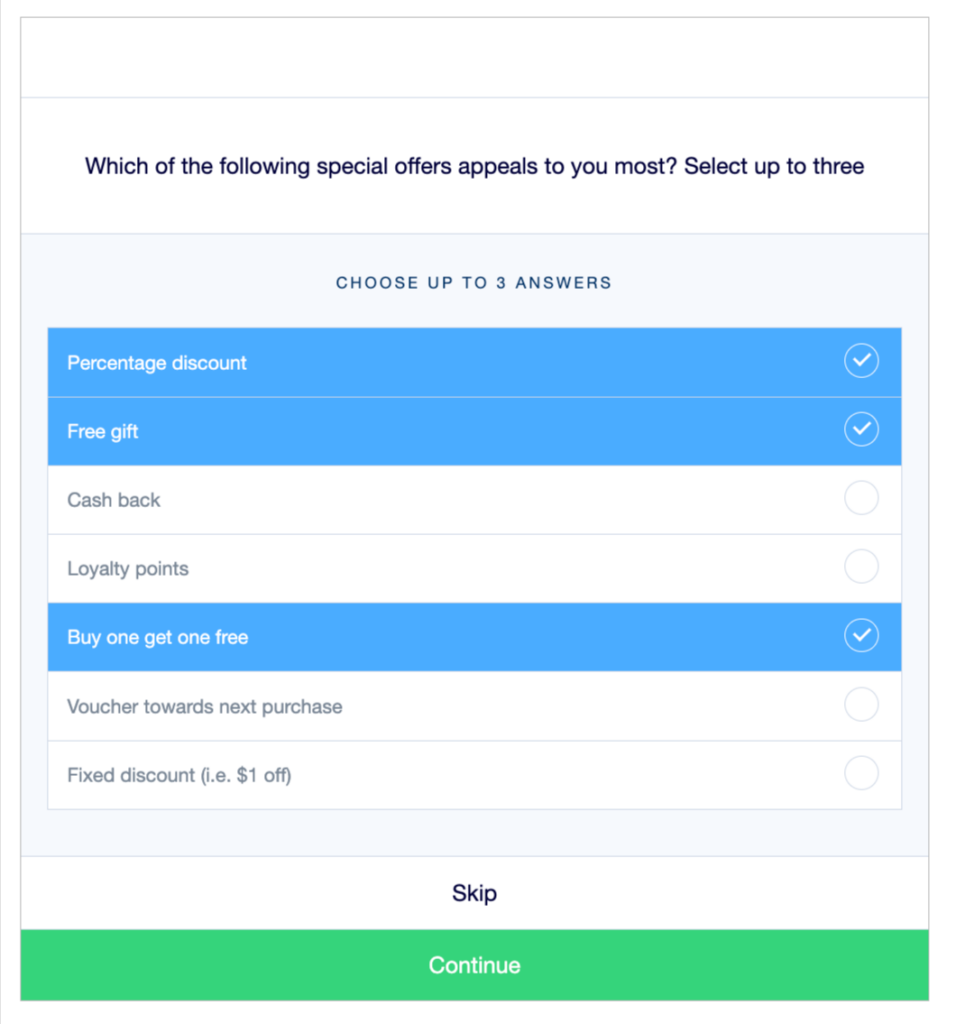
Use multi-select when more than one answer may apply. This is useful for questions about behaviors, preferences or influences where people are unlikely to have just one response.
Rating scale
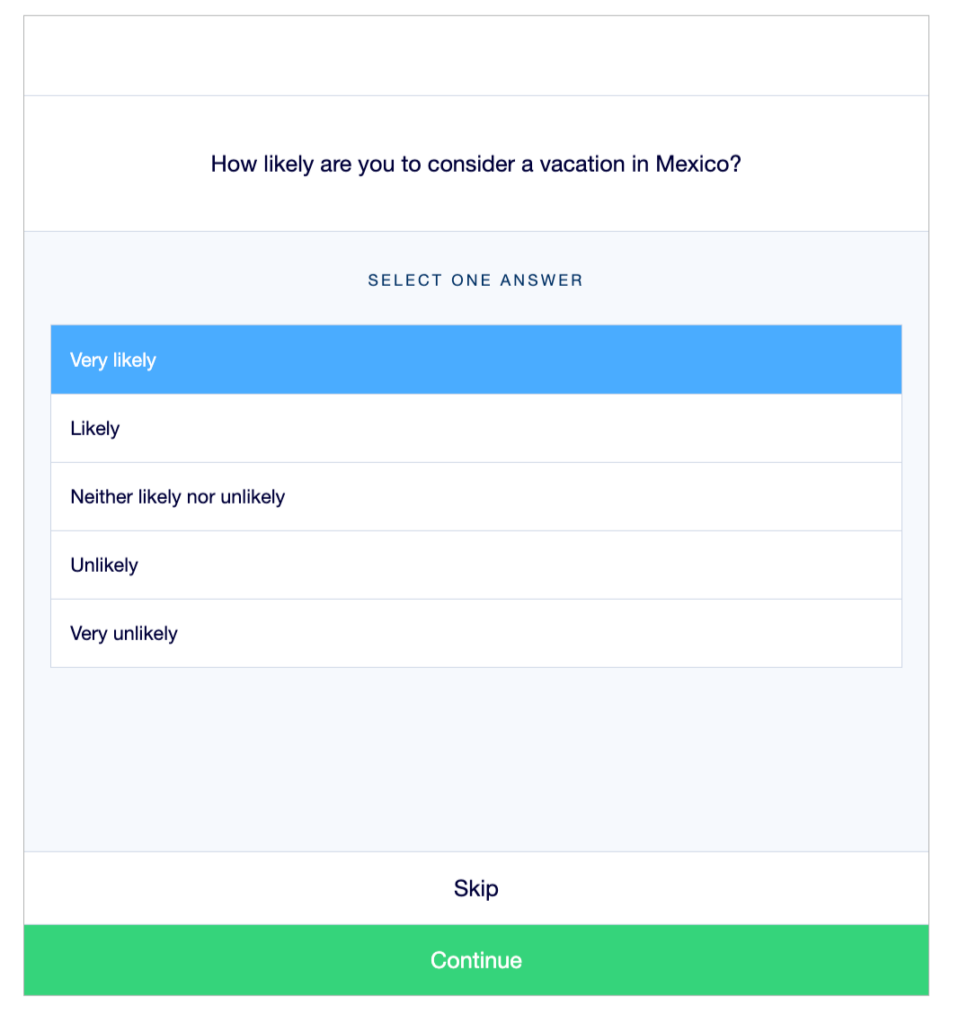
Rating scale questions ask respondents to score something, such as satisfaction, likelihood or quality.
This includes formats like Likert scales, which measure agreement with a statement and makes rating scales useful for comparing attitudes and experiences across a group.
Open-ended
Open-text questions let respondents answer in their own words. They are useful when you want to understand the reasoning behind an answer, but they take longer to review, so use them selectively.
Demographic questions
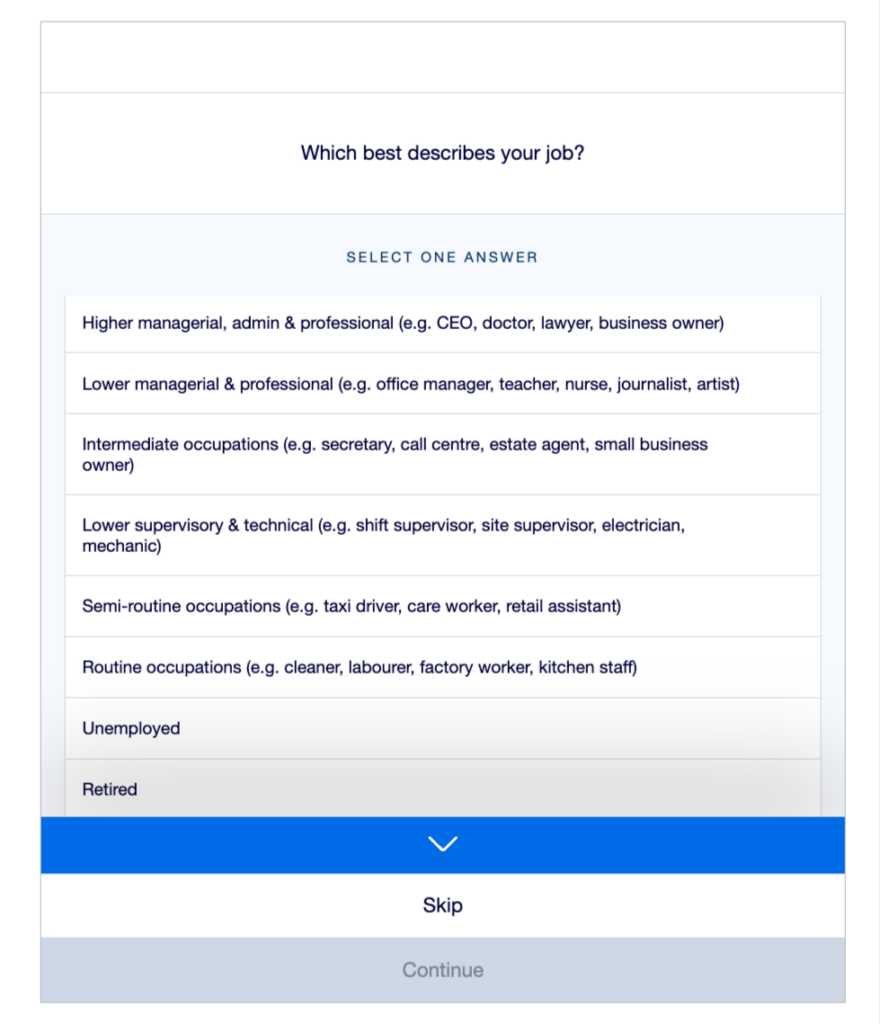
Demographic questions help you understand who your respondents are, such as their age, gender, location, income or job role. That makes it easier to segment results and see how answers differ across groups.
Matrix table
A matrix table groups similar questions together in a grid, where each row is an item and each column shares the same set of answer options. This makes it easier to compare how respondents rate or feel about multiple things at once.
Ready to launch your first survey? Start here
A well-structured survey should be designed with intent and tested before launch, all while keeping the end goal in mind.
Rushed surveys lead to weak data. But a well-executed one is your fast track to real answers and smarter decisions.
Here’s a step-by-step guide to creating surveys.
1. Define your goals
Start with a focused research question: What do you need to know to make a better business decision?
You might want to test product-market fit, evaluate brand perception or gather feedback on a recent marketing campaign. A well-defined goal keeps your questions sharp and your survey data meaningful.
2. Identify your target audience
The next step is to clarify who you need to hear from: existing customers, lapsed users, potential buyers or internal teams.
For example, a brand tracking survey may need a broad sample of your target market, while a product or usability survey may need current customers.
Once you know who you want to reach, the next step is to determine your sample size. Your aim here is not to collect as many responses as possible, but to calculate how many people you need to form a representative sample of your target audience.
Depending on your research goals, approaches like stratified sampling and quota sampling can help you build a more balanced sample and reduce bias in your results.
3. Choose your survey tools
Whatever insights you want to gather, you’ll need a suitable survey tool that fits your needs. Some of the better-known tools for data collection include:
- Attest is a consumer research platform designed to take you from idea to insight in one place. You can build surveys using a wide range of question types, target specific audiences through Attest’s panel or your own data, and analyze results in real time. Compass, Attest’s AI copilot, helps you plan your research, quickly create surveys and refine questions, while built-in dashboards and Boards make it easier to interpret and share findings.
- Google Forms is a free tool perfect for simple surveys and internal feedback. It works well for basic data collection, but offers limited targeting and analysis capabilities.
- Typeform Focuses on user experience, with more visually engaging and conversational survey formats. It is often used when design and completion experience are a priority, although it is less focused on advanced research workflows.

4. Design your survey
Once you know what you want to learn and who you want to hear from, the next step is building the survey itself.
A common mistake at this stage is trying to ask too much. Keep your survey as short, focused and easy to complete as possible, and only include questions that align with your objectives.
Start by drafting your questions and choosing the right question types for the kind of feedback you need, whether that is single choice, multiple choice, ranked, grid or open text.
If you need a faster starting point, tools like Compass can help you generate a first draft based on your research goal or brief.
From there, think carefully about the respondent experience. Add clear answer options, instructions and supporting media where needed so questions are easy to follow and answer.
If you need to screen people in or out, put those qualifying questions at the start. You can also group related questions together, randomize where it makes sense and apply logic so people only see the questions that are relevant to them.
5. Test your survey before launch
Once you have finalized your questions, take the time to preview the survey exactly as respondents will experience it.
If you’re doing an online survey, check that answer options and media display properly, routing and display logic work as intended, and the survey is easy to complete on mobile (which is where many respondents will see it).
This is one of the simplest ways to catch unclear wording, broken logic and formatting issues before they affect your results.
For an extra layer of quality control, share the preview link with teammates or stakeholders so they can review the survey and give feedback or sign-off before launch.
6. Launch and distribute
When you’re ready to go live, consider the best way to reach your target audience. Your distribution method depends on your survey format, and both should align with where your audience already is.
Surveys can be conducted in various ways:
- Face-to-face: Often distributed at physical locations like stores or events
- Over the phone: Typically via cold or warm calling
- Paper questionnaires: Handed out or mailed
- Online: Via email, social media, website pop-ups, or online panel surveys
7. Analyze data and act on the results
Once responses are in, the next step is making sense of the data. That means cleaning up incomplete or low-quality responses, reviewing open-text answers and looking for patterns that help answer your original research question.
Start with the top-line results to get a clear view of the main takeaways. Which responses stand out? Where is there a clear preference, concern or point of difference? This gives you a baseline understanding of what the data is saying before you look more closely.
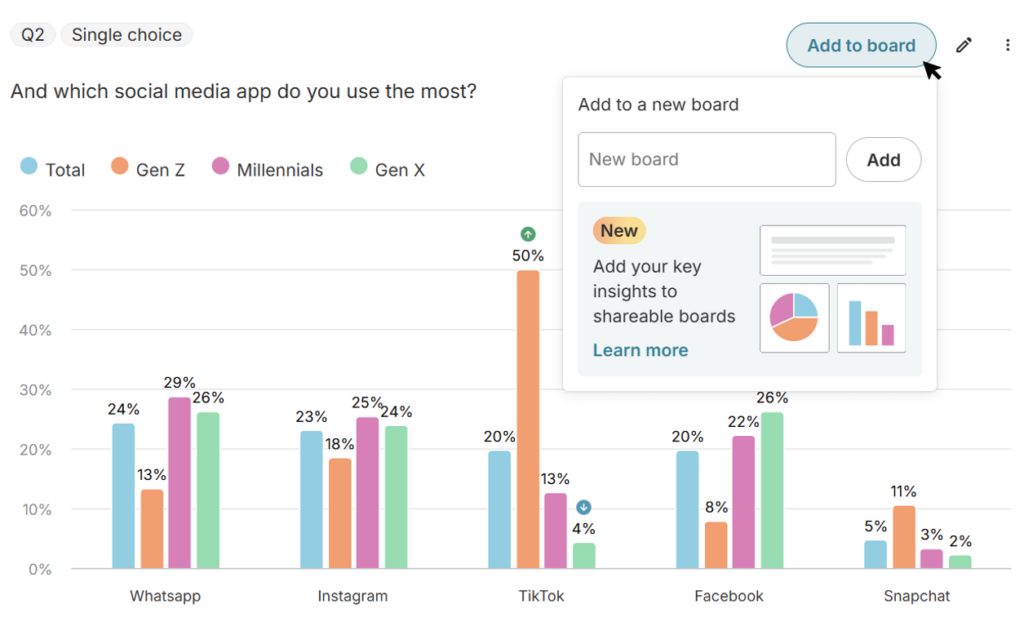
From there, it helps to split your results down further. Looking at responses by demographics, audience, wave or answer type can reveal differences that are easy to miss in the overall averages.
If you need a more detailed view, crosstabs can help you compare how different groups responded and examine relationships between answers more clearly.
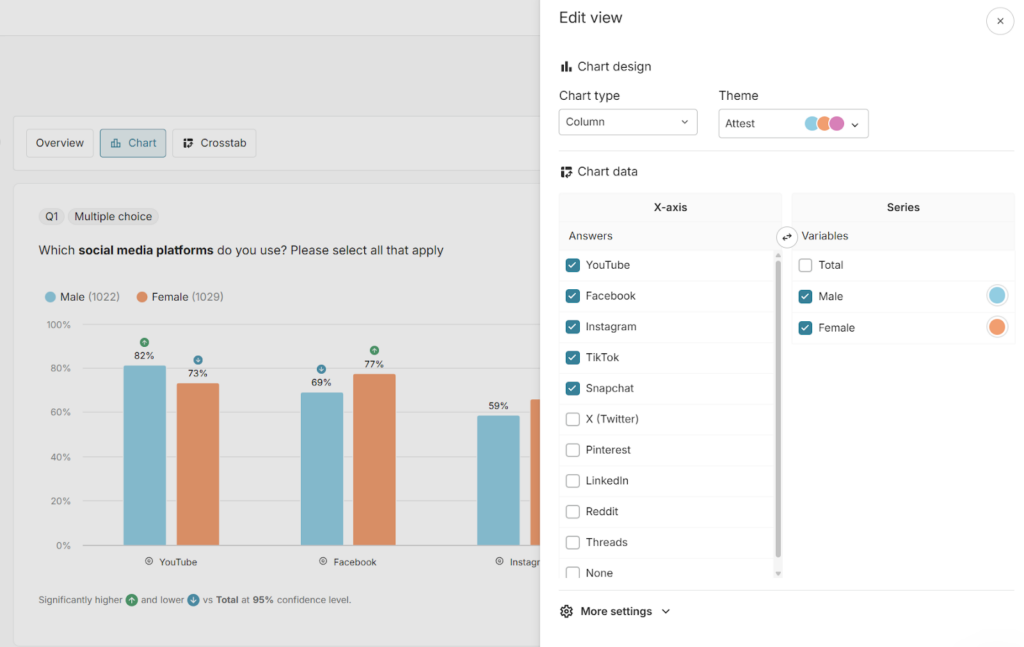
Don’t overlook open-text responses. Written answers can reveal the reasoning behind the numbers, adding context that closed-ended questions alone may miss.
When response volumes are high, AI-powered text analysis can help you identify recurring themes, surface top keywords and make sense of the feedback faster before diving into manual review.
The final step is turning those findings into a clear next move and a clear story for stakeholders.
Once you know what matters, your next job is to bring the key charts, comparisons and commentary together in a way that makes the takeaway obvious.
Some stakeholders will want a quick summary of the main findings, while others will need more context behind the patterns.
The value comes from helping people understand what the data says, why it matters and what should happen next.
How surveys support better business decisions
By this point, you have the foundations of a good survey:
- A clear goal
- The right audience
- A solid structure
- A plan for turning responses into insight
The next question is how that insight gets used. Here are some of the most common ways surveys support those decisions.
- Launching new products: Before investing in product development, surveys help you test demand, gauge price sensitivity and understand what features people actually want. It means fewer missed marks and more products that land.
- Optimizing marketing messages: Test creative, refine positioning or choose between taglines. Surveys reveal what strikes a chord with your target audience and why. In turn, you can formulate messages that convert.
- Tracking brand health: Regular brand tracking surveys measure awareness, perception and recall across different audiences. They help you spot shifts early, benchmark against competitors and stay in control of your brand’s direction.
- Improving customer experience: Post-purchase or post-support surveys can identify friction points, highlight what’s working well and point to where you need to dig deeper. At the same time, they show customers you’re listening.
- Exploring new markets: Surveys make it easier to understand unfamiliar audiences. You can assess demand, test value propositions and uncover local nuances before expanding into new regions or segments.
- Refining customer profiles: Audience profiling can reveal how your ideal customer thinks, shops and behaves. As a result, you can build more accurate personas and sharpen your targeting across channels.
Key takeaway: Survey data lets business stakeholders reduce guesswork and unlock clarity at every stage of the decision-making process.
Great decisions start with the right questions
Surveys aren’t just a box to tick — they’re a strategic tool for staying close to your audience and making better business decisions.
When done well, surveys surface insights that help you build stronger products, sharper messaging and a brand that customers can relate to.
Whether you’re validating a new idea or tracking brand perception, the quality of your questions will define the quality of your insights. `
Want to sharpen your survey skills even further? Explore our guide to writing better survey questions and start asking smarter.