

You can’t survey everyone in your market. But you don’t need to. A representative sample gives you accurate insights by capturing the views of a smaller group that reflects the whole population. Done well, it means a few hundred responses can reveal what millions think.
For marketers, product teams and research professionals, this isn’t just theory. It’s the difference between confident decisions and costly mistakes. In this article, we’ll define representative sampling, explain why it matters, explore the main methods and show you how to get it right in practice.
TL;DR
A representative sample is a smaller group that mirrors your target population’s key traits, giving you accurate insights without surveying everyone.
Why it matters:
- Saves time and cost while maintaining accuracy
- Reduces sampling error and bias
- Builds confidence in decisions based on real market views
- Improves ROI by anchoring strategies in reality
How to get it right:
- Define your target population clearly
- Calculate the right sample size (use a calculator for margin of error + confidence level)
- Choose a sampling method (probability for precision, non-probability for speed)
- Apply quotas or stratification to balance subgroups
- Use a survey platform with quota controls, live monitoring, and quality checks
Bottom line: A representative sample ensures your research reflects the full market, so every survey delivers trustworthy, actionable results.
What is a representative sample?
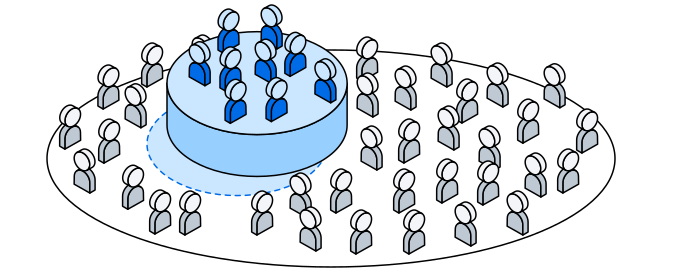
A representative sample is a subset of a population that accurately reflects the larger group’s key traits. This could be demographics like age and gender, or behavioural patterns and attitudes, which can be explored through demographic survey questions. In other words, it’s not just a random slice of people; it’s a carefully constructed mini-version of the population you care about.
Why does this matter? Because most research projects don’t have the resources (or need) to reach everyone in a target market. Instead, you study a smaller group. However, the value of your insights depends on whether that group truly mirrors the bigger picture.
Think about election polling: A good representative sample of voters is the difference between predicting the outcome correctly or missing the mark entirely. The same principle applies in market research. Whether you want to test a product concept or track brand perception, a representative sample ensures your findings can be trusted to guide real-world decisions.
Why representative samples are essential in market research
In market research, accuracy is the foundation for every decision that follows. A representative sample ensures your findings reflect the realities of your target market, so you don’t build strategies on shaky ground. When your sample truly mirrors the population you’re studying, you gain insights you can act on with confidence.
Representative sampling delivers four major business benefits, especially when working with market research companies:
Cost and time saving
As we mentioned above, surveying an entire population isn’t feasible, but that doesn’t mean you need to compromise on accuracy when it comes to your survey results.
Representative sampling allows you to capture reliable insights from a smaller, carefully selected group. For example, instead of surveying every consumer in a new market, you can reach a few hundred participants who reflect the population’s diversity.
Overall, this reduces fieldwork costs, accelerates research timelines and still delivers statistically valid results. When teams work with limited budgets or under pressure to validate decisions quickly, this is crucial.
Make confident decisions
When your sample mirrors your true audience, you can trust that research findings will hold up in the real world. Imagine testing creative concepts: if your sample skews too young or too urban, you might launch an ad that resonates in one pocket of your audience but misses everywhere else.
Representative sampling gives decision-makers confidence that their campaigns, products or pricing strategies won’t just work for a subset of customers. Instead, they’ll work for the broader market they need to reach.
Avoid sampling errors
Sampling error refers to the natural difference between what your sample says and what the entire population might say. Even with a well-chosen, representative sample, there’s always some level of random variation. But if your sample is too small or lacks diversity, that error can grow and lead to misleading conclusions, like overstating demand or missing key pain points.
This is different from sampling bias, where errors stem from how the sample is selected. A truly representative sample helps minimize both risk types to give you more reliable insights that protect your business from costly missteps, like overinvesting in the wrong feature or ditching a concept with real potential. Understanding the difference between qualitative vs quantitative research can further enhance your research strategy.
Better ROI in the long run
Every research project is an investment of time, money and strategic focus. Representative sampling improves the odds that this investment delivers returns by anchoring decisions in reality. The closer your sample reflects your customers, the more accurately you can forecast outcomes, prioritise opportunities and allocate resources.
Over time, this compounds into measurable ROI: campaigns that deliver stronger lift, products that meet real demand and strategies that scale effectively because they’re built on trustworthy evidence.
Representative sampling methods
Once you understand what a representative sample is and why it matters, the next question is: how do you actually create one? There are two main approaches:
- Probability sampling: Every member of a population has a known chance of being selected. This produces stronger representativeness and is the gold standard for statistical reliability.
- Non-probability sampling: Participants are selected through non-random methods. This is faster, easier and sometimes the only practical option, though it carries a higher risk of bias.
The choice between the method you choose depends on your research goals, resources and timelines. Let’s look at each in detail below.
Probability sampling
Probability sampling is best when you need high statistical accuracy and want your results to generalize confidently to the wider population. It’s especially valuable for large-scale brand tracking, product validation or any research where precision is non-negotiable.
Within this approach, there are several techniques:
Simple random sampling
This is the most straightforward method. Everyone in the population group has an equal opportunity of being picked, often using random number generators or lottery-style draws.
The method is simple to execute and avoids selection bias (when certain groups are left out or overrepresented in your sample). For example, if you want to survey 1,000 people from a national database of 1 million consumers, you’d randomly select names until you hit your quota.
The benefit is transparency; your data can’t be accused of favouritism. The drawback is that you may end up with fewer people from smaller subgroups (e.g., rural customers), unless you add extra steps to balance the sample.
Systematic sampling
Systematic sampling involves choosing every n-th individual from a list after a random starting point. For instance, if you have a customer database of 10,000 names and need 1,000 respondents, you’d select every 10th person after starting at a random number between 1 and 10.
This method is efficient and ensures coverage across the list. However, it carries a risk: If the list has hidden patterns (e.g., sorted by geography or sign-up date), you could introduce unintended bias. It works best when your source list is well-randomised and you want a simpler alternative to full random sampling.
Stratified sampling
Stratified sampling divides the population into subgroups (or strata) based on characteristics such as age, income or region. Respondents are then randomly selected from each subgroup in proportion to their size in the population. For example, if 60% of your customers are female and 40% male, your sample would mirror this ratio.
This method is highly effective for ensuring key groups aren’t under- or over-represented. It’s ideal for projects like brand perception studies where demographic accuracy is critical. The trade-off is complexity: you need detailed population data upfront to define your strata correctly.
Cluster sampling
Cluster sampling is useful when a population is geographically dispersed or difficult to reach. Instead of sampling individuals directly, you divide the population into clusters (such as cities or schools) and then randomly select entire clusters for your study.
In single-stage cluster sampling, everyone in the chosen clusters is surveyed. In multi-stage cluster sampling, you first choose clusters, then randomly select individuals within them. For example, to study healthcare access in a large country, you might select 10 regions, then survey a subset of people in each.
This method saves time and cost. But clusters may not perfectly reflect the broader population, so results need careful interpretation.
Non-probability sampling
Non-probability sampling is often used when speed, budget or access constraints make probability methods impractical. While it carries a higher risk of bias, it can still be valuable, especially for exploratory research, concept testing or studies where reaching niche audiences matters more than statistical generalisation.
Convenience sampling
Convenience sampling selects participants who are easiest to reach. For example, you might survey shoppers at a mall or users who respond to an in-app pop-up. It’s quick and inexpensive, so it’s a common choice for early-stage research.
The trade-off is representativeness. Your results may skew heavily toward people who are available and willing to participate. This makes it less reliable for decisions that require market-wide accuracy, but acceptable for exploratory studies or pilot testing.
Quota sampling
Quota sampling is where researchers divide the population into exclusive subgroups, such as age, gender, income, or region and then recruit participants until a set “quota” for each subgroup is met.
Unlike stratified random sampling, participants within each subgroup are not chosen randomly. Instead, they’re selected based on convenience or accessibility. For example, if a study requires 40% of respondents to be women and 60% men, the researcher will continue collecting responses until those proportions are filled, regardless of how participants are sourced.
This method is widely used in consumer and market research because it ensures that key demographics are represented in the sample, even when random sampling isn’t feasible. However, the lack of randomization introduces potential bias, meaning quota samples may not always provide the same level of statistical reliability as probability-based methods.
Snowball sampling
Snowball sampling recruits participants through referrals from existing respondents. Say you’re studying niche B2B audiences like procurement managers; your initial contacts can recommend colleagues who fit the same profile.
This method is invaluable for reaching niche or hard-to-identify groups. However, it often creates networks of participants who share similar perspectives, which reduces representativeness. Snowball sampling is best used when the priority is access over precision, for example, qualitative exploration of specialized markets.
Purposive sampling
Purposive sampling, also known as judgmental sampling, involves the deliberate selection of participants who meet specific criteria. To illustrate this, imagine your research project is to investigate digital banking adoption; you might only recruit consumers who have switched banks in the past year. This method ensures you gather insights from exactly the people relevant to your research question.
The limitation is that the sample won’t generalize to the wider population. Its purpose is depth, not breadth. Purposive sampling is especially useful for in-depth studies where representativeness is less important than the relevance of participants’ experiences.
How to build a representative sample
Whether a researcher uses probability-based sampling (random selection) or non-probability methods (like quota sampling), the end goal is the same: To mirror the target population’s composition as closely as possible.
However, a sample should not just be large enough; it should be balanced enough to reflect the real-world mix of people you want insights from. Follow these steps to build a representative sample that will allow you to apply your research findings with confidence.
1. Define your target population
The first step is to establish who you want to gather insights from. This isn’t just a broad demographic like “consumers in the US”. It’s a well-defined population that aligns with your business objectives. Go beyond general descriptors like “consumers” or “B2B buyers” and specify characteristics such as:
- Demographics (age, gender, income, education)
- Geography (region, country, urban vs. rural)
- Behavioral traits (purchase frequency, product use, brand awareness)
An example could be “US adults aged 25–45 who shop online at least twice a month.”
A precise definition of your target population ensures you don’t waste time collecting data from people who aren’t representative of the group you want to understand.
It’s also critical to distinguish between population and sample:
➡️The population is the entire group you’re interested in
➡️The sample is the smaller group you’ll actually survey
Your sample should act as a microcosm of the larger population, capturing its key traits in the right proportions.
2. Determine your sample size
Sample size determines how much confidence you can place in your results. As a general rule, a larger sample generally reduces the margin of error and increases reliability.
But what matters is representativeness, not sheer scale. For example, conducting a market research survey of 1,000 people in a population of 50,000 can give similar confidence to 1,000 in a population of 5 million. Bigger isn’t always better if it overshoots your research goals or budget.
The key considerations to calculate sample size include:
- Margin of error: A percentage setting expressed as ±X% (industry standard is ±3%) that defines the maximum expected difference between your sample estimate and the true population value at your chosen confidence level. Smaller margins of error give more precision but more respondents.
- Confidence level: The degree of certainty you want that your sample truly reflects the population, typically set at 90%, 95%, or 99%. A higher confidence level reduces the risk of being wrong but demands a larger sample size.
- Population size: Total number of people in the group you want to study (e.g., all finance managers in mid-size companies). Once your population is large enough (e.g., thousands or millions), the required sample size levels off.
ℹ️ To make this easier, you can use Attest’s sample size calculator. Just set your desired margin of error and confidence level and the tool will instantly show you the ideal sample size required for reliable results.
3. Choose your sampling method
The method you select should balance accuracy, feasibility and cost. Probability-based methods (like simple random or stratified sampling) deliver stronger statistical reliability but may be more complex or expensive. It’s also important to understand the differences between a survey vs questionnaire when designing your research tools.
Non-probability methods (like quota or convenience sampling) are faster and often used in market research where speed is critical. But they carry a higher risk of bias.
Tip: If resources allow, aim for probability-based methods for high-stakes decisions. Use non-probability approaches when you need quick, directional insights.
4. Apply quotas or stratification where needed
To ensure balance in your representative sample, divide your population into meaningful subgroups (e.g., age, gender, income, geography) and set quotas or strata based on their real-world proportions. This helps prevent over-representation of easily accessible groups and keeps the sample aligned with reality.
For instance, if 20% of your target market is aged 18–24, then 20% of your respondents should fall into that bracket.
5. Choose a survey platform that helps you recruit and monitor effectively
The right market research tools make it easier to reach your target audience evenly and maintain balance as responses come in. A strong tool will let you set quotas upfront, track fieldwork as it happens and adjust on the fly if certain groups become under-represented.
Without these safeguards, you risk collecting data skewed toward a few demographics. For example, you might end up with too many responses from urban professionals while rural consumers remain under-represented. That imbalance can lower your survey response rate, distort your findings and lead to decisions that miss key market segments.
With Attest, you don’t just get quota-setting and live monitoring — you also get access to a diverse global audience across 59 countries and 70 languages. You can choose from pre-set audiences for extra confidence in the sample. For example, if you want a nationally-representative sample of US working adults, selecting the pre-built audience will ensure you recruit respondents that mirror the population on demographic dimensions (age, gender, region)
Plus, you have a dedicated Research Manager on hand for planning, survey reviews, and analysis support at no extra cost. The result: Every survey stays representative, reliable and easy to manage from launch to storytelling .
Make every survey count with representative sampling
A representative sample is the foundation of reliable market research. When you ensure that your sample mirrors the wider population, you save time and cost, reduce errors and make confident decisions that improve ROI.
Whether you use probability or non-probability methods, the goal is the same: to capture the full picture of your audience so your insights drive real impact.
With the right tools, building representative samples doesn’t have to be complex. Attest helps you set quotas, track progress and keep your research aligned with the people who matter most.