
Your team is preparing a new brand tracking survey. Someone suggests a five-point Likert scale, another a ten-point numeric scale and someone else argues for emojis to increase completion. Who’s right?
Choosing a rating scale isn’t just a matter of preference, but precision. The wrong scale can distort your data and introduce bias. The right one captures attitudes and behaviors accurately, revealing clear, actionable insights. Below, we’ll help you choose the right rating scale for your research.
TL;DR
Rating scales turn opinions and behaviors into measurable data, but only if you choose the right format.
- What they are: Structured response options that quantify how people feel, think or act (for example, satisfaction, agreement or likelihood).
- Main types: From simple 5-point Likert and 10-point numeric scales to sliders, ranking and adjective checklists, each reveals a different kind of insight.
- How to choose: Match your scale to your research goal (attitude, behavior, comparison), depth of insight needed (broad vs detailed) and audience (consumer vs professional).
- When to avoid: Skip rating scales when you need context or explanation, and pair them with open-ended questions to understand the why behind a score.
What are survey rating scales?
A survey rating scale is a structured response format used in closed-ended survey questions. Respondents choose from fixed options to express how they feel, think or behave toward a statement or scenario.
Rating scales are a core part of survey best practices, helping researchers collect structured, comparable data that leads to quantifiable insights.
They’re used across many types of survey questions, such as:
- Agreement scales: Measure how much someone agrees or disagrees with a statement (e.g., Strongly disagree to Strongly agree)
- Satisfaction scales: Gauge satisfaction levels with a product, service, or experience (e.g., Very dissatisfied to Very satisfied)
- Likelihood scales: Assess how likely someone is to take an action (e.g., Not at all likely to Extremely likely)
Here are some more examples of the different types of survey rating scales:
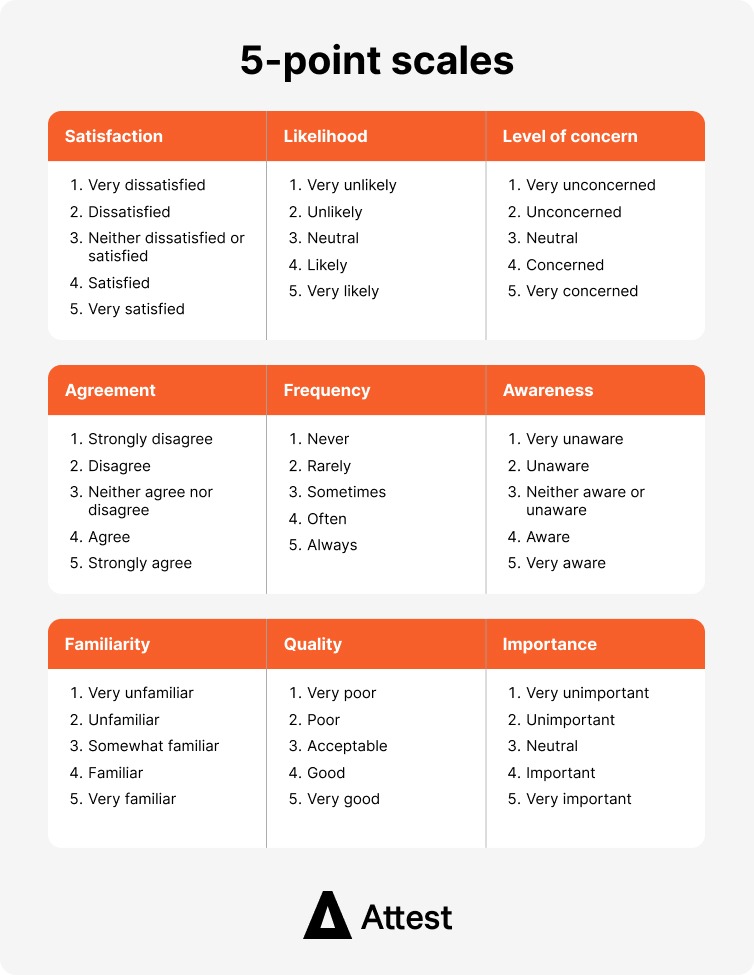
15 types of survey rating scales
From Likert scales that measure agreement to slider scales that capture intensity, each format helps quantify responses in a different way.
Below, we’ll break down fifteen types of rating scales, explaining what they measure, when to use them and the pitfalls to avoid.
1. Likert scale
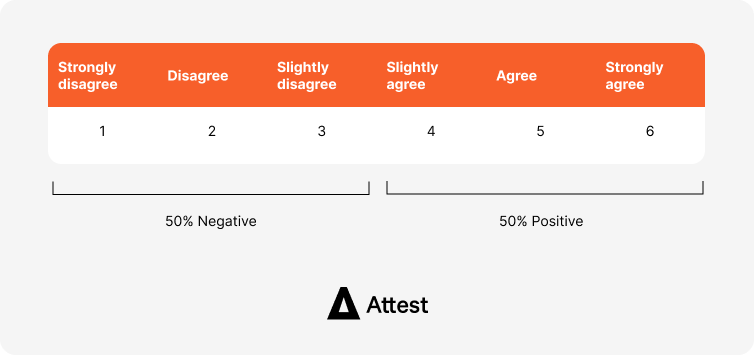
The Likert scale asks respondents to indicate their level of agreement or disagreement with a statement, usually on a 5- or 7-point scale ranging from “Strongly disagree” to “Strongly agree.”
It’s one of the most widely used methods in survey research for capturing attitudes, perceptions and opinions in a structured way.
- Pros: Familiar, standardized, easy to interpret and reliable for tracking sentiment over time.
- Cons: Prone to midpoint bias and acquiescence bias and produces interval scale data, which limits some statistical analysis.
- Example use case: Measuring brand trust, customer perception, or employee engagement.
Key-point: What is midpoint and acquiescence bias? As we mentioned above, two common response biases can affect Likert data. Midpoint bias happens when respondents repeatedly choose the neutral option to avoid expressing a strong view, while acquiescence bias occurs when they tend to agree with statements regardless of their actual opinion.
2. Numeric/linear rating scale
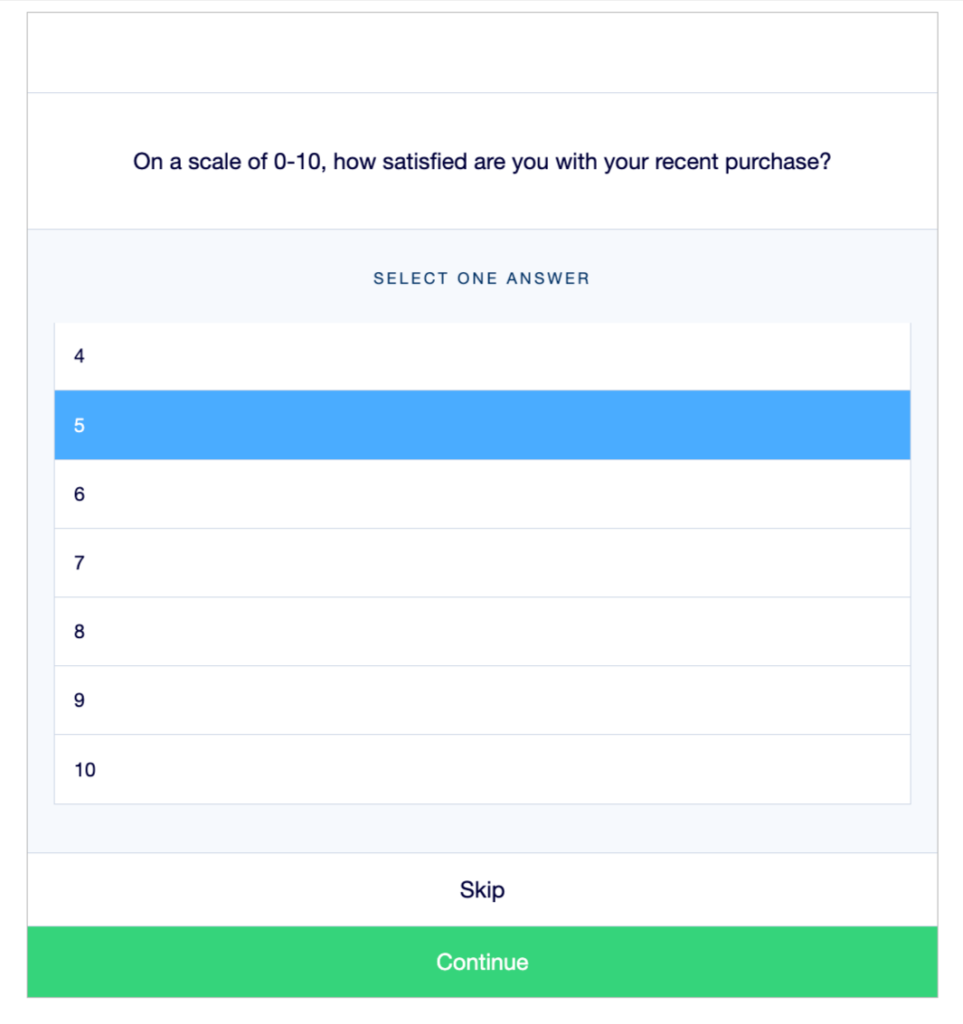
Respondents rate an item using a defined numeric range, often 0–10 or 1–5. Endpoints may be labelled, for example, ‘Very dissatisfied’ to ‘Very satisfied,’ while middle values are numeric only.
Linear scales work well when you need a quick, quantifiable measure of intensity. They’re also the foundation for Net Promoter Score (NPS) questions that measure likelihood to recommend.
- Pros: Simple, universally familiar and easy to analyze across large datasets.
- Cons: Different cultures could interpret numbers differently and similar to a Likert scale, responses sometimes cluster around the midpoint.
- Example use case: Measuring customer satisfaction, service quality or post-support experience.
3. Multiple rating matrix
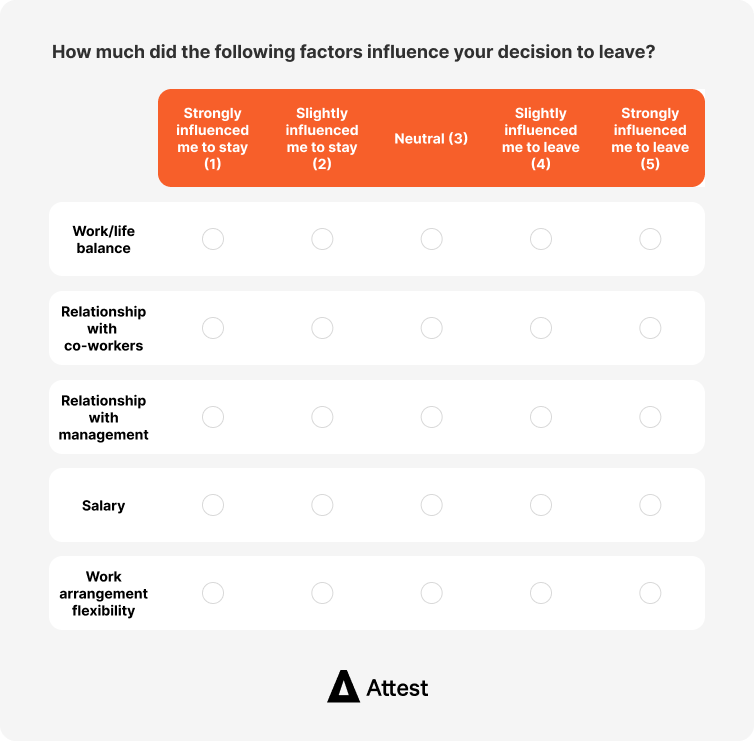
A multiple rating matrix presents a grid where respondents rate several items using the same scale, such as 1–5 or “Strongly disagree” to “Strongly agree.” This structure allows for quick, consistent comparison across multiple attributes or features within a single question.
It’s especially useful when assessing perceptions of different product or brand elements side by side. However, long or repetitive grids can lead to fatigue and “straight-lining,” where respondents select the same answer across rows without careful consideration.
- Pros: Efficient, uses a consistent scale for easy comparison and helps spot patterns quickly.
- Cons: Can cause survey fatigue and careless answers on longer grids.
- Example use case: Product attribute evaluation, feature usability testing and employee satisfaction surveys.
4. Frequency scale
A frequency scale measures how often a behavior or event occurs, using categories such as “Always,” “Often,” “Sometimes,” “Rarely,” or “Never.” Rather than capturing attitudes, it focuses on behaviors and patterns over time which makes it valuable for understanding usage habits or repeated experiences:
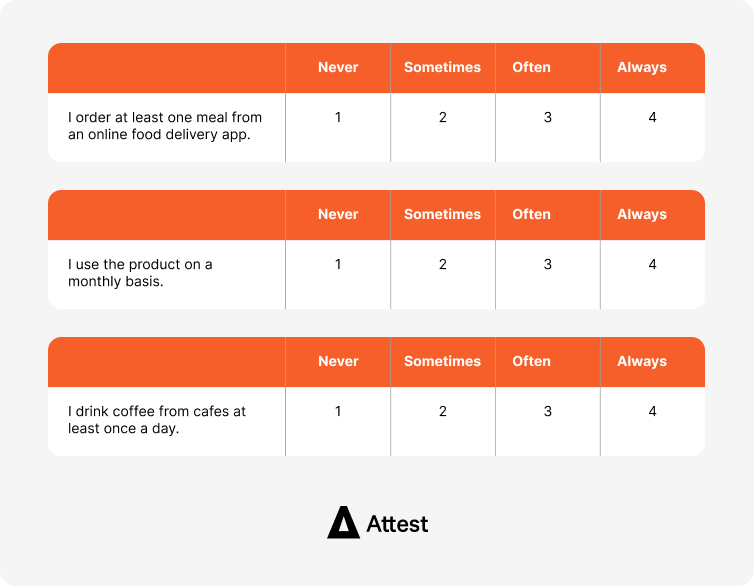
Frequency scales can use either descriptive terms or specific timeframes (e.g., “daily,” “weekly”), depending on the context. While simple and intuitive, they rely on subjective interpretation. For example, one person’s “often” might be another’s “sometimes.”
- Pros: Easy for respondents to answer and useful for tracking behavioral trends.
- Cons: Subjective wording can lead to inconsistent interpretation.
- Example use case: Tracking app usage, shopping frequency or media consumption habits.
5. Forced ranking scale
A forced ranking scale asks respondents to arrange a list of items in order of preference or importance. Unlike rating scales, where every item can score highly, forced ranking requires trade-offs. Ultimately, it reveals what truly matters most to your audience. Here’s an example:
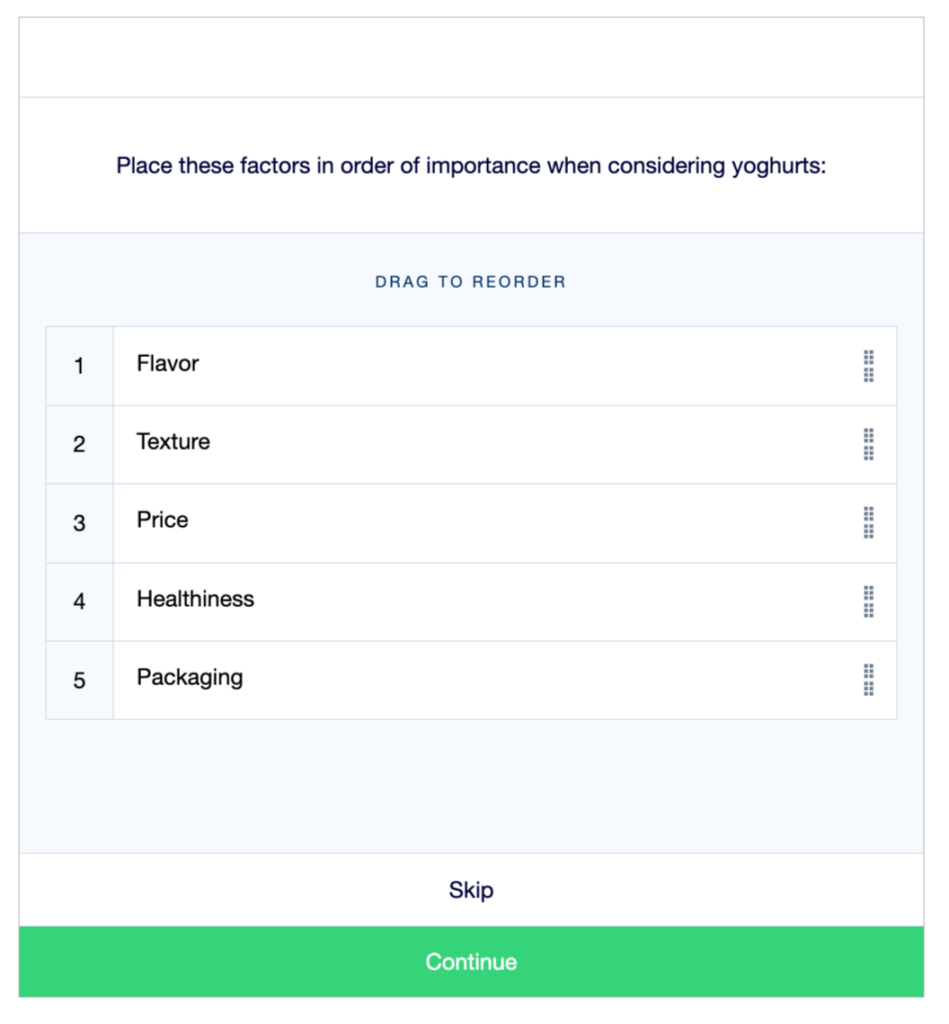
This type of survey rating scale is particularly useful for uncovering priorities among competing options, such as product features or marketing messages. However, it can increase cognitive load, especially when the list is long and results require more advanced analysis.
Keeping the list short and randomizing item order helps reduce bias and fatigue.
- Pros: Highlights what matters most and avoids “everything is important” responses.
- Cons: Higher cognitive load and more complex to analyze accurately.
- Example use case: Prioritizing product features for roadmap planning or evaluating campaign concepts.
6. Pick-some (top task) scale
A pick-some (or top task) scale asks respondents to select a limited number of options from a list. For example, “Pick up to three.” This method highlights the most important items or motivations without requiring respondents to rank everything, for instance:
“Which of the following factors most influenced your purchase? (Select up to 3.)”
☐ Price
☐ Customer reviews
☐ Delivery speed
☐ Product range
☐ Brand reputation
It’s ideal for identifying top drivers or reasons behind behaviors, such as why customers choose a product or feature. However, it doesn’t measure how strongly one item is preferred over another and may oversimplify nuanced opinions. Randomizing answer order helps minimize position bias.
- Pros: Fast and engaging to complete, clearly identifies top priorities.
- Cons: Ignores relative ranking among unselected items, may oversimplify results.
- Example use case: Identifying the top reasons customers choose a particular service or brand.
7. Paired comparison scale
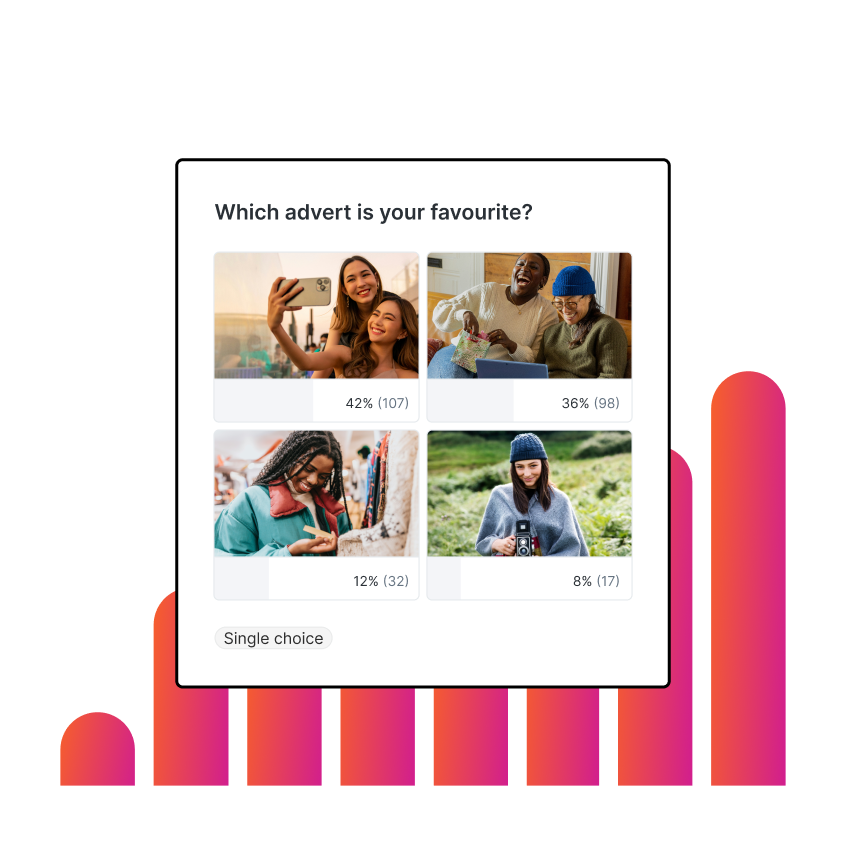
A paired comparison scale presents respondents with two options at a time, such as products, ads or design concepts and asks them to choose which they prefer. By cycling through multiple pairs, you can identify overall preferences and determine the relative strength of appeal between items.
This approach simplifies decision-making by breaking complex comparisons into smaller, more manageable choices. However, it can become time-consuming with larger sets and may require more advanced analysis methods.
- Pros: Simplifies complex comparisons, strong for clear preference testing.
- Cons: Lengthy with many pairs, analysis can be more complex.
- Example use case: Comparing ad creatives, product designs or packaging concepts to identify the most appealing option.
8. Comparative intensity scale
A comparative rating scale asks respondents not only which option they prefer, but how strongly they prefer it. For example, a question might ask, “Do you prefer Brand A or Brand B — and by how much?” This adds valuable depth to understanding customer sentiment which reveals intensity rather than just direction:
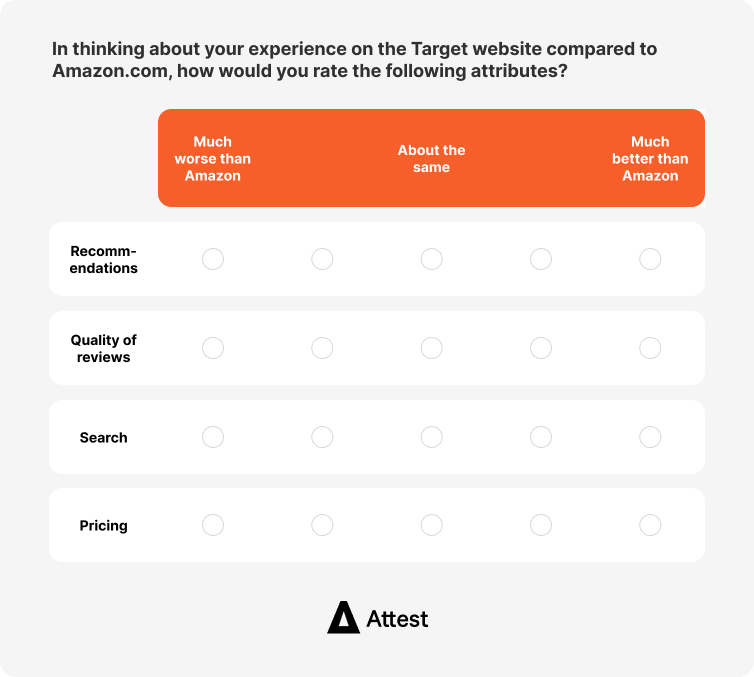
It’s particularly useful when testing closely competing concepts or brands. However, it can be more complex to design, explain and analyze. This may lead to fatigue in longer surveys.
- Pros: Captures nuance in preferences and goes deeper than simple ranking.
- Cons: More complex to explain and analyze, can fatigue respondents.
- Example use case: Competitive benchmarking or assessing brand preference strength in market research.
9. Semantic differential scale
A semantic differential scale asks respondents to rate an item between two opposite adjectives. For example, “Easy ↔ Difficult” or “Modern ↔ Outdated.” This approach helps measure perceptions and attitudes to reveal how people feel about a brand, product or experience. For example:
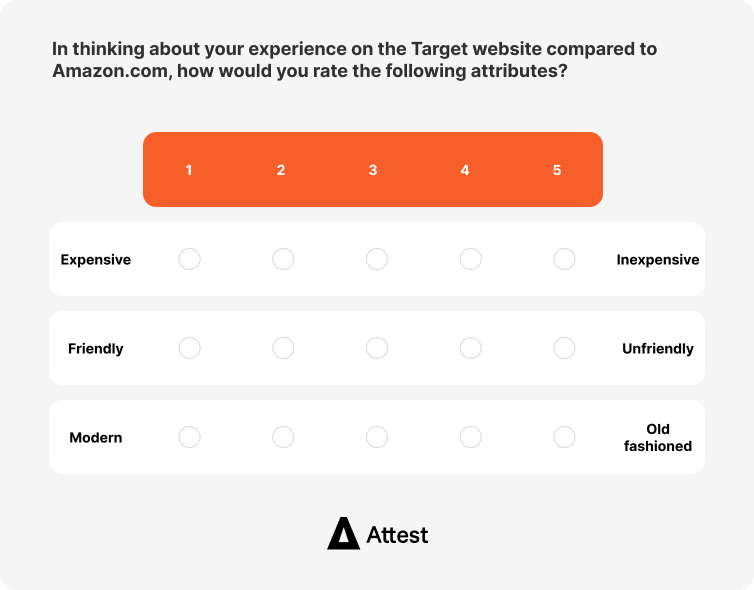
It’s particularly effective for capturing subtle emotional or cognitive associations but relies on choosing clear, balanced adjective pairs. Poorly worded opposites can confuse respondents or distort results.
- Pros: Captures nuanced perceptions, effective for brand or UX evaluation.
- Cons: Requires carefully chosen adjectives and can be harder to interpret.
- Example use case: Assessing brand personality or brand design perception.
10. Adjective checklist
An adjective checklist asks respondents to select all adjectives from a list that describe a product, service or brand. For example:
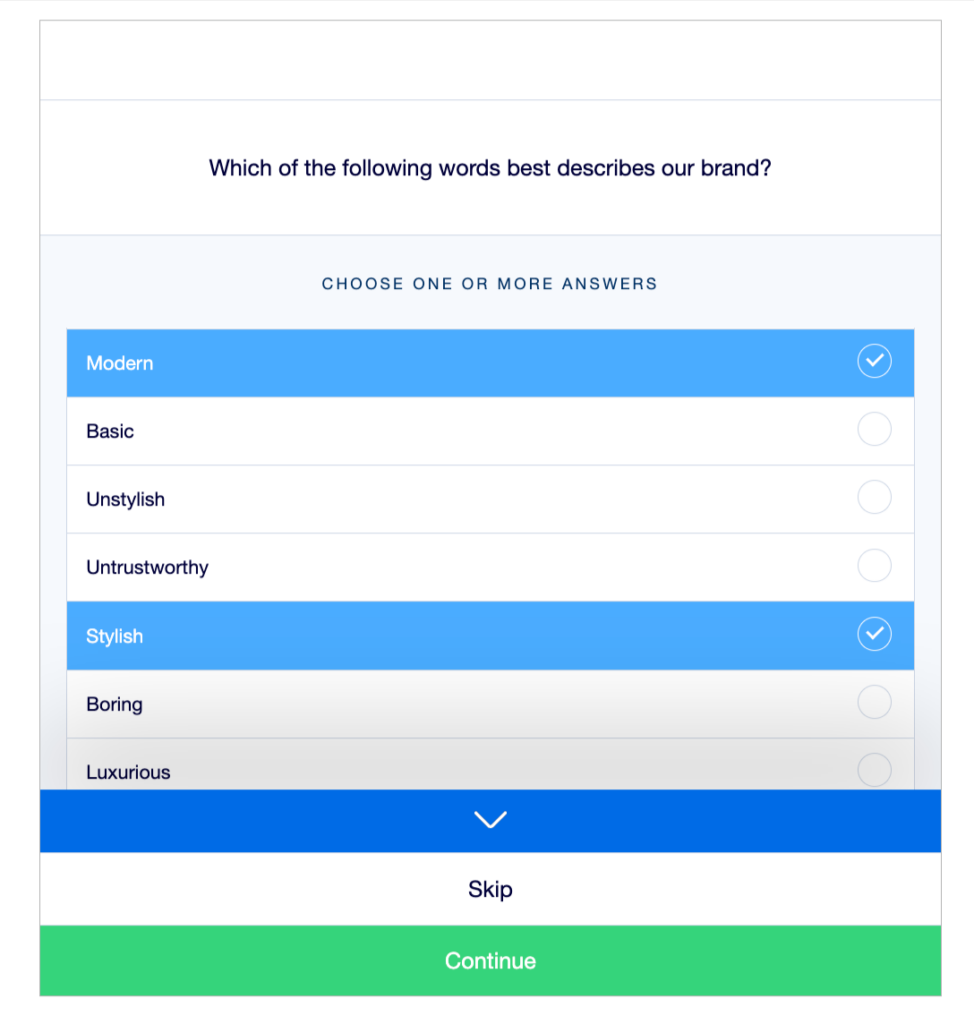
This method is quick and intuitive which makes it helpful in identifying how people perceive or associate with a brand.
However, because it doesn’t measure intensity, it only shows which traits apply, not how strongly they’re felt. The choice and order of adjectives can also influence responses, so careful wording and randomization are key.
- Pros: Easy to administer and complete, efficiently captures multiple associations.
- Cons: Doesn’t measure strength of feeling, list design may bias results.
- Example use case: Best used to uncover how audiences describe your brand and whether those perceptions align with your intended positioning.
11. Semantic distance scale
A semantic distance scale measures how far a concept is perceived from a neutral midpoint on a continuum. For example, from “Neutral” to “Strongly Positive.” It focuses on the distance or intensity of feeling rather than direct comparison between opposites. For example:
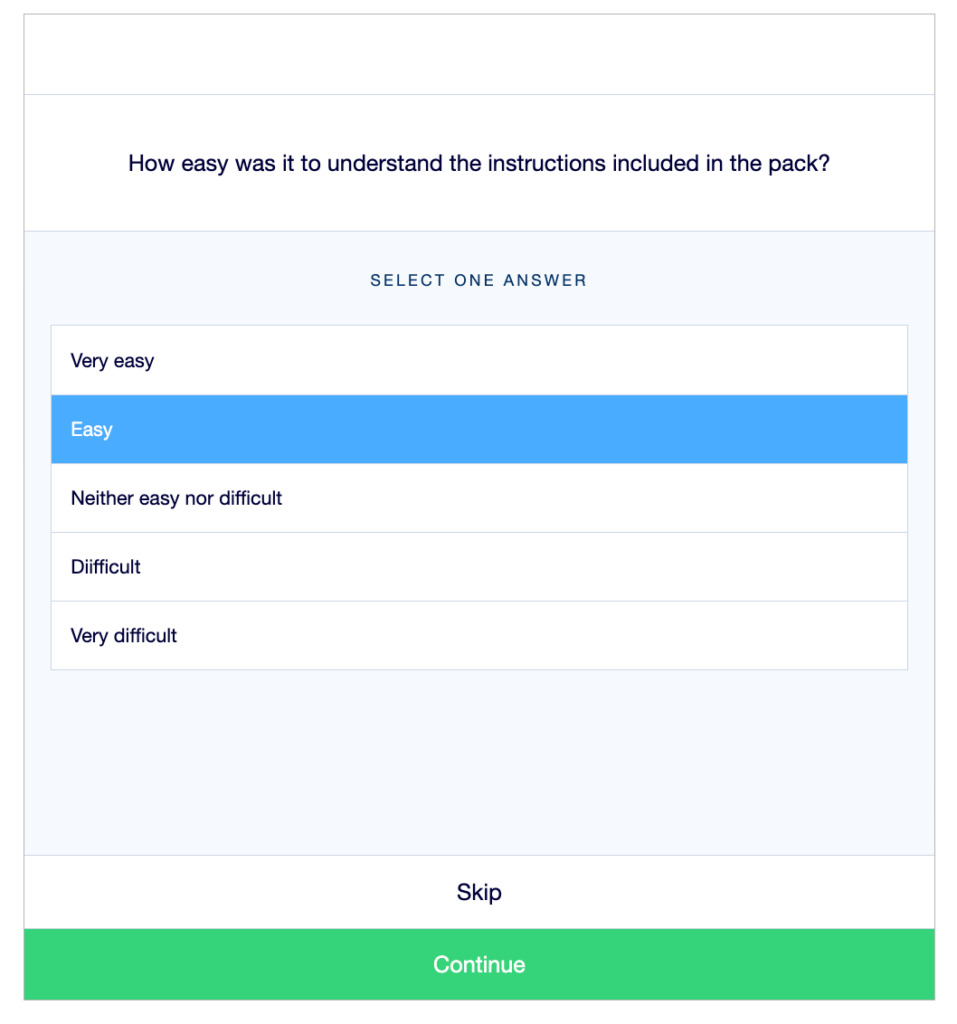
This scale helps researchers understand how strongly people lean toward or away from an idea or statement. However, it’s less familiar to most respondents and may need clear instructions to avoid confusion.
- Pros: Visualizes intensity and distance from neutrality.
- Cons: Less common, can confuse respondents if not explained well.
- Example use case: Measuring political or social attitudes.
12. Fixed sum scale
A fixed sum scale asks respondents to allocate a set number of points, typically 100, across several categories or options to indicate their relative importance. This approach forces trade-offs, which helps you understand how respondents prioritize between competing choices such as product features, budgets or benefits. Here’s an example:
“Allocate 100 points across the following factors based on their importance when choosing a product.”
- Price: ___
- Quality: ___
- Brand reputation: ___
- Sustainability: ___
This type of rating scale provides clear quantitative data on relative weightings but requires more effort and concentration from participants, which can increase drop-off rates if overused.
- Pros: Encourages prioritization and quantifies relative importance.
- Cons: Demands higher cognitive effort and can frustrate respondents.
- Example use case: Budget allocation or prioritizing new product features.
13. Compound matrix
A compound matrix combines multiple attributes for each item, asking respondents to rate several dimensions at once, such as satisfaction, importance and usability. This format provides multi-layered insights that help researchers understand how different factors interact:
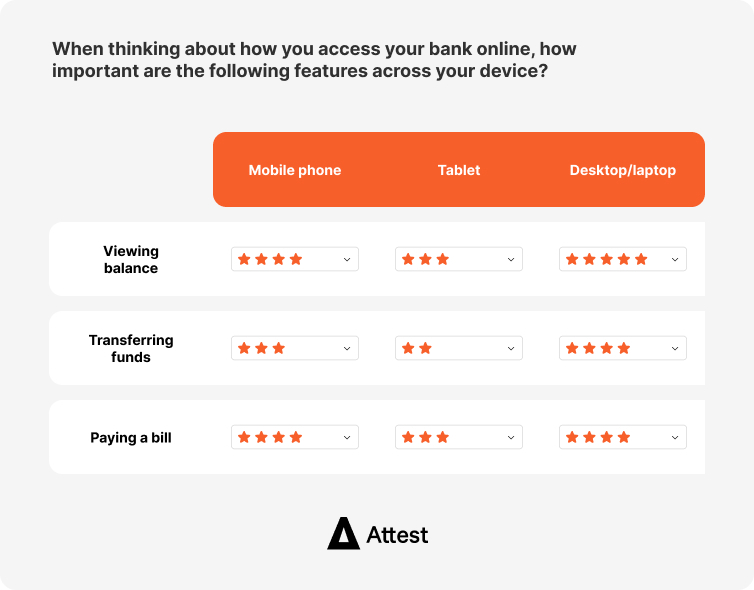
However, because it requires multiple judgments per question, it can feel demanding and lead to respondent fatigue or “straight-lining” . Use sparingly for complex evaluations where depth outweighs speed.
- Pros: Captures detailed, in-depth data.
- Cons: Time-consuming and respondents are prone to survey fatigue.
- Example use case: Evaluating product features or service experiences.
14. Pictorial/graphic scale
A pictorial or graphic rating scale uses images, such as stars, emojis, smiley faces, or thumbs up/down, instead of text or numbers. This format is highly visual and intuitive, making it ideal for quick customer feedback in consumer or mobile surveys. You’ve likely seen one before:
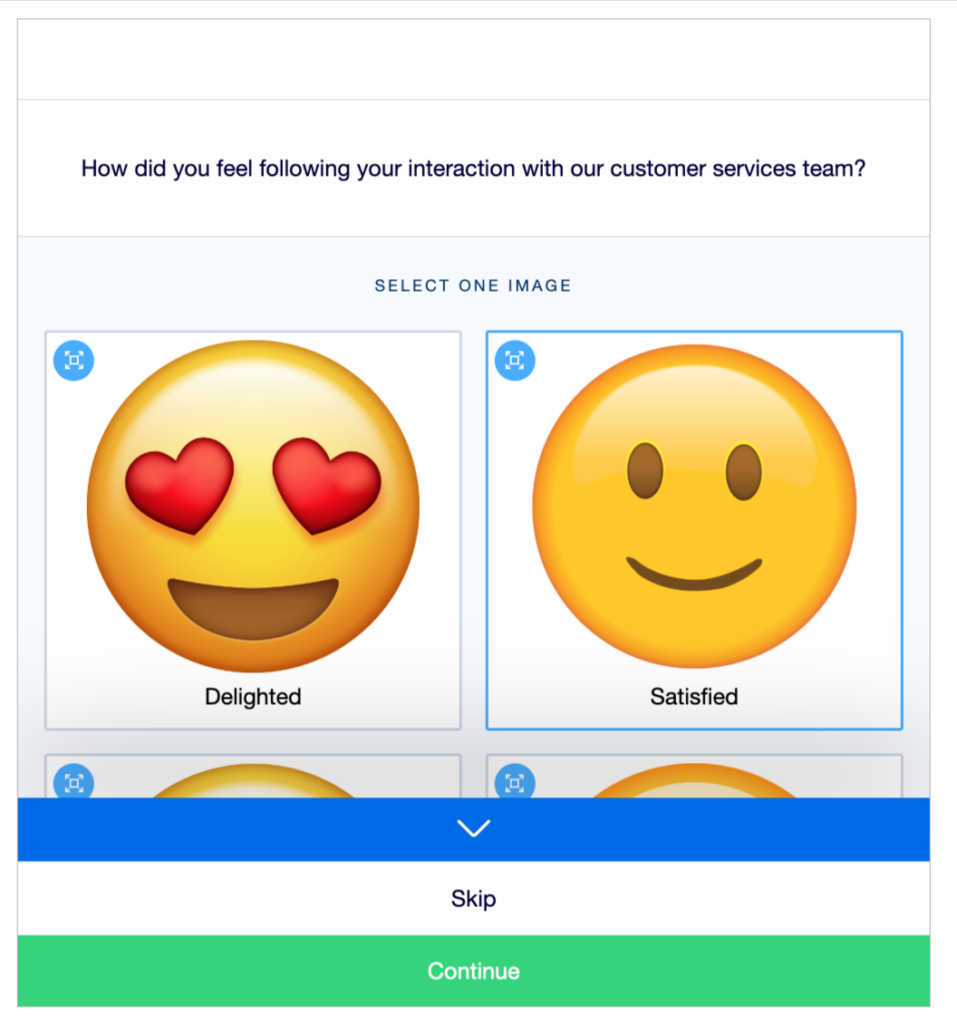
It captures sentiment at a glance but doesn’t provide the same precision as numeric scales. Cultural differences in how icons are interpreted can also affect consistency, so clear labeling is important.
- Pros: Fun, engaging and easy for mobile surveys.
- Cons: Less precise data and interpretation of emojis can vary by cultural context.
- Example use case: Collecting in-app feedback or product reviews.
15. Visual analog/slider scale
A visual analog or slider scale lets survey respondents drag a slider along a continuous line. For example, from “Not helpful” to “Extremely helpful.” This approach captures subtle differences in opinion, offering more granular insight than fixed-point scales.
It’s interactive and visually appealing, which can improve engagement, but analysis is more complex since responses aren’t grouped into set intervals. Sliders can also be less reliable on smaller screens if not well-designed.
- Pros: Captures nuanced responses, modern and interactive.
- Cons: Harder to analyze, UX challenges on mobile.
- Example use case: Measuring emotional intensity or usability customer feedback.
How to choose the right survey rating scale
Now that you know the main types of rating scales, the next step is selecting the right one for your survey. This section offers a simple, practical framework to match each scale type to your specific research goal, so you can confidently move from understanding what’s available to knowing what fits best.
1. Start with your research objective
First, get clear on what your survey is trying to measure. Your research objective should determine the type of scale you use. The clearer the goal, the stronger your insights.
For example:
- Comparing two objects: Use a paired comparison scale.
- Comparing several objects: Use a forced ranking, fixed sum or compound matrix scale.
- Measuring intensity of opinion/attitude: Use a Likert, linear numeric, or semantic differential scale.
- Capturing behaviors: Use a frequency scale.
2. Decide how much precision you need
Once you’ve picked a scale type, the next decision is how many points it should have. The number of points affects both precision and respondent experience:
- 3–5 points: Quick to complete and easy to interpret, but less detailed. Best when you only need a broad read on sentiment or behavior.
- 7–10 points: Offers more nuance and supports deeper analysis, but can cause fatigue or inconsistent responses. Ideal when precision is essential.
You’ll also need to decide between:
- Odd-numbered scales: Include a neutral midpoint for balanced responses.
- Even-numbered scales: Remove neutrality to reduce fence-sitting(when respondents consistently choose neutral or middle options).
For example, a 5-point scale suits employee engagement surveys, while a 10-point scale works better for CSAT surveys where subtle differences in customer satisfaction can impact business decisions.
3. Consider your respondents’ experience
Your choice of rating scale should reflect who’s taking your survey. A busy, general consumer audience will respond better to quick, visual formats like sliders, pictorial scales, or star ratings. A research-savvy or professional audience can handle more complex formats, such as compound matrices or fixed sum scales.
Device type also matters: Sliders can be fiddly on mobile, while word-heavy scales can frustrate survey respondents on smaller screens. The more cognitive effort a survey requires, the higher the risk of fatigue and drop-offs. Always balance depth with ease.
4. Know when not to use a rating scale
Rating scales are excellent for collecting structured, comparable data. But they’re not always the right choice. Sometimes, open-ended survey questions provide richer insight.
Two situations where rating scales aren’t ideal:
- When you need context or explanation. A score can’t reveal why something happens. For example, if you’re studying customer churn, a rating might show dissatisfaction but not its cause.
- When the topic is new or unclear. Respondents may interpret scale points differently, leading to unreliable data.
A hybrid approach often works best. For example, you can pair scales with follow-ups like:
“On a scale of 1–10, how satisfied are you with our support team?” followed by “Why did you give that score?”
Choosing the right rating scale is just the start
Selecting the right rating scale isn’t just a technical step. It’s a core part of collecting accurate, meaningful data. The scale you choose shapes how respondents think, answer and ultimately how reliable your insights are.
You should now understand the most common scale types, how to match them to your research goals, balance precision with respondent experience and recognize when a rating scale isn’t the best tool.
But remember your scale choice is only one aspect of creating a great survey. Clear, unbiased rating scale questions are key to gathering honest, high-quality responses.