

Scales of measurement matter for anyone who runs surveys and needs to trust the results. Different types of measurement scales aren’t just for statisticians to consider; which you decide to use will impact the insights you can extract from your data.
Interval data is one of the most common scales you’ll encounter in survey research. It’s a type of quantitative system where the difference between two points is meaningful and measurable, but there’s no true zero.
In this guide, we’ll explain what an interval scale is and how it differs from nominal, ordinal and ratio scales. We’ll also share examples of interval-scale survey questions, break down the pros and cons of interval scales, explain how to analyze interval data and share our best practices for designing interval scale survey questions.
TL;DR
- Interval scales have equal spacing between points, so differences are meaningful, but there’s no true zero.
- Interval data sits above nominal and ordinal data because it keeps the order of responses and unlocks more analysis, including averages and group comparisons. However, you can’t multiply and divide values because there’s no true zero.
- In surveys, interval-style questions commonly show up as Likert-type scales, 0–10 ratings (like NPS) and bipolar matrix tables.
- To analyse interval data, start with the distribution, then summarize with mean/median/mode, measure variability (range, IQR, variance, standard deviation) and use statistical tests when needed.
- For better data quality, keep scales consistent: use 5–7 points for Likert-type questions or 0–10 for ratings. You should also label endpoints clearly, keep direction consistent and be intentional about a neutral midpoint.
Interval scale defined
An interval scale is a quantitative measurement scale where responses are ordered and the distance between each point is equal.
Interval scales have two defining features. First, the spacing between points is consistent. For instance, the “step” from 2 to 3 represents the same amount of change as the step from 6 to 7.
Second, interval scales don’t have an absolute (true) zero. In other words, a value of 0 doesn’t represent the complete absence of what’s being measured.
A classic example is temperature measured in degrees Celsius. The difference between 10°C and 20°C is the same as the difference between 20°C and 30°C. But 0°C doesn’t mean “no temperature”—it’s simply another point on the scale. You can say one day is 10°C warmer than another, but you can’t say 20°C is twice as warm as 10°C.
Interval scales are the third level of measurement, after nominal and ordinal scales. Understanding the first two levels makes it much easier to understand what an interval scale is, so we’ll discuss the different levels of measurement next.
The 4 levels of measurement (and where interval fits)
There are four levels of measurement: nominal, ordinal, interval and ratio. Each level includes the properties of the one before it and adds something new.
As you move up, your data becomes more precise and you unlock more ways to analyze and use your results.
Nominal scale
A nominal scale is used when variables don’t have a natural order. Responses are simply categories. For example: gender, location, device type, political party or preferred brand.
You can count them and report percentages, but there’s no “higher” or “lower” option.
Ordinal scale
An ordinal scale is used when order matters, but the spacing between options isn’t consistent or measurable. For example, income brackets (“under $25k”, “$25k–$50k”, “$50k–$75k”) or satisfaction labels (“Unsatisfied”, “Neutral”, “Satisfied”).
You can rank responses, but you can’t assume the gap between each option is equal.
Interval scale
This is where the interval scale fits in. It preserves order, but also uses equal spacing between points. For example, a 1 to 7 agreement scale (“Strongly disagree” to “Strongly agree”) or a 0 to 10 satisfaction rating (“Very dissatisfied” to “Very satisfied”).
In practice, this is what makes it possible to summarize results with averages and compare groups using mean scores (more on this below).
Ratio scale
Finally, we have the highest level of measurement: The ratio scale. It has everything an interval scale has, plus a true zero point. Because zero represents “none,” you can multiply and divide ratio data.
Common examples of ratio data include age, revenue, height and weight.
This table breaks the differences down at a glance:
| Feature | Nominal | Ordinal | Interval | Ratio |
| Categories | ✅ | ✅ | ✅ | ✅ |
| Has rank order? | ❌ | ✅ | ✅ | ✅ |
| Equal spacing between points? | ❌ | ❌ | ✅ | ✅ |
| True zero? | ❌ | ❌ | ❌ | ✅ |
| Examples | Gender, brand | Satisfaction levels, rankings | Likert / NPS scales | Age, income, revenue |
| Quantitative / qualitative | Qualitative | Qualitative | Quantitative | Quantitative |
What makes a scale “interval”? (Key characteristics)
You’ve already seen the two core features that separate interval from ordinal: equal spacing between points and no true zero. Here are the other important characteristics of interval scales.
- It’s quantitative: Interval scales capture numeric differences between responses, which makes them easier to summarize and compare than nominal or ordinal scales.
- Addition and subtraction are meaningful: Because each step represents the same amount of change, you can add and subtract interval data.
- Multiplication and division aren’t meaningful: Because interval scales lack a true zero, you can’t multiply and divide values. For example, an IQ score of 120 doesn’t mean someone is twice as intelligent as someone with an IQ score of 60.
- Discrete or continuous values: That is, interval scales can be discrete data with whole numbers like 8 degrees, 5 years, 6 months, etc., or continuous data with fractional numbers like 10.9 degrees or 3.5 years.
Now that we’ve discussed all the characteristics, let’s look at some examples of interval scales in surveys.
Interval scale examples
Interval scales show up frequently in survey research. Any time you’re asking respondents to rate agreement, likelihood, satisfaction or perception using evenly spaced numeric options, you’re likely working with an interval-style survey question.
Here are three common examples.
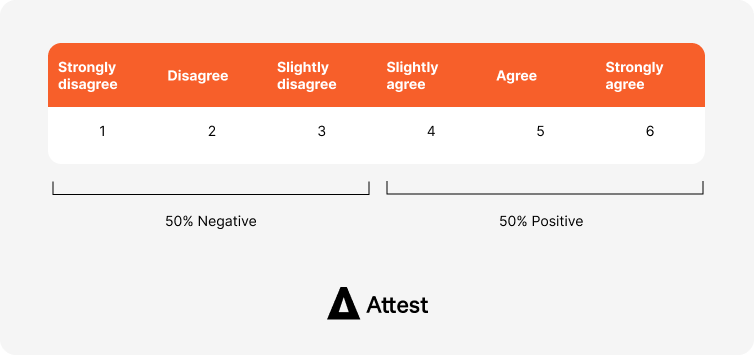
Likert scale
A Likert scale is one of the most widely used interval-style formats in research. It typically asks respondents to rate their level of agreement on a scale such as 1 to 5 or 1 to 7, anchored by “Strongly disagree” and “Strongly agree.” end point labels
Net Promoter Score (NPS)
Net Promoter Score (NPS) measures customer loyalty by asking respondents how likely they are to recommend a product or service on a scale from 0 to 10.
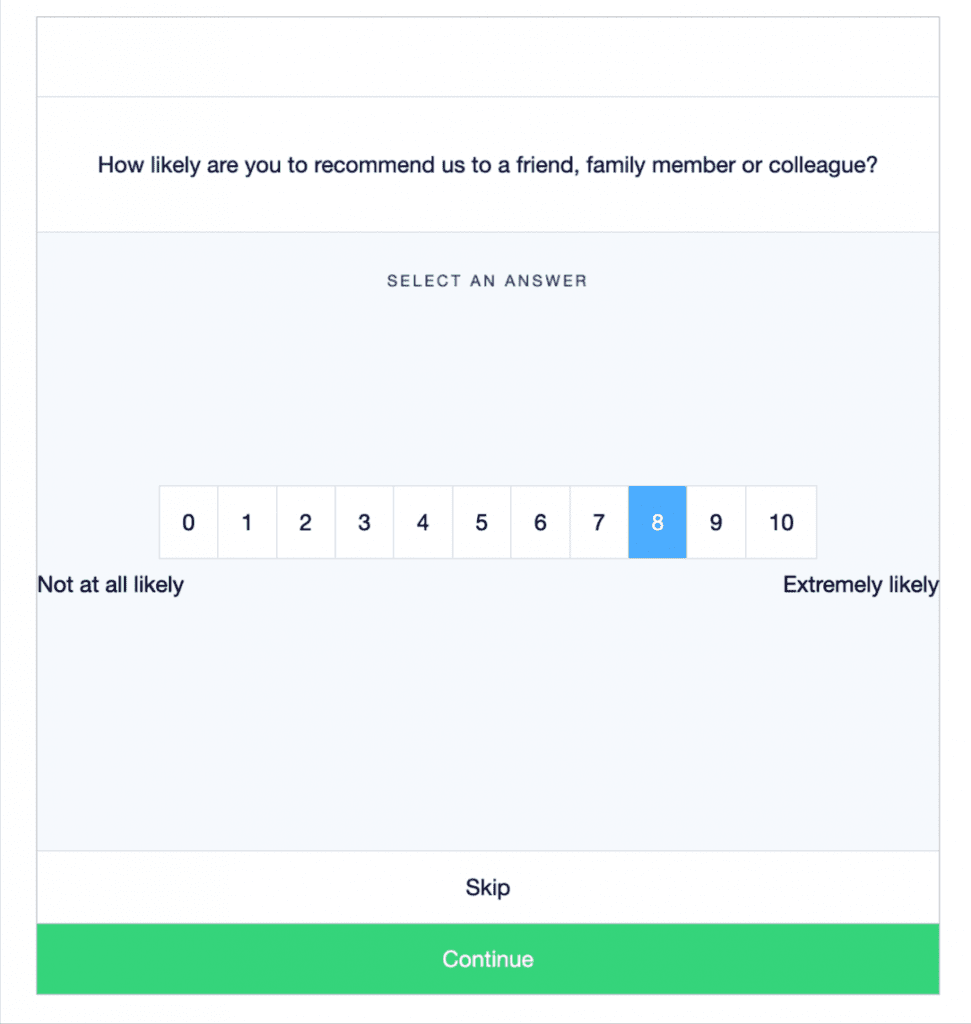
Here’s how you interpret this interval data:
- Scores from 0 to 6 are considered detractors
- Scores of 7 to 8 are passives
- Scores of 9 to 10 are promoters
Because each point on the scale is evenly spaced, it’s possible to calculate averages and compare detractors, passives and promoters. This makes it easy to gather insight into customer satisfaction and loyalty over time.
Bipolar matrix table
Include infographic of this type of interval scale
A bipolar matrix table asks respondents to rate a concept between two opposing adjectives on a numeric scale.
For example:
| Very much | Somewhat | Neither | Somewhat | Very much | ||
| Difficult to use | ○ | ○ | ○ | ○ | ○ | Easy to use |
| Easy to navigate | ○ | ○ | ○ | ○ | ○ | Hard to navigate |
| Slow | ○ | ○ | ○ | ○ | ○ | Fast |
| Untrustworthy | ○ | ○ | ○ | ○ | ○ | Trustworthy |
| Outdated | ○ | ○ | ○ | ○ | ○ | Modern |
Because the numeric spacing between each point is consistent, these questions are treated as interval scales. They’re especially useful for brand perception studies and 360-style evaluations.
How to analyze interval data
You can get a lot of value from interval data, especially when you use it to compare groups and spot meaningful shifts. Below are a few practical ways to pull insight from your interval scale data.
1. Look at the distribution
Start your analysis by taking a look at how your survey response data is spread. You can use frequency tables, histograms, box plots or density plots to do this.
These graphs will help you to see if your data is normally distributed or whether you have outliers. For example, if you’re analyzing a 1–10 satisfaction scale, a histogram can show whether most respondents selected 8–10 (strong satisfaction) or whether opinions are more evenly spread.
Understanding the distribution is essential because it determines which statistical tests are appropriate and helps ensure your insights are accurate.
2. Measure central tendency
Interval data allows you to calculate all major measures of central tendency:
- Mean (average)
- Median (middle value)
- Mode (most frequent value)
If your data is normally distributed, the mean, median and mode will be close together.
3. Assess variability
Next, measure how spread out your data is using the following metrics:
- Range: the difference between the highest and lowest values
- Interquartile range (IQR): the spread of the middle 50% of responses
- Variance: the average squared distance of values from the mean
- Standard deviation: the typical distance of values from the mean
Higher variability isn’t inherently “bad.” It just indicates more disagreement or dispersion in responses.
In survey analysis, variability can reveal polarization, uncertainty or differences across different segments, which may be strategically important for your organization.
4. Run statistical tests
You can also use statistical tests to compare groups or identify relationships when analyzing interval data.
If your interval data is approximately normally distributed, you can use parametric tests (t-tests, ANOVA, regression) to assess whether differences between groups or relationships between variables are statistically significant.
If your data is heavily skewed or violates assumptions, you may use non-parametric alternatives, such as:
- Mann–Whitney U test
- Wilcoxon signed-rank test
- Kruskal–Wallis test
✨Pro-tip: New to statistical analysis? Check out our beginners guide to navigating consumer research data analysis.
Advantages and disadvantages of interval scales
Below, we’ll walk through the pros and cons of interval scales so you can decide whether they’re the right fit for your survey.
Advantages of interval scales
- You can calculate averages and variation. Interval data supports the arithmetic mean and measures like standard deviation and variance, which makes reporting and analysis more informative.
- You can compare differences between groups and over time. Because the gaps between points are treated as consistent, it’s easier to track movement (up or down) and quantify change.
- It unlocks stronger statistical techniques. Interval-level variables can be used for correlation and regression-style analysis where ordinal data often falls short.
- It’s practical for measuring attitudes and perceptions. Well-designed interval scales can quantify qualitative concepts like sentiment in a way that’s easy to summarize.
Disadvantages of interval scales
- No true zero limits interpretation. You can compare differences, but ratio claims like “twice as much” aren’t meaningful.
- Equal spacing is an assumption. If labels feel uneven or ambiguous, the scale may behave more like ordinal data and averages become less trustworthy.
- Likert-style data can be debated. Because the spacing between options is assumed, some analysts have debatedwhich statistical analysis is the most appropriate.
- Averages can hide what’s really happening. A mean score can look stable even when responses are polarized, so it’s smart to check distribution and key segments.
How to write interval scale survey questions (best practices)
Well-designed questions that use an interval scale make responses easier to interpret and results easier to compare. Here are our best practices for writing interval scale type questions:
- Choose the right number of points and stick to it: For Likert-type questions, 5–7 points is the most commonly recommended balance between clarity and sensitivity. For recommendation-style ratings, a 0–10 scale is standard (for example in NPS-style questions).
- Label endpoints clearly: Clear endpoint labels help respondents understand what the lowest and highest values represent. Make sure those labels are specific and unambiguous.
- Keep direction consistent: If higher numbers mean “better” in one question, they should mean “better” everywhere. This reduces misreported answers and improves comparability across questions.
- Decide whether you need a neutral midpoint: Include a midpoint when “neutral/unsure” is a meaningful response.
Interval scales make your survey results easier to use
Interval scales strike the right balance between qualitative structure and flexibility. They allow you to calculate averages, measure variation and compare groups over time.
That’s what makes them so useful for tracking sentiment, satisfaction, perception and performance. When designed carefully—with clear endpoints, consistent direction and an appropriate scale length—they turn subjective opinions into structured insight.
If you want to refine how you design these questions, the next step is understanding different survey rating scales and when to use each one