

Choosing the right type of survey question is essential for collecting accurate and actionable insights.
Even experienced researchers can make mistakes if they confuse question types, which can lead to misinterpreted results or flawed analysis.
Two of the most common categories in surveys are nominal and ordinal questions, and understanding the difference between them is important for designing effective studies.
Nominal questions help you categorize respondents into clear groups, while ordinal questions reveal how those groups or individuals differ in priority, opinion or preference.
Despite their differences, these question types are often used together in research to provide a fuller picture of your audience.
In this guide, we’ll discuss the core definitions of nominal and ordinal questions, provide real examples and give you practical guidance on when to use each type in surveys.
TL;DR
Nominal and ordinal scales are both used to categorize survey data, but they differ in whether or not the categories have a defined order: such as satisfied to dissatisfied.
What is an ordinal scale?
An ordinal scale organizes responses into a ranked order, but the spacing between each rank isn’t necessarily equal. It tells you which options come before or after others, but not by how much.
Examples of ordinal survey questions
- “How satisfied are you?” Very satisfied / Satisfied / Neutral / Dissatisfied / Very dissatisfied
- “How often do you exercise?” Never / Rarely / Sometimes / Often / Always
What is a nominal scale?
A nominal scale classifies data into categories without any inherent order. Examples include gender, hair color or product type. These categories can be labeled with numbers, but the numbers have no mathematical meaning.
Examples of nominal survey questions
- “What is your preferred browser?” Chrome / Safari / Firefox
- “Which brand do you use most often?” Brand A / Brand B / Brand C
When to use nominal vs ordinal scales
Use nominal scales when you need to label categories without implying order. Use ordinal scales when the order matters but exact differences between choices aren’t measurable.
Nominal data is best analyzed with counts and percentages; ordinal data allows for ranking and median comparisons.
What is a nominal scale?
A nominal scale is used to label or categorize responses without implying any order or hierarchy between them. It’s the simplest level of measurement in survey data, and is designed to classify information into distinct groups that are mutually exclusive.
For example, respondents might be asked to select their gender, ethnicity or preferred brand of soft drink. Each option represents a different category, but none is ranked higher or inherently better than another.
While nominal data can include numbers, these figures act purely as labels rather than carrying numerical value or meaning.
For instance, coding “1” for Coca-Cola and “2” for Pepsi doesn’t suggest that Pepsi ranks above Coca-Cola. It’s just a convenient way to record information for data analysis.
Nominal scales are essential for grouping audiences, analyzing categorical trends and filtering responses in survey tools, like Attest.
They’re often used in brand awareness and customer profiling. They can also be used for segmentation studies where the goal is to understand what people choose, not how much or to what extent.
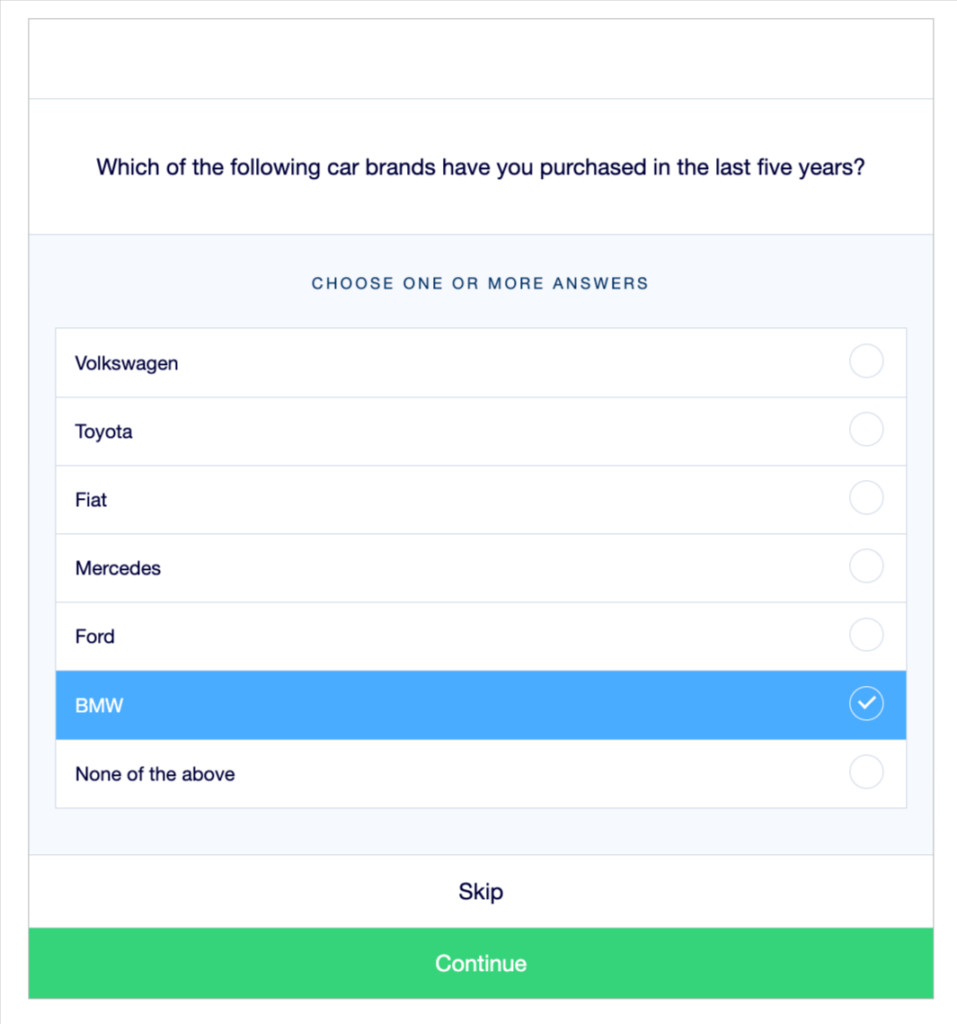
Examples of nominal survey questions
Nominal survey questions are central to data collection because they help researchers group responses into distinct categories without implying order or ranking.
They’re especially useful when analyzing survey data to identify audience segments and spot patterns in market research. Below are a few examples that show how nominal questions work across different contexts.
Demographics
These questions help researchers categorize data from respondents for segmentation or audience profiling.
Example: Which of the following best describes your employment status?
Answers: Employed full-time / Employed part-time / Self-employed / Unemployed / Student / Retired
Product usage
Nominal scales are ideal for identifying product preference or loyalty without ranking one brand above another.
Example: Which brand of smartphone do you currently use?
Answers: Apple / Samsung / Google / Other
Geography
This format helps businesses understand regional variations or customer distribution.
Example: In which region do you live?
Answers: North / South / East / West
Preferences
Preference-based questions like the one below reveal patterns in consumer taste or lifestyle choices.
Example: What is your favorite type of cuisine?
Answers: Italian / Indian / Japanese / Mexican
What is an ordinal scale?
An ordinal scale is used in survey research to capture responses that have a clear order or ranking.
Unlike nominal data, which only categorizes responses, ordinal scales measure the relative position of each response within a sequence. This allows researchers to understand whether one option ranks higher or lower than another.
However, ordinal scales do not show the size of the gap between responses. The distance between categories is not guaranteed to be equal.
For example, a question asking respondents to rate their satisfaction from “Very dissatisfied” to “Very satisfied” produces ranked data. We know that “Satisfied” ranks above “Neutral,” but we cannot assume the difference between those two options is the same as the difference between “Neutral” and “Dissatisfied.”
This is where ordinal scales differ from interval scales. Interval scales use evenly spaced numeric values, which means the distance between points is consistent and measurable. Ordinal scales, by contrast, only capture order, not precise differences between responses.
Ordinal scales are commonly used to measure opinions, attitudes, and preferences. They are useful for comparing trends across groups or tracking change over time.
In market research, ordinal questions frequently appear in customer satisfaction surveys, brand perception studies, and purchase intent measurements, where understanding the direction of sentiment is more important than calculating exact numerical differences.
Examples of ordinal survey questions
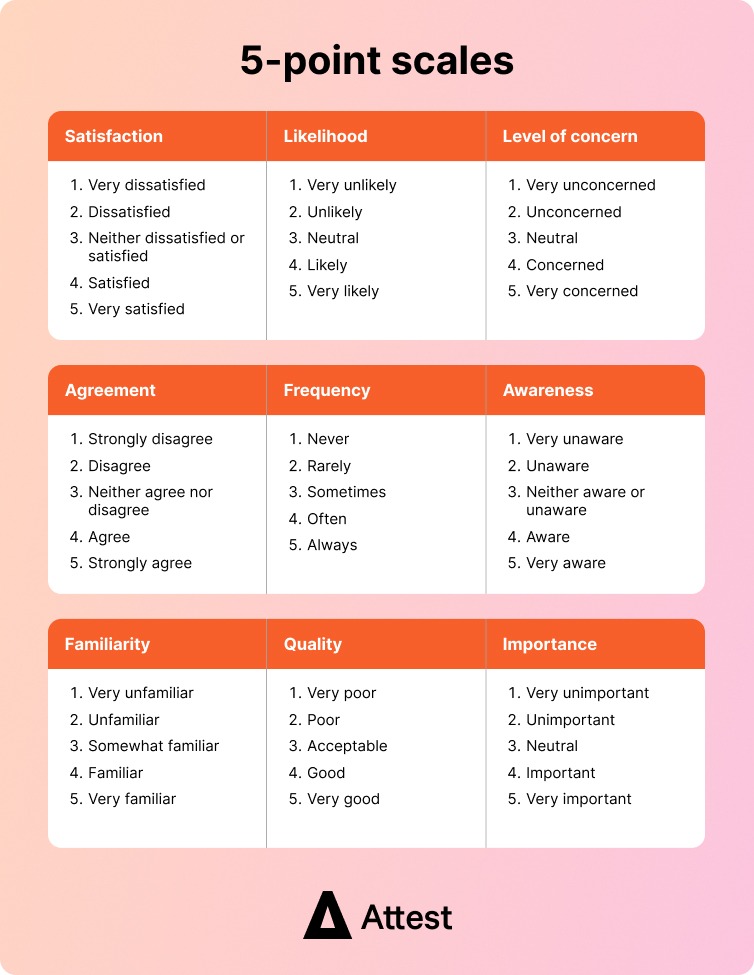
As mentioned above, ordinal survey questions play a significant role in survey design because they capture opinions and behaviors that can be ranked in order.
These questions don’t measure exact differences between responses but show a clear progression from low to high or negative to positive.
When combined across studies, ordinal data provides the structure needed for data-driven decisions. It turns subjective opinions into measurable insights that can inform decision-making around aspects of your business, like marketing and product development.
Below are some common examples used in research.
Satisfaction scale
This format helps businesses assess customer experience levels and track improvement over time.
Example: How satisfied are you with our customer service?
Answers: Very dissatisfied / Dissatisfied / Neutral / Satisfied / Very satisfied
Agreement (Likert scale)
Likert scales are widely used to gauge agreement or perception, and they reveal the direction and strength of sentiment.
Example: To what extent do you agree with the statement: “This product is easy to use”?
Answers: Strongly disagree / Disagree / Neutral / Agree / Strongly agree
Frequency
Frequency questions help researchers understand behavior patterns and identify shifts in habits.
Example: How often do you shop online?
Answers: Never / Rarely / Sometimes / Often / Always
Nominal vs ordinal scales for surveys: When to use each
When designing surveys, understanding the difference between nominal and ordinal data is important for collecting meaningful results.
Each type captures a different aspect of respondent information: nominal data classifies answers into groups, while ordinal data arranges them by order or preference.
Choosing the right question type helps to make sure your findings are reliable and your analysis reflects true audience behavior. Here’s a quick comparison.
| Aspect | Nominal scale | Ordinal scale |
| Purpose | Classify responses into categories | Rank responses by order or preference |
| Order implied | None | Yes |
| Equal intervals | Not applicable | Not guaranteed |
| Measurement level | Categorical | Ranked categorical |
| Examples | Gender, location, product type | Satisfaction, agreement, frequency |
| Analysis focus | Grouping and filtering | Comparing direction or intensity |
Nominal questions are ideal when you need to bucket respondents into distinct groups, such as demographics, product ownership or region. They’re also useful when your analysis relies on identifying patterns rather than measuring differences.
You should use ordinal questions when you want to understand ranking, priority or sentiment, such as satisfaction levels or purchase likelihood. You’ll also want to use these questions when exploring trends that involve ordered relationships, like agreement or frequency scales.
Key takeaway: A strong survey design often combines both nominal and ordinal questions. Think nominal for understanding who your respondents are, and ordinal for understanding how they think and feel. This balance provides richer insights and supports a more nuanced analysis.
How data type affects analysis
The type of data you collect determines how you can analyze and interpret your survey results.
Nominal data is best suited for statistical tests that compare categories rather than measure numerical relationships.
- A common example is the chi-square test for independence, which identifies whether two categorical variables are related.
- Since nominal variables have no order, the mode (the most frequently chosen response) is the only way to describe the “average” or central value.
Ordinal data, on the other hand, captures ranked responses, which lets you see patterns or differences between groups. This allows for more nuanced analysis.
- You can use non-parametric tests such as the Mann-Whitney U or Kruskal-Wallis to explore differences between groups while preserving the order of responses.
- With ordinal data, measures like the median percentile are appropriate because they reflect ranking without assuming equal gaps between options.
Quick explainer:
The median shows the middle value in ordered data (i.e.half the responses fall above it and half below). Percentiles go a step further, dividing data into 100 parts to show how one response compares to the rest (for example, the 75th percentile means higher than 75% of responses).
- Although you can report both the mode and median for ordinal questions, calculating an average isn’t meaningful, as the distances between ranks aren’t consistent.
Conclusion: Nominal vs. ordinal survey questions
Understanding the difference between nominal and ordinal survey questions is key to designing effective research and interpreting results accurately.
Nominal scales classify responses into categories without any order, while ordinal scales arrange them in a defined order, though the spacing between ranks isn’t equal.
Use nominal questions when you need to group respondents by shared traits such as demographics or preferences. Use ordinal questions when you want to measure ranking, sentiment or level of agreement.
Recognizing which scale to use helps ensure your data is analyzed correctly and your findings reflect actual respondent behavior. And combining both types of questions in a survey helps you capture a complete picture of who your audience is and how they think, feel and make decisions.
With deep expertise in survey design and analysis, Attest’s research experts can help your business choose the right types of questions and interpret results with confidence.
From brand tracking to concept testing, Attest provides the guidance and tools you need to design research that delivers clear, actionable insights.