

Multiple choice survey questions are everywhere. They’re the default in customer feedback forms, product surveys, onboarding flows: You name it. We lean on them because they’re quick to write, quick to answer and they make analysis easier. Most of us barely think twice before adding one to a survey.
But that’s kind of the problem. Multiple choice questions (MCQs) are familiar, but they’re also surprisingly easy to mess up. One awkward phrase can nudge people toward an option they don’t actually mean. A missing answer choice can force them into something that doesn’t reflect their experience. And once the data’s collected, it’s too late; you’re stuck with insights you’re not sure you can trust.
In this article, we’re slowing down the process. We’ll look at how to write multiple choice questions that actually capture what you’re trying to measure, how to choose between the different formats and the subtle ways MCQs can accidentally bias your results.
TL;DR
- What they are: A question type where respondents choose from a fixed list of answers, making results easy to compare and quantify. For example: “How often do you shop online?” Daily, Weekly, Rarely, Never
- Why use them: They’re fast to complete, simple to analyse, work well on mobile and reduce vague or inconsistent responses.
- Common types: Single select, multi select, rating scales, Likert scales, dropdowns and range-based options.
- Best practices: Use clear, neutral wording, make options mutually exclusive, keep lists short, include “None of the above” or “Prefer not to say” when relevant and randomise long option lists.
- When to avoid: When you need exploratory insight, nuanced detail or answers that do not fit clean categories.
What are multiple choice questions?
A multiple choice question is a simple way to gather structured feedback without asking people to write anything. You give respondents a fixed set of options, and they choose the one that matches or, in multi-select questions, as many as apply.
Because everyone is choosing from the same list, multiple choice questions produce quantitative data that is easy to quantify and compare.
Also, multiple choice survey questions encourage faster completion because people don’t have to think as hard about how to phrase their response.
When your options are written well, respondents immediately understand what’s being asked. For teams that need quick insights without heavy analysis, multiple choice questions are often the most efficient choice.
Why use multiple choice questions?
Close-ended questions, like MCQs, get a lot of love in survey design, and for good reason. They’re fast, they’re familiar, and they keep your data clean without making respondents work too hard. When you’re trying to balance accuracy with a smooth survey experience, MCQs hit that sweet spot.
Here’s why they’re such a reliable choice:
- They’re quick and easy to complete: Respondents can answer an MCQ in seconds, which helps reduce friction and increases your overall completion rate.
- They produce clean, structured data: Since everyone is choosing from the same predefined list, the data comes back tidy and easy to interpret. You avoid the heavy work that comes with open-ended answers.
- They’re naturally mobile-friendly: MCQs work well on small screens, where typing can feel tedious. A simple list of answer options makes the entire survey feel more lightweight.
- They support reliable comparisons: If you need to measure trends, segment your audience or compare performance over time, MCQs give you consistent, quantifiable data you can trust.
- They help you avoid vague or irrelevant responses: With open text, people can go off track or give responses you can’t use. MCQs gently guide respondents toward the type of information you’re looking for.
Types of multiple choice questions
There’s more than one way to structure a multiple choice question, and the format you choose shapes the kind of insight you’ll get back. Here’s a quick look at the main types of multiple choice questions you’ll come across.
Single-select
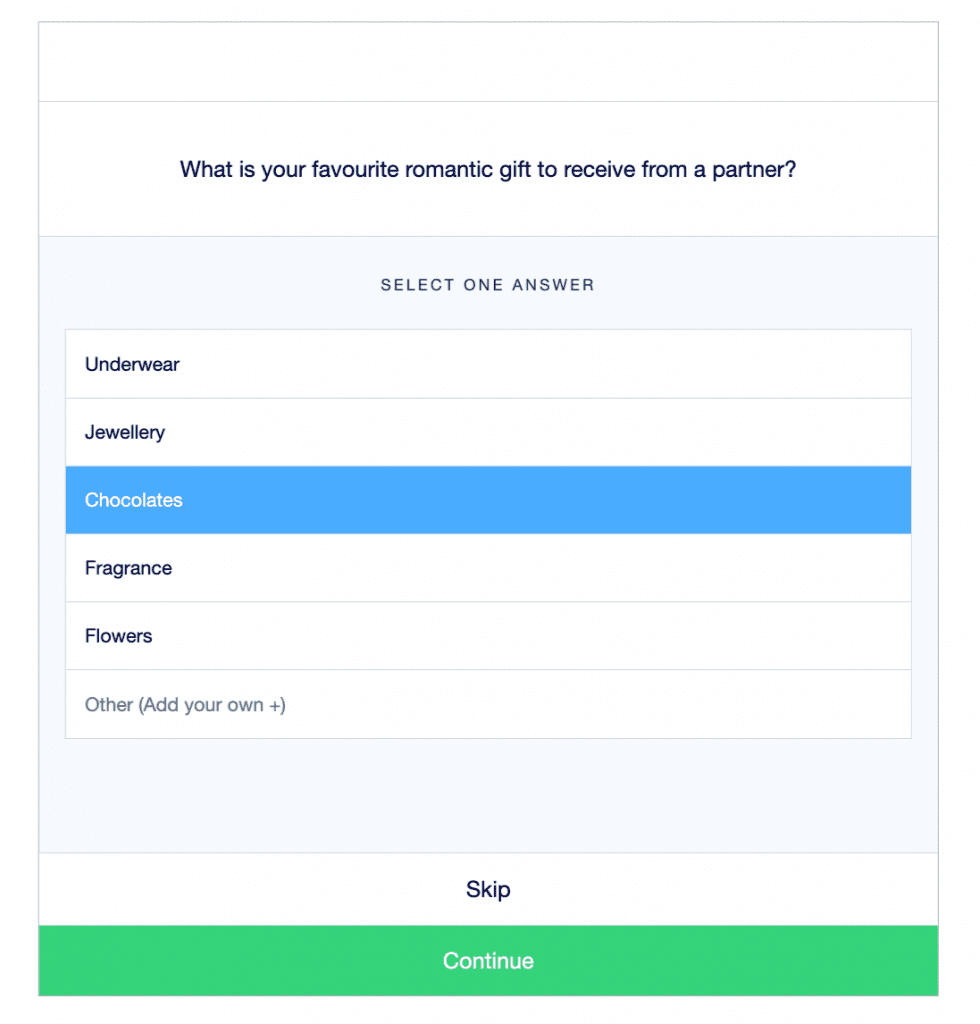
A single-select question gives respondents a short list of answer options and asks them to pick just one. Think of it as the “choose your best match” format.
You should ideally use it when you want people to commit to only one answer, like their main reason for using a product or their preferred communication channel.
Multi-select
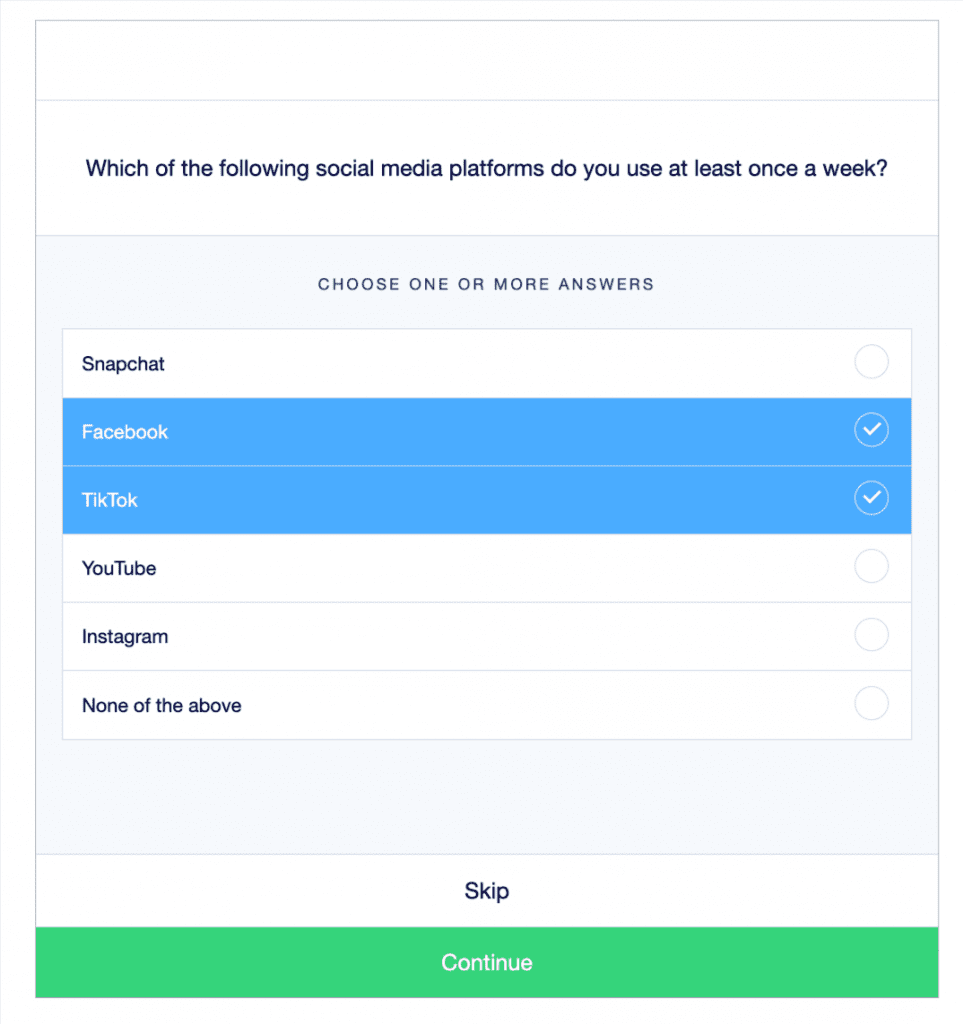
Multi-select questions let people choose multiple answers from a list. Instead of forcing a single pick, they give respondents room to say, “actually… I have more than one answer!”
Use this format when you’re open to getting multiple answers and want to understand the range of behaviours, preferences, or tools someone might use. It’s perfect for questions like shopping habits, product features used or reasons behind a decision.
Rating scales
Rating scales are questions where you ask someone to “rate it” along a line or numbered scale like stars, numbers or descriptive labels. It’s basically a way to capture shades of opinion instead of a simple yes/no.
You can use rating scales when you want to know how much someone likes, agrees, or experiences something. Scale questions are great for customer satisfaction, product feedback or measuring attitudes that aren’t black-and-white.
Likert scales
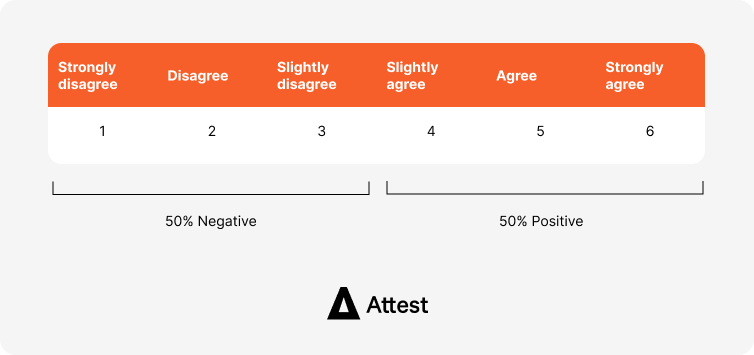
A Likert scale asks people how much they agree or disagree with a statement. You might see 5 answer options like “Strongly disagree” to “Strongly agree,” which lets people show shades of opinion.
Likert scale questions work best when you want to understand attitudes, feelings or perceptions; anything where intensity matters. They’re great for customer feedback, brand and market research or team engagement surveys.
Worded ranges (rarely / sometimes / often etc.)
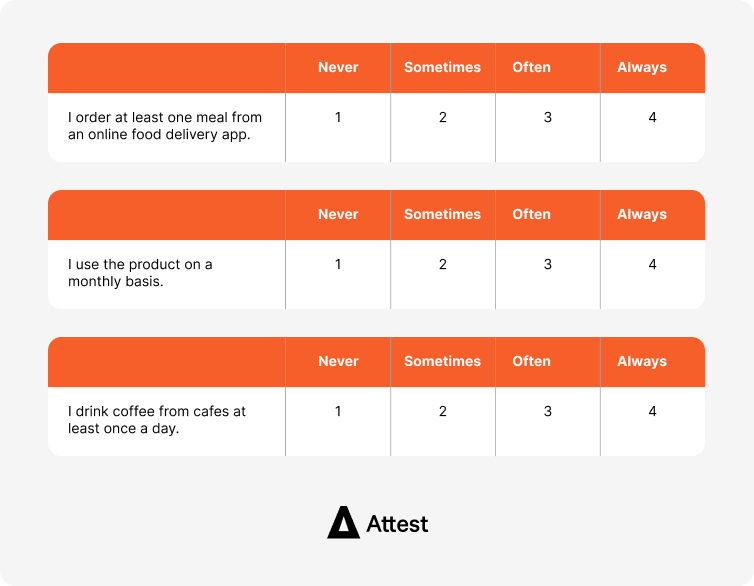
A worded range question asks people how often or how much something happens using words instead of numbers like “Rarely, Sometimes, Often.” It’s a simple way to turn subjective experiences into structured data.
Use this format when you’re measuring frequency, habits or intensity. This type of multiple choice question is especially helpful when numeric scales might feel too rigid. It’s ideal for questions about behaviour, product usage or experiences.
Numeric ranges
Numeric range questions are the ones where people pick a number along a scale, like 1–10, to show how much, how often or how likely something is. Your classic NPS-type question.
Use them when you need a numeric answer that’s easy to compare or track over time. They’re ideal for measuring things like satisfaction, confidence or frequency.
Dropdown lists
A dropdown list is a hidden menu that pops open so respondents can pick an option. It’s the common “choose your country, state or category” format.
Use dropdowns when you need respondents to pick one option from a long list without cluttering the page, and not multiple answers. They’re great for structured data like locations, departments or product categories.
Matrix / grid questions
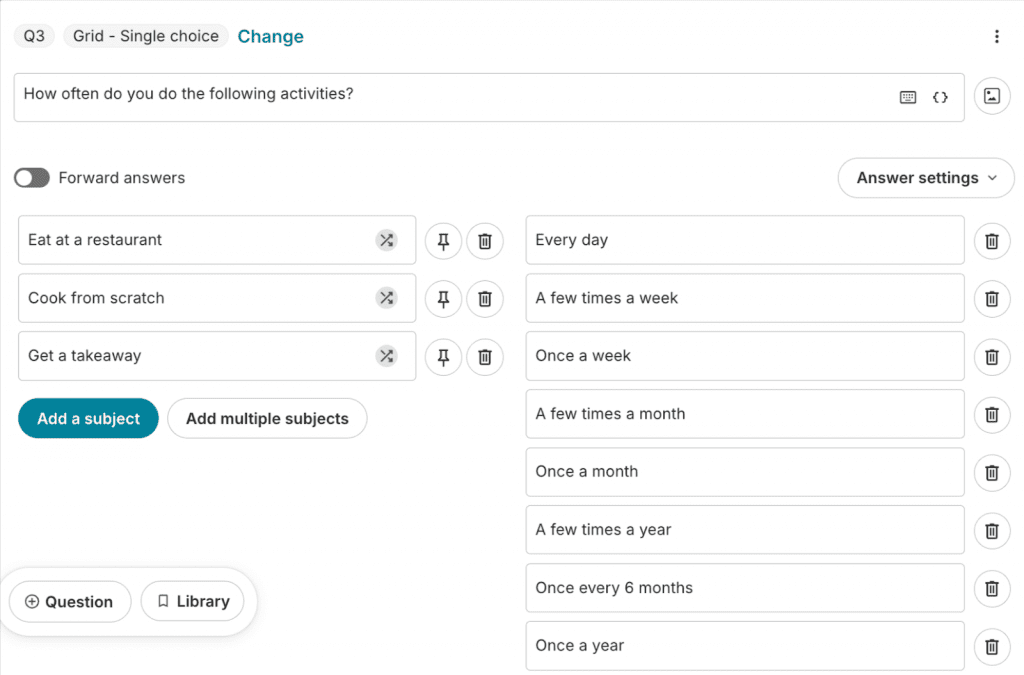
Matrix questions display several related questions in a grid format with the same answer scale. Respondents move down the list and select an option for each row, which makes it fast and consistent to answer.
Matrices are perfect for when you want to measure multiple, similar attributes at the same time like satisfaction with different product features or agreement with a series of statements.
💡Pro tip: Not sure when to use a matrix question versus something else? Our complete survey question types guidebreaks it all down.
How to use multiple choice questions in surveys
Multiple choice questions are powerful, but only if they’re used thoughtfully. A poorly designed multiple choice question can confuse respondents, skew results or make analysis harder.
Here are some best practices for using different types of multiple choice questions in your surveys.
1. Use MCQs when the answers are predictable
Multiple choice questions shine when you already know the possible answers. Think common brands, behaviours, categories or product types.When the answers are limited and well-defined , you can guide respondents to a clear choice, and your data comes back structured and easy to analyze.
If the answer could be anything (like open-ended feedback or personal opinions), stick with a free-text question instead.
2.Put MCQs early in the survey
Starting your survey with a few multiple choice questions helps you quickly understand who the respondent is and what applies to them. This information is crucial if you’re using qualifying questions, skip logic or routing.
For example, you don’t want to ask someone about advanced features if they don’t even use the product. Early MCQs help keep the survey relevant, engaging and fast for each respondent.
3. Keep option lists short
Long lists make people think too hard, which increases drop-offs. A good rule of thumb is around 6–8 options. Shorter lists reduce mental effort, make the survey feel easier and improve completion rates.
4. Include an “Other” option when needed
If there’s a chance you’ve missed an answer, provide a safe catch-all. This ensures respondents aren’t forced into the wrong option and helps you discover new categories to include later.
Example:
Which tools do you use?Google Analytics / Mixpanel / Amplitude / Other (please specify)
5. Make options specific
Vague answer options like “Sometimes” or “Other” can be confusing and hard to compare. Use numbers, distinct ranges or clearly defined categories whenever possible so respondents instantly know which one fits them.
For example, if you ask: How often do you shop online? Instead of using answer options like Rarely / Sometimes / Often, try Less than once a month / 1–3 times a month / Weekly or more
6. Use MCQ answers to trigger relevant follow-up questions
A single choice gives you comparable data, but pairing it with a follow-up open-ended question shows why someone chose that option. Think about an NPS or CSAT question: you get a score you can analyze at scale, then a quick comment that uncovers the real drivers behind the rating. For example:
- How satisfied are you with our onboarding? (1–5 rating)
- What would have made it better? (open text)
Use this approach when you want both the numbers and the story behind them. It keeps feedback structured, while still giving respondents space to share what really matters.
7. Order options logically
How you arrange options affects how people choose. Alphabetical order works well for brands or categories. Place numeric ranges in ascending or descending order. Group similar items together. A logical order reduces cognitive load and keeps respondents from scanning back and forth.
Example:
Which size do you usually buy?
XS / S / M / L / XL (ascending order)
8. Make sure options are mutually exclusive
If choices overlap, respondents may not know which to pick, and your data becomes unreliable. Each option should represent a single, distinct bucket. For example:
❌Don’t use: 1–5 / 5–10 / 10–15 (5 fits two options)
✔️Use: 1–4 / 5–9 / 10–14 (no overlap)

Want to create better multiple choice questions?
Good survey design isn’t just about which question types you choose. It’s how you phrase them. Learn how to write clear, unbiased questions that produce data you can trust.Read our guide to writing survey questions
Examples of multiple choice questions
We’ve talked about rules and best practices: now let’s see them in action. Here are a few multiple choice questions done right (and a few done… not so right) across common survey scenarios.
Brand awareness
Before you ask about opinions or behaviours, it’s often helpful to understand what your respondents already know. Brand awareness survey questions are perfect for measuring recognition in a structured way.
✔️Good example: Which of the following brands have you heard of? (Select all that apply)
- Brand A
- Brand B
- Brand C
- Brand D
- None of the above
❌ Bad example: Do you know any brands at all?
Why it works: The good version is specific and easy to answer quickly, which reduces guessing. It also gives you clean data you can quantify (awareness by brand) and a true “none” option that prevents inflated awareness. The poor version is vague, doesn’t define the category (which brands, in what market), and produces answers that are hard to compare or analyze.
Product feedback
Once you know who your respondents are, you want to dig into their experience. Product feedback survey questions help you figure out which features, services or aspects of your offering people actually use and value.
✔️Good example: Which features of our app do you use most often? (Select all that apply)
- Feature 1
- Feature 2
- Feature 3
- Feature 4
- I do not use any of these features
❌ Bad example: Do you use our app features?
Why it works: The good version turns a broad topic into actionable insight by showing feature-level adoption. That helps you prioritise improvements, spot gaps in education and identify what features people don’t use. The bad version limits you to a yes or no response and gives no detail on which features matter.
Demographics
Finally, demographic questions give context to your survey data. Collecting basic information like age, location or occupation helps you segment responses and see patterns across different groups.
✔️Good example: What is your age range?
- 18–24
- 25–34
- 35–44
- 45–54
- 55+
- Prefer not to say
❌ Bad example: How old are you?
Why it works: The good version uses consistent categories that are easy to analyse without extra cleanup. Including a “Prefer not to say” option reduces drop-off and avoids forcing an answer. The bad version often leads to inconsistent formats and adds time-consuming data cleaning before you can segment responses.
Common pitfalls (and when not to use multiple choice questions)
Multiple choice questions are convenient, but they’re not always the right tool. Using them in the wrong context can frustrate respondents, skew your data or obscure insights.
Here’s a quick guide to when multiple choice questions might not be your best option and what to watch out for.
- Exploring new or undefined territory: If you don’t know what answers to expect, multiple choice questions can limit insight. Open-ended survey questions are better for uncovering unexpected behaviours, attitudes or ideas.
- You need unaided recall, not recognition: If you’re measuring top-of-mind awareness, a list of options can cue respondents and inflate results. Use an open-ended question first, then follow with an aided recognition question if needed.
- You can’t confidently define the answer choices: If you’re not sure you can list options that cover most real responses, don’t use a multiple choice question yet. Start with an open-ended question to learn how people answer, then turn those themes into a strong MCQ later.
- Responses are too subjective for fixed categories: When answers depend heavily on personal interpretation or experience, forcing respondents into predefined options can distort their true feelings.
- Nuance or detailed feedback is required: Sometimes you need the “why” behind an answer. Multiple choice questions can’t capture qualitative data.
- Forcing respondents into options that don’t fit: Even carefully designed lists can leave some respondents without a suitable choice, which may result in skipped survey questions or random selections.
- You need true priorities or trade-offs across many items: If you need to know what matters most, standard MCQs and “select all that apply” can be too blunt. Consider ranking, or a best-worst approach, to force clearer trade-offs.
Common MCQ pitfalls to watch for
Even when multiple choice questions are the right format, small design choices can distort your results. Here are the MCQ pitfalls to watch for so you can trust the data you get back.
- Leading or unbalanced answers: Biased wording or uneven ranges can influence responses, producing survey data that misrepresents reality.
- Too many choices (cognitive overload): Long lists of options can overwhelm respondents, reduce completion rates and lead to careless selections.
- Order bias in answer options: People often gravitate toward the first or last options. If order could affect results, randomize options or use a clear logical sequence.
- Missing opt-out choices when they’re needed: If “Not applicable,” “I don’t know,” or “Prefer not to answer” are realistic, leave room for them. Otherwise you’ll force inaccurate answers.
- Double-barreled questions or options: Avoid combining two ideas into one option (like “Fast and easy”). Respondents may agree with one part but not the other, which makes results hard to interpret.
- Matrix fatigue and straight-lining: Long grids encourage people to rush or pick the same response repeatedly down the column. Keep matrices short, or split them into smaller questions
- Using “All of the above” as a shortcut: It can inflate selections and blur what respondents actually mean. In most cases, a clean multi-select list plus “None of the above” is clearer.
Ready to turn multiple choice questions into better insights?
Multiple choice questions give you a structured way to understand your audience, but only when you design them thoughtfully. Choosing the right type of question, writing unambiguous options and avoiding leading or unbalanced answers helps you capture reliable data.
Multiple choice questions work best for quantitative data and analysis, but they’re even more effective when combined with open-ended questions that provide context and depth. This combination ensures you don’t just see what your audience does or thinks, but also understand why.
Attest makes creating high-quality multiple choice surveys effortless. From building clear answer options to setting up logic that keeps questions relevant, the platform helps you turn survey responses into actionable insights that can guide strategy, product development and marketing decisions.
If you’re ready to get started, use these quantitative market research questions as your next step to build a stronger survey and start collecting insights you can act on. Then, if you want more inspiration, browse these 100 great survey questionsfor examples you can adapt fast.