

When it comes to surveys, the first thing to figure out isn’t the survey questions, it’s how you’ll structure the study.
Two types of survey designs dominate most research: Cross-sectional surveys, which capture a single moment in time. They show you what people think or do right now.
Longitudinal surveys, on the other hand, track the same audience (or matching cohorts) over multiple waves to show how and why attitudes or behaviours change.
Each approach unlocks different types of insight, so choosing the right one can shape the quality and usefulness of your results.
In this article, we’ll break down how the two methods work, where each excels, how to pick the best fit for your goals, and how Attest supports both one-off studies and ongoing tracking.
TL;DR
- Cross-sectional surveys give you a snapshot of what people think or do right now. They’re fast to run, budget-friendly and ideal for concept testing, campaign checks, market sizing and quick decision-making.
- Longitudinal surveys reveal how attitudes or behaviours change over time. They use the same respondents or matched cohorts across multiple waves to track brand health, campaign impact, product usage and long-term trends.
- Choose cross-sectional when you need fast, reliable answers or have tight timelines and limited resources.
- Choose longitudinal when your goal is to understand movement, momentum or the long-term effects of marketing and product decisions.
- Attest supports both, helping teams launch rapid one-off studies or build multi-wave trackers confidently, with high-quality samples, automated checks and intuitive comparisons across waves and markets.
Understanding the two survey designs
Understanding the differences between cross-sectional and longitudinal surveys is key to choosing the right design. Before we explore when to use each one, we’ll define them.
What is a cross-sectional study?
A cross-sectional study is a survey that collects data from a sample at a specific point in time. It provides a clear snapshot of current attitudes, behaviors or preferences without tracking changes across multiple waves.
A strong example is our AI in the Shopping Experience: What Consumers Want report. In March 2024, We surveyed 9,500 working-age consumers across eight markets. Run concurrently with balanced or nationally representative samples, across age groups, the study captured a clear global snapshot of how shoppers feel about AI.
A cross-sectional study like this one is designed to understand what’s happening at the same point in time, and it can reveal relationships similar to correlational research, though it cannot establish causality.
Cross-sectional surveys are ideal when you need quick insight or broad coverage. They work well for market sizing, audience profiling, concept testing and any situation where the aim is to understand what’s happening right now.
✔️Benefits
- Fast results with minimal setup
- Lower cost than multi-wave tracking
- Works well for nationally representative samples or specific customer groups
- Great for early product development, creative testing or rapid validation
- Having a fresh sample each time reduces respondent fatigue
❌ Limitations
- Shows a moment in time, not how attitudes shift
- Cannot measure cause-and-effect relationships with the same confidence as repeated market research surveys
- Not suitable for long-term brand tracking without repeated follow-up waves
- Does not offer a complete picture of how behavior develops
- Comparability in later studies requires asking the same types of survey questions
ℹ️ Key takeaway: Cross-sectional research is often the best choice when teams face limited time, budget or resources and need answers that guide decisions quickly.
What is a longitudinal study?
A longitudinal study is a survey repeated over time with the same sample, the same participants, or a closely matched cohort. It tracks how attitudes, behaviors or awareness shift which helps teams understand not just what is changing, but why.
A good example here is our 2025 US Media Consumption Report. Each year, we survey 2,000 nationally representative US consumers aged 18–67 during March and April. While the exact participants may differ across waves, the demographic makeup remains consistent.
This allows us to compare findings year after year and see how viewing habits, content formats or device usage evolve.
A longitudinal study is designed to reveal overall trends rather than moments. By running repeated waves, you can monitor movement in brand awareness, loyalty, category behavior or the impact of campaigns.
✔️Benefits
- Tracks shifts in behaviour, sentiment or awareness
- Supports long-term strategy, such as brand tracking or campaign evaluation
- Can highlight casual relationships when run consistently
- Helpful in understanding seasonality or recurring behaviours
- Helps teams spot early signals before they become major changes
❌ Limitations
- Requires more time, planning and budget
- Consistent survey design is essential to maintain comparability
- Respondent drop-off can occur if recontacting the same individuals
- Less suitable for projects that need immediate answers
ℹ️ Key takeaway: Longitudinal studies are best for questions that rely on understanding movement, not just measurement.
Key differences between cross-sectional and longitudinal surveys
Before choosing a survey design, it helps to compare the two approaches side by side. This table outlines the main differences so you can quickly identify which design fits your goals, timing and budget.
| Feature | Cross-sectional | Longitudinal |
| Sample | One sample, collected once. Respondents can be nationally representative or targeted. | Same respondents or a matched cohort surveyed across multiple waves. |
| Timeline | Single moment in time. | Multiple points in time (weekly, monthly, quarterly or annually). |
| Data shows | A snapshot of current attitudes, behaviors or preferences. | How attitudes, behaviors, or awareness shift over time, and the possible reasons for those changes. |
| Best for | Market sizing, segmentation, concept testing, campaign checks and quick insights . | Tracking brand health, campaign impact, product usage,market trends, or long-term behavior patterns. |
| Cost/time | Lower cost, quicker setup, faster results. | Higher long-term cost and planning effort due to repeated waves. |
| Example | Attest AI in the Shopping Experience: What Consumers Want (2024): A one-time set of eight nationally representative or balanced surveys. | Attest US Media Consumption Tracker: annual waves run with a consistent demographic profile. |
Cross-sectional vs longitudinal: Which survey type is right for you?
Choosing between a cross-sectional and longitudinal study comes down to what you need to learn, how fast you need results and whether you’re looking for a moment-in-time read or long-term patterns.
Here’s how to decide which one fits your goals.
When to use cross-sectional surveys
Cross-sectional surveys are the right choice when you need answers quickly and want the results to be representative of a whole audience or market. They capture what people think or do at a single point in time which makes them ideal for fast decision-making.
“If you’re looking to make a decision or validate an opportunity in the short term, a cross-sectional survey would be the best option as they are fast, flexible, and perfect for early-stage product development, campaign testing, or market sizing.” – Nicholas White, Head of Strategic Research at Attest
Use cross-sectional surveys when you need to:
- Size a market or segment an audience: Build a clear picture of who your customers are and what they value right now.
- Test concepts before launch: Validate product ideas, test messaging, or creative before committing more budget.
- Comparing perceptions between customer segments: Understand how different groups currently view your brand or category.
- Quick campaign checks: Measure immediate reactions to ads or creative.
- Make decisions on tight timelines: Ideal for teams that need answers within days, not weeks.
Cross-sectional surveys also work well when time and budget are limited. Many brands lean on them because markets move too quickly for long-running trackers. Self-serve survey tools make them affordable and flexible, and teams have full control over the setup.
Nicholas also notes that cross-sectional surveys can be just as reliable as longitudinal ones when the sampling, quotas and questionnaire design are done well:
“The accuracy and reliability of the data is consistent across the two types of research as long as you have a strong sample design, a focused questionnaire and keep the survey length manageable.“
With a well-matched audience profile, a high-quality sample provider, and the right sample size (often around 1,000 for a ±3% margin of error), you can get robust insights without needing multiple waves.
When to use longitudinal surveys
Longitudinal surveys are the right choice when you want to understand how attitudes or behaviours shift over time. Instead of capturing a single moment, you survey the same group (or a closely matched cohort) across multiple waves. Nicholas also notes:
“If you have the time, and the objectives are about understanding the longer-term impact of investment (e.g., a marketing campaign), this is where longitudinal research shines as it looks at differences, growth, and general impact on activity going on.”
Common use cases include:
- Tracking brand awareness or perception across quarters or years
- Evaluating campaign performance over multiple waves to see sustained impact
- Following cohorts, such as new vs returning customers
- Monitoring product adoption or changes in usage habits
- Understanding shifts in habits, like dining out vs. eating at home
- Measuring the long-term impact of marketing activity
Because you’re comparing results over time, Nick notes that consistency is essential. The core questions need to stay consistent across waves.
The respondents themselves can change as long as the demographic profile remains representative — matched cohorts are valid when recontacting the original sample isn’t feasible. This allows you to maintain reliability while still capturing long-term change.
Longitudinal studies also reveal seasonality, letting you identify patterns that single-wave research can’t surface. If seasonality is part of the objective, additional modules can be added for deep dives, as long as they’re repeated at the same point the following year.
This approach requires more planning, time and budget, so most brands reserve it for brand tracking, long-standing category reviews or use cases where understanding momentum truly matters.
When your goal is to see direction, growth, and the reasons behind change, a longitudinal study delivers depth a cross-sectional survey can’t match.
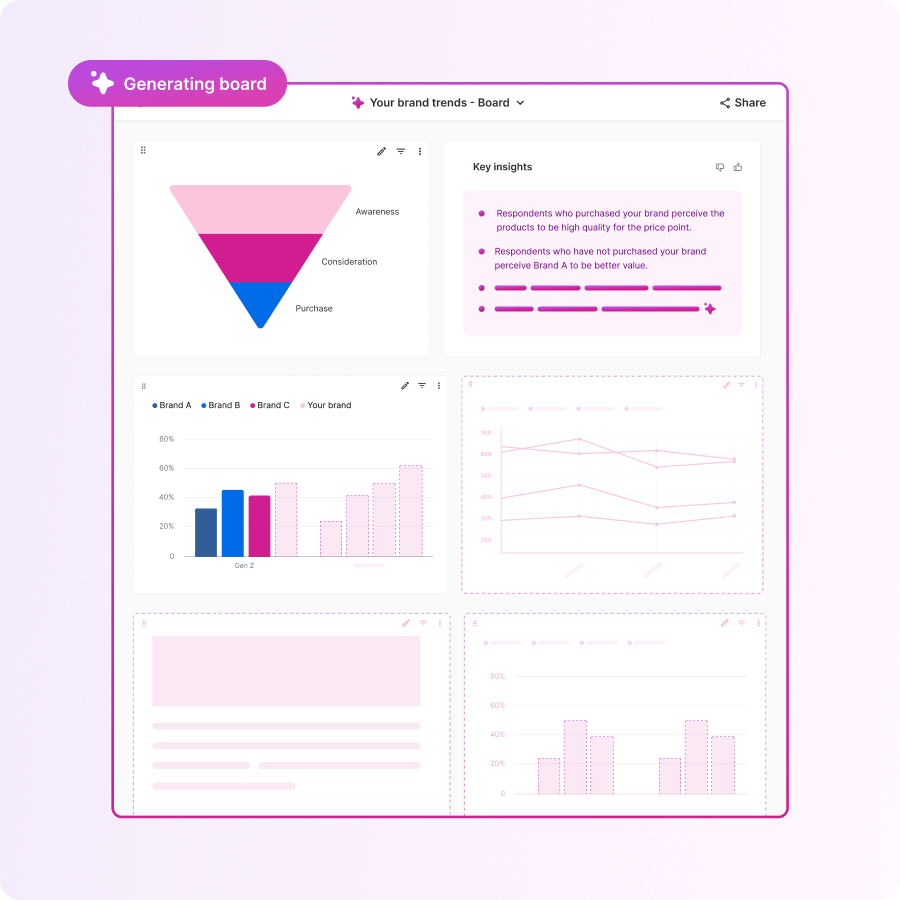
Want to explore every type of survey?
Learn how cross-sectional and longitudinal studies fit into the bigger picture. Discover the pros, cons and best uses for all major survey types in our complete guide.Read the guide
How to decide which one fits your goals
Choosing the right survey design starts with clarifying what you need to learn, how quickly you need answers and how you plan to use the results.
This framework can help guide the decision.
| Question | If this is true… | Choose… | Why this matters |
| What do you want to learn? | You need a quick, reliable snapshot of current opinions or behaviors | Cross-sectional | Ideal for fast benchmarking, market sizing or audience profiling |
| You want to see how attitudes or behavior evolve over an extended period | Longitudinal | Reveals shifts, loyalty trends or the impact of marketing actions | |
| What’s your timeline and budget? | You need results this week, or you have a limited budget | Cross-sectional | Lower cost and setup with data in days, not months |
| You’re investing in an ongoing research program or KPI tracking | Longitudinal | Higher setup cost but delivers richer, more valuable insights over time | |
| How will you use the results? | To optimize campaigns, test messaging, or compare audience segments | Cross-sectional | Great for quick validation and decision-making |
| To guide strategy, retention or product roadmap decisions | Longitudinal | Connects actions to outcomes and shows long-term impact |
How Attest makes cross-sectional and longitudinal research easy
Cross-sectional surveys help you move fast. Longitudinal studies help you understand change. Most teams need both at different points in their decision-making — and that’s exactly where Attest comes in.
Attest builds both approaches into one intuitive platform, so you spend less time setting up research and more time acting on it.
Launch quick one-off studies for concepts, campaigns or market sizing, or build multi-wave trackers that show how awareness, behaviour and sentiment shift over time. Attest’s quality safeguards keep data clean, and intuitive analysis tools make it easy to compare markets, waves or segments.
And it works. GoCardless uses Attest for cross-sectional studies to understand payment pain points across five markets to help them shape stronger product launches and refine their positioning. Today, 100% of their product and feature releases are backed by consumer data collected through Attest.
Trustpilot, on the other hand, used Attest to run a longitudinal brand-tracking study to measure awareness, affinity and sentiment across 10 global markets. Tracking these metrics in repeated waves helps them see how consumer perceptions shift over time and refine their positioning accordingly.
Whether you need a single snapshot or long-term tracking, Attest gives you the flexibility to move at the pace your strategy requires.
A cross-sectional study collects quantitative data from a target population at one point in time to give you a snapshot of current views or behaviors. A longitudinal study gathers data points from the same or matched groups across multiple waves to show how results shift over time.
A cross-sectional study is a research method that gathers data from a sample at one moment. A survey is the tool researchers use to collect that information. In other words, a survey is the questionnaire, while a cross-sectional study describes how researchers conduct and organize the data collection.