

Great ideas start with great data. If you want to launch a product, sharpen your brand message or choose the best place for your ad spend, you need insights you can trust.
Market research surveys give you those insights quickly and effectively, straight from the people who matter most: your customers.
In this guide, you’ll learn what a market research survey is, the types you can run and a step-by-step process to design one that delivers reliable and actionable results. You’ll also see how the right tools help you reach the right people, ask the right questions and turn responses into confident decisions.
TL;DR
What is a market research survey?
A market research survey is a structured questionnaire that collects customer insights to guide decisions on products, pricing, messaging, and brand perception. Surveys can be primary research (firsthand data you gather through surveys, interviews, or focus groups) or secondary research (existing studies, reports, and competitor benchmarks).
How to run a market research survey
1) Define clear goals
2) Identify your target audience
3) Choose the right survey type and tool
4) Deliver through the best channel
5) Write clear, unbiased questions
6) Set sample size and margin of error
7)Analyze results
8)Take action based on your findings
Why do market research surveys matter?
They confirm whether there’s real demand for your product, show how people perceive your brand, reveal competitor strengths and weaknesses, highlight price sensitivity, and help optimize campaigns.
What is a market research survey?
A market research survey is a research method that uses a detailed questionnaire to collect information from your audience on a large scale. These help you:
- Understand customer needs and preferences. Find what drives customers’ choices, behaviors, desires and buying habits.
- Identify market trends. Discover shifts in customer demand, industry patterns and emerging opportunities.
- Evaluate marketing campaigns. Analyze how well campaigns perform and influence customer behavior.
- Test new products and services. Collect feedback to refine offerings before a full launch.
- Gather demographic information. Compile key data like age, location, income or lifestyle to segment audiences.
- Brand awareness and perception. Determine how well people recognize your brand and what they think of it.
- Price sensitivity. Spot how much customers are willing to pay and how they react to price changes.
You might be wondering if a market research survey is the same as market research or marketing research.
The answer is no: Marketing research is the broader process of gathering and analyzing information to guide business or marketing decisions.
It can include surveys, customer feedback studies, voice of the customer analysis, or even a competitive SWOT analysis. A market research survey is just one part of that larger process.
Primary vs. secondary research market research
Research is considered primary or secondary depending on the source and the person collecting the information.
For example, conducting user interviews (primary) vs. analyzing an industry report (secondary). Let’s explore each of these in detail.
Primary market research
Primary market research, or field research, is the type of study you conduct firsthand. In other words, it’s the data a business gathers by having direct communication with the source.
Some common survey methods include market research surveys, user interviews, focus groups and usability studies.
Think of launching a customer survey to collect feedback on a new feature. This is primary research because you’re the one conducting the study and discovering new information.
Secondary market research
Secondary market research, or desk research, is what you do when you look at publicly available sources like studies and reports to gather insights or make decisions.
It’s secondary because someone else conducted the study for you. Plus, it’s out there for you and your competitors to see.
Some sources for secondary research include market reports, academic papers, competitor data or industry benchmarks.
For example, you conduct secondary research when you access government reports to understand total market size or access trends reports, like our 2025 report on UK media consumption.
How to conduct a market research survey
You’re all caught up with basic definitions. Now it’s time to get into the details of creating and launching market research surveys.
1. Define your goals
This step is non-negotiable. Setting clear goals will guide the type of questions you ask, the insights you gather and the decisions you make.
Start by identifying exactly what you want to achieve from the survey and linking it to a concrete business objective. Ask yourself these questions:
- What problem are we trying to solve with this data?
- How will it benefit our product, customers or company?
- What form of data response (quantitative vs. qualitative) is most valuable for this study?
- What’s one hypothesis we want to validate?
Once you’ve come up with the answers, take some time to write down your goals. Be as precise as possible with them, as they will guide your question design and survey distribution.
For example, your goal could be to have a clear understanding of who your target audience is, their habits, beliefs and jobs-to-be-done. This objective may require a mix of different primary and secondary research methods.
[H3] 2. Identify your target audience
After setting up your market research goals, determine who you want to hear from. This means choosing whether to target:
- Existing customers: Helps assess current customer satisfaction and loyalty or explore adoption of potential new launches.
- Potential customers: Shows how likely your target market is to try your product or service.
- A mixed audience: Lets you compare perceptions and preferences between groups.
While having a properly defined target audience lets you craft better market research questions and gather hyper-relevant data, being overly specific reduces the sample size and increases costs.
We recommend using buyer personas with broader demographics, psychographics and behaviors, instead of targeting ultra-detailed audiences — e.g., “25–30-year-old women in London who shop online weekly.”
Use screening questions at the start of your survey to qualify respondents. For example, you could invite women in London aged 25–34 to take part, then ask at the outset: “Have you purchased [product category] in the last 6 months?”
This way, you focus only on relevant participants, gather valuable insights and avoid overspending.
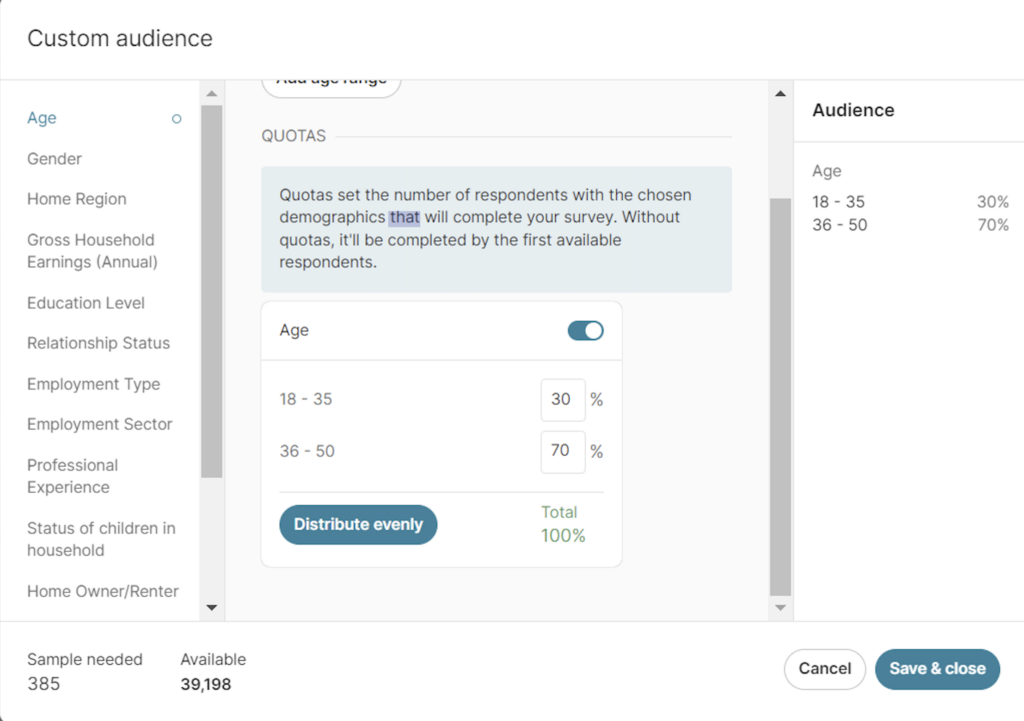
With Attest, you can speed up the targeting process by tapping into our panel and forgetting about manual recruitment. Set precise demographic filters (such as age, gender, location, income, etc.) across [attest_audience_size] in [attest_num_markets] countries.
Attest gives you real-time feasibility checks to show how many respondents match the criteria before launch. This helps you balance targeting ambition with practical reach:
3. Choose your survey type and survey tool
The type of survey you write and run varies depending on your market research goals, which could include:
- Customer demographics survey: Collect basic demographic details like age, income or location to better segment your audience. This data is baked into the Attest platform.
- Brand awareness survey: Measure how familiar people are with your brand and what they associate with it.
- Competitor research survey: Understand how customers view your competitors compared to your business.
- Consumer behavior survey: Explore customers’ habits, motivations and decision-making processes.
- Price testing survey: Identify what customers are willing to pay and how they perceive value.
- Product feedback survey: Gather opinions on your product’s features, usability and overall experience.
Choosing the right tool to host your online surveys makes creation, targeting, distribution and analysis easier. For example, Attest is an all-in-one platform that offers:
- Access to a large audience
- Precise demographic, targeting
- Ability to combine panel and own-audience research
- Built-in analytics for faster insight-to-action
Using Attest to host, distribute and analyze your surveys simplifies your job and guarantees valuable insights. Also, Attest also comes with specific, proven and ready-to-use survey templates.
4. Decide on how you’ll deliver your survey
The way you deliver your survey has a direct impact on the type of responses you get. Here are the most common delivery options with their pros and cons:
- Online forms: Easy distribution and analysis, especially for large and global samples. However, you risk low response rates or poor targeting.
- Email: Cost-effective and customizable for specific segments, but it may be marked as spam and you risk low open rates.
- SMS: Could drive fast responses, but these can feel intrusive and should be limited to one question.
- Panels: Let you quickly gather a large volume of responses, but are best suited to quantitative studies.
- In-person: Rich insights and higher completion rates, but these take longer to plan, collect and analyze.
- Over the phone: Enables a conversation and allows you to clarify. However, it’s costly and could feel intrusive.
- Social media: Lets you meet your audience where they’re at, but isn’t necessarily useful for long studies.
While phone and in-person surveys were popular a few years back, customers are now more used to answering questions online.
Using a tool like Attest makes the surveying process even simpler for you. All you need to do is create your survey and set your target audience.
Then, respondents complete surveys on their devices via trusted partner apps and websites. You get to see instant insights from your surveys and access data reports without having to do any of the distribution work.
5. Craft your survey questions
When writing survey questions, focus on clarity and relevance to the study goals. Here are some quick tips to follow:
- Mix closed- and open-ended questions: Use rating scales, multiple choice, rankings, or yes/no closed-ended questions and follow with some open-ended questions to let respondents explain their choices. For example, ask “How likely are you to recommend our product to others?” and follow up with an open-ended question to understand why they gave that rating.
- Avoid leading questions: These are the type of inquiries that hint at the answer, for example: “How easy did you find this new feature to adopt?” Keep these to a minimum as they can lead to biases.
- Don’t double-barrel your questions: Avoid asking about two topics at once, as this can confuse your audience. For example: “How would you rate our integrations and the analytics feature?”
- Allow respondents to skip sensitive questions: Be respectful of your audience and let them opt out of personal or private questions. This also helps reduce drop-offs.
6. Set your sample size and margin of error
Surveying a statistically valid sample lets you draw conclusions about your entire market. Meaning, if your sample says they would pay $10 for your product, it’s fair to assume your entire target market would do the same, with some margin of error.
To determine how many responses you need to get for the results to be statistically valid, you need to factor in:
- Population size: The total number of people you want to study. For example, if you’re researching 25- to 30-year-old women in London, the population is the total number of women in that age bracket living there.
- Acceptable margin of error: This is the amount of your results that could be off in both directions, for example: ±5%. This decision is up to you.
- Confidence level: This is how much you can trust that the results are an accurate representation of the general population.
If this all sounds like too much, try Attest’s sample size calculator. It will help you calculate the exact number you need in seconds.
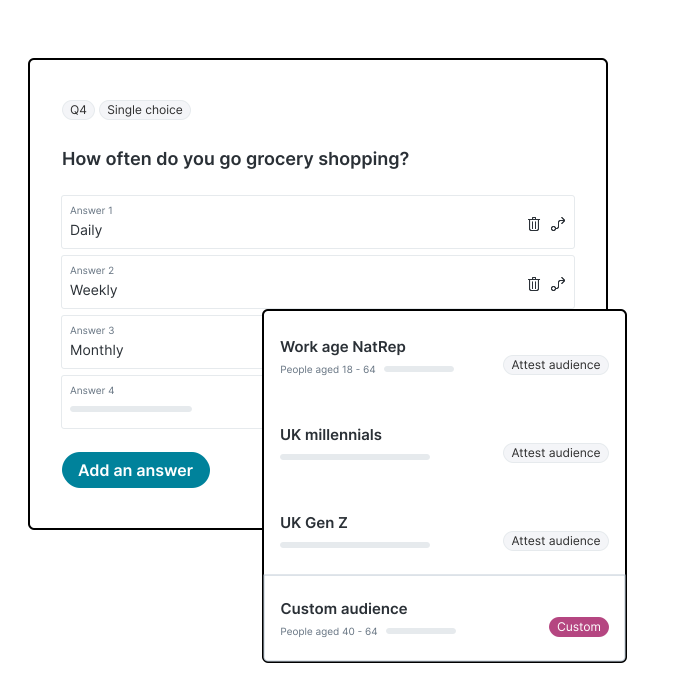
And, if you use Attest to conduct your surveys, and want to be be confident that you poll a balanced, representative samples , simply select one of the pre-set nationally representative audiences.
8. Analyze the results
When you analyze data, you can spot trends, key results and opinions, then turn them into insights to reach your survey research goals.
To analyze the market research data, determine your qualitative and quantitative analysis methods. Then:
- See the big picture fast by calculating averages like satisfaction scores or purchase frequency
- Identify recurring themes or stand-out feedback in qualitative responses
- Separate results into segments to compare groups side by side
- Put findings in context by contrasting them with benchmarks or industry reports
There are hundreds of insights you can get from analyzing survey data. However, keep the analysis focused by circling back to your goals. This will tell you what’s relevant for this study and what’s just nice to know.
Also, using a tool like Attest simplifies the analysis for you. The results dashboard combines AI-powered insights with flexible tools so you can split, explore and query the data as much as you need.
AI analysis provides a clear survey overview, breaks down data splits and saves key insights and charts to your board. You can also dig into segments, test for statistical significance and use ready-made crosstabs for deeper comparisons.
9. Take action
The last step is to close the loop with participants and internal stakeholders. Share what you’ll do with the collected information and how you’ll share insights internally to turn them into strategic actions.
A good idea is to do this by showing examples of potential changes that could result from survey findings. For example, adjusting pricing, refining messaging, developing new features or improving your onboarding.
Reddit, for instance, uses Attest to conduct ongoing multi-market research and show advertisers the influence this community has on purchasing decisions.
Uncovering these insights allows the company to “Highlight the unique competitive value that Reddit brings across industries and key moments. These insights have been integrated into large live events, sales pitches and digital media strategy,” shares Marissa Bell, Marketing and International Head, Global Insights, Reddit.
The business benefits of market research surveys
Companies of all sizes use market research surveys to put themselves in their audience’s shoes and create better experiences for them.
But these companies don’t do it just for altruistic reasons; doing a market research survey allows businesses to:
Reach niche audiences with precision
Surveys help you connect directly with your ideal customers to build tailored, data-driven strategies.
The more you understand them, the more tailored your product will be to their specific needs. Use this feedback to build better products and drive more sales.
Validate your target market before investing
Use survey insights to understand market size, buyer behavior and pricing sensitivity before launching.
Also, take this chance to really assess feasibility before spending big bucks on a prototype.
Measure and benchmark brand awareness
Gauge how your brand is perceived by real users and prospects.
Compare how it stacks up against the competition and use it as a competitive advantage to get ahead of them.
Uncover competitor strengths and weaknesses
Ask your audience directly to see how they view your rivals and why they choose certain brands. Turn this into your advantage and win them over.
Optimize your social media strategy
Find out which platforms matter most to your audience and how to show up better on each one.
Meeting them where they are builds stronger connections and puts you at the top of their mind. This is helpful for when they need to make a purchasing decision.
Build a clearer picture of customer demographics
Get the demographic data you need to target and message more effectively to capture your customers’ attention.
Getting more qualified eyes on your campaigns could potentially lead to higher conversions.
Test brand messaging and names before you commit
Validate your brand name, positioning and identity with real consumer feedback.
Make data-based changes to become more appealing to your target audience.
Track market sentiment to guide decisions
Use ongoing surveys to stay in tune with consumer opinions across industries and trends.
Share statements with your point of view to become closer and build better, longer-lasting relationships with your customers.
Create market research surveys with Attest
Market research surveys are a powerful way to get to know your audience and gather insights.
They may look simple, but these questionnaires can shift how you see your target market and help you redesign strategies to reach them more effectively.
Surveys can help you understand brand perception, test new product ideas, refine pricing, identify customer demographics and gather product feedback.
If you want to put customers at the center of your product, pricing and marketing decisions, you can’t skip market research surveys.
But data alone isn’t enough — you need to analyze it, put it in context and turn findings into actionable next steps that drive results. That’s where the right research platform comes in.
Attest lets you create, deliver and analyze surveys in one place. It also saves time with ready-to-use templates, a large pre-vetted participants panel and AI features that simplify data analysis.
This way, you only have to focus on the fun part: Making your audience fall in love with your product.