
Net Promoter Score (NPS) is one of the most widely used ways to measure customer satisfaction, loyalty and experience. Most teams track it religiously, but far fewer know how to turn the number into real improvement.
On its own, NPS shows you how customers feel at a single point in time. Its value grows when you connect it to the reasons behind the score: The moments that create promoters, the friction that turns people into detractors and the signals that highlight where to focus next.
A higher NPS is simply the outcome. What really matters is fixing the experiences underneath it. When you tackle the issues that shape satisfaction and loyalty, you see the results across your business:
- More predictable recurring revenue
- Improved retention and fewer churn risks
- Lower acquisition costs over time
- Higher customer lifetime value
- Teams that are less stretched and more focused
Here’s how to improve NPS and turn your NPS data into insight and action.
What factors affect your NPS?
Behind every Net Promoter Score are dozens of factors that shape how customers think and feel: some big, some small.
To move your score in the right direction, it helps to know which of these make the biggest difference. Here are the heavy hitters:
1. Customer and business type
Your business model and customer profile have a big impact on your NPS. In B2B, long sales cycles, multiple decision-makers and ongoing engagements mean customers tend to weigh their experiences more cautiously.
Scores often increase or decrease gradually and you’ll see fewer extreme highs or lows; a cautious middle ground is common.
In B2C, the dynamic is different. One-on-one interactions, instant gratification and emotional triggers make it easier to spark enthusiasm and win Promoters quickly. A delightful experience, even something small like a fix on an app or speedy support, can have an outsized effect on NPS scores.
Even within the same business model, NPS can differ by customer type. Buyers tend to evaluate your product or service based on business impact or ROI, while end-users are more sensitive to day-to-day experiences like ease of use, speed and support quality.
2. Industry and culture
A “good” NPS number doesn’t mean the same thing everywhere.
Industries with high regulation or complex service models, think financial institutions, telecoms or utilities, typically see scores between 20 and 40. That just reflects a tougher evaluation environment, and not failure on your part.
On the other hand, industries built around fast feedback loops and emotional experiences, like SaaS, retail, or travel, can reach the 40s or even 50s.
Cultural differences shape the picture too. U.S. customers often rate more positively, while European and Asian audiences tend to be more restrained. The real insight comes from benchmarking against others who serve the same kind of customers in the same markets.
3. Survey design and timing
How and when you ask customers for their feedback can make a big difference in your Net Promoter Score.
For example, sending NPS surveys right after onboarding will often give different results than asking six months later because their experience and perspective change over time.
The channel, question phrasing, and alignment with the customer journey also affect responses.
4. Customer experience quality
A customer’s experience is the single biggest factor shaping your NPS. How they interact with your product, support and onboarding will directly influence whether they become Promoters or Detractors.
Three key drivers stand out:
- Product performance: Is your product reliable, easy to use and feature-rich? Even small frustrations can add up.
- Onboarding: The first experience sets the tone. A smooth, guided setup makes customers feel confident and valued.
- Customer support: Fast, empathetic and effective problem resolution can make or break customer satisfaction.
Unlike industry norms or cultural tendencies, these are levers you can control. A confusing onboarding flow or a delayed support response can quickly turn a neutral user into a detractor.
To stay ahead, track NPS alongside product usage and support metrics. Doing so helps you pinpoint exactly what drives satisfaction, and which areas need urgent improvement to increase customer loyalty.
Common challenges to improving NPS
Many organizations hit roadblocks that keep their NPS stagnant, or worse, misinterpret customer data and chase the wrong levers. Here are some of the most common challenges to look out for so you don’t end up on the wrong side of your NPS score.
Limited context and depth
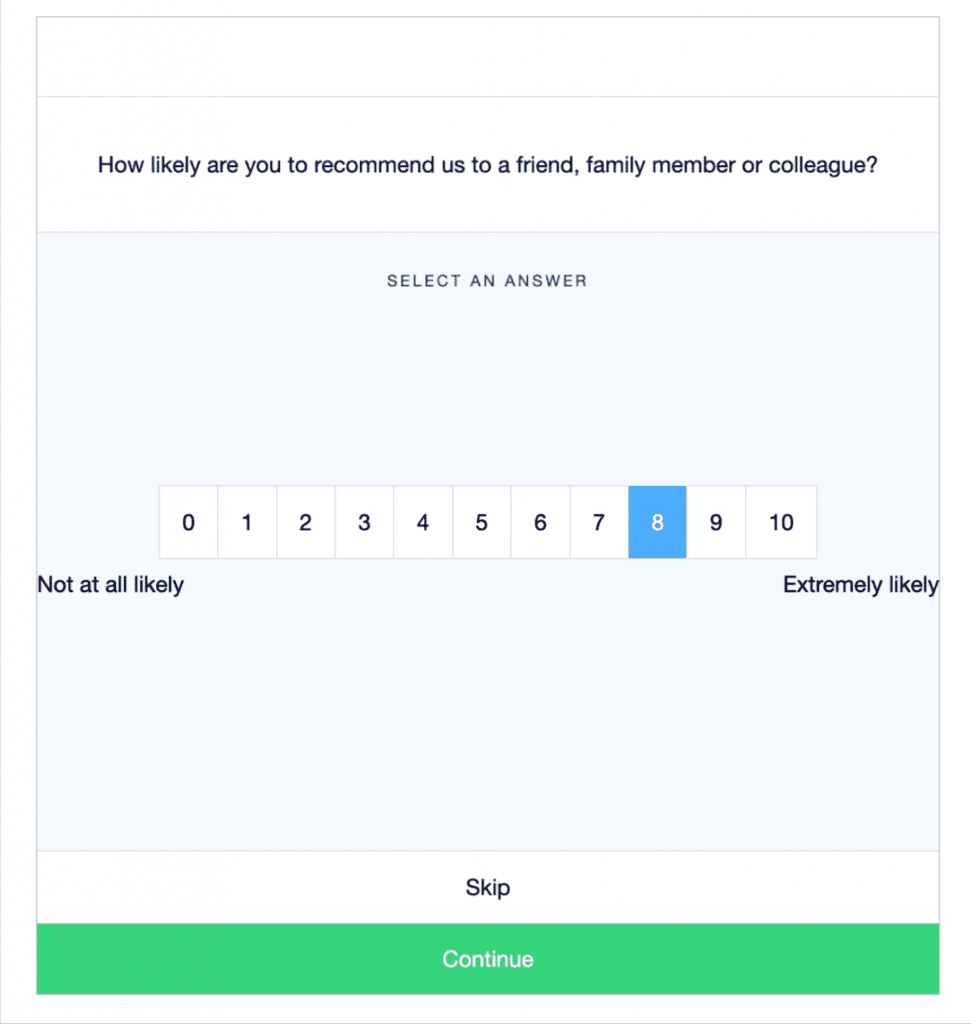
NPS asks a single question: “How likely are you to recommend us?” While this gives a snapshot of sentiment, it doesn’t explain why customers feel that way.
Without context, teams struggle to know what to improve. Pairing NPS with qualitative feedback, customer interviews, open ended questions or product usage data can uncover the real drivers behind the score.
Low response rate or biased sampling
Very satisfied or very unhappy customers are often the first to reply, which naturally skews results. On top of that, biased or leading questions can nudge people toward higher or lower scores without you realising it.
Together, these factors make it hard to trust the number even if it looks good on paper.
Focusing only on the number
Treating NPS as the goal itself is a common trap. Some teams celebrate a high score or panic over a drop without digging into actionable insights.
NPS should be a trigger for deeper analysis: Identifying friction points, tracking improvements over time and implementing changes that genuinely move the needle.
Lack of segmentation
Looking only at the overall score hides differences between customer types, geographies, or lifecycle stages.
Segmenting your NPS by plan, product usage, location, or role reveals which groups are happiest and which are at risk which enables targeted interventions rather than one-size-fits-all fixes.
Over-reliance on benchmarks
Industry averages and competitor scores can be tempting reference points. They give you something to measure yourself against. But leaning too heavily on them can be misleading.
As we mentioned above, what counts as a “good” NPS in one market or industry might be completely average in another. Cultural differences, customer expectations, and even business models can skew comparisons.
Misinterpreting causality
A high NPS is encouraging, but it doesn’t automatically translate into growth, retention, or revenue.
Think of it as a valuable indicator of how customers feel rather than a guarantee of business outcomes. Over-relying on the score alone can lead to false confidence or misplaced priorities.
Survey fatigue or disengagement
Sending too many NPS surveys, or worse, collecting customer feedback and doing nothing with it, can quickly erode trust and frustrate customers.
When customers feel their input disappears into a black hole, they disengage and response rates drop, leaving your NPS less reliable.
13 proven tips to improve your NPS

You’ve got the NPS number on your dashboard, but what does it really tell you? These 13 tips show how to dig deeper, act smarter, and actually improve customer satisfaction.
1. Close the loop with detractors
One major mistake that a lot of businesses make is that surveys go out, scores come in and then nothing happens. Customers notice that silence, and it erodes trust. Closing the loop by letting participants know how their input is being acted on is essential.
When a customer gives you a low score, be sure to do something about it. Reach out quickly and personally. A simple email or call to understand their frustration can go a long way. In SaaS, this might look like offering a 1:1 session to resolve the issue.
You can also actively learn from both ends of the scale:
- When you get a detractor (0-6), ask “Can we fix this?” and try to resolve the issue directly
- When you get a promoter (9-10), ask what worked well and explore advocacy opportunities like case studies or referrals
Share these insights internally so teams understand what needs to change next. You’ll not only fix specific issues but you’ll also uncover the patterns that are quietly hurting the customer experience.
2. Dig into feedback to find patterns
An NPS score tells you that something is happening. The feedback from open-ended questions is where you’ll get the most insight from customers. Read through customer feedback carefully, notice patterns and negative feedback, and prioritize underlying issues that crop up most often.
Work the feedback like a system:
- Segment results by journey stage, channel or product so you can see where the main issues lie
- Tag open text responses by theme and by segment, for example onboarding too slow, feature missing or support not responsive
- Quantify each theme by frequency and impact, then pick the top three to five drivers to tackle first
- Create KPIs for those drivers rather than for the score itself, for example onboarding completion rate, first response time and feature adoption
- Assign an owner for each driver and add the fix to the product or ops roadmap, then report back to customers where relevant
- Measure before and after so you can see whether detractors drop and promoters rise
ℹ️ For example: If many detractors mention a confusing billing page, log it as a theme, prioritise it based on volume and churn risk, set a KPI such as billing-related tickets per 100 accounts, assign a product owner, redesign the flow, and follow up with customers who flagged it.
3. Segment your NPS data to uncover where loyalty shifts
An aggregate NPS score hides the nuance. When you break the data down by customer type, product line or journey stage, you start to see which groups are thriving and which groups are struggling.
Here are some ways you could segment your scores:
- Plan or pricing tier
- Product variant or feature bundle
- Lifecycle moment, for example newly onboarded customers versus long-term customers
- Company size or industry for B2B audiences
- Usage profile, for example power users versus light users
Once segmented, patterns become clearer. You may find that enterprise customers love the product but small teams struggle with setup. Or that scores improve sharply once users adopt a specific feature.
Segmenting the results gives you a more precise understanding of where to focus so improvements land in the areas that matter most.
4. Regularly send NPS surveys and create your own benchmarks
Generic industry benchmarks can be helpful for context, but they should not drive your improvement decisions. Your NPS becomes most meaningful when you compare it to your own historical performance over time.
Track NPS regularly using a survey platform like Attest so you can see how the score moves month to month or quarter to quarter. When you monitor trends consistently, you can connect movements in the score to specific changes such as onboarding improvements, new features or support process updates.
Focusing on your own customers’ experience gives you a more accurate picture of progress than aiming to match an external average which may not reflect your product, category or audience at all.
When should I send NPS surveys?
Remember, you don’t want to send NPS surveys too regularly! Not all NPS surveys serve the same purpose, so the cadence you choose depends on the type of insight you want. There are two main approaches — relational NPS and transactional NPS — and each has its own ideal timing.
Relational NPS (overall satisfaction)
Use relational NPS to measure the strength of your long-term customer relationships.
- Quarterly: A good starting point for most established businesses, offering a regular pulse on customer sentiment.
- Bi-annually or annually: Better for smaller customer bases, longer customer lifecycles or high-value B2B contracts.
Pro-tip: To avoid conflicts, send outside of peak sales periods or major moments that could distort how customers feel overall.
Transactional NPS (interaction-specific)
Use transactional NPS to understand how customers felt about a specific touchpoint or moment.
- After support tickets: 1–2 days after resolution, while the interaction is still fresh.
- After purchases or renewals: Within a few days of the transaction to capture authentic feedback.
- After key milestones: Such as completing onboarding, hitting a usage milestone or finishing a major project.
- Before renewal: Sending a survey a few weeks before a contract is up helps surface issues that could impact retention.
5. Fix what matters most
Not every piece of feedback carries the same weight. The biggest gains come from improving the touchpoints that affect many customers and have the strongest link to retention and loyalty.
Start by mapping key stages in your journey, for example:
- Onboarding
- Product use
- Renewal moments
- Support interactions
Look for where detractor feedback concentrates and prioritise based on two things that matter most: how often the issue occurs and how much it influences outcomes.
It helps to treat this like an experiment loop. If many customers struggle with a specific onboarding step, fix that before you worry about small UI or copy tweaks. Make the improvement, measure before and after, and see whether passives drop and promoters rise.
Key takeaway: Your goal is not to clean up every rough edge. It is to invest your effort in the areas where fixes will create the biggest loyalty shift.
6. Smooth out onboarding and key touch points
NPS becomes more actionable when you measure it at meaningful points in the customer journey instead of only running a single periodic survey. Different moments carry different emotional weight, and friction at one stage can drag the whole relationship down.
For example, onboarding, first value, first support interaction and renewal conversations are all moments where sentiment naturally spikes or dips.
If you capture NPS (and the open text feedback that comes with it) at these stages, you get clearer visibility into where loyalty is formed and where it is lost.
Walk through your journey like a customer would and pinpoint the stages where questions, confusion or friction are likely to occur. Then, trigger NPS at those exact moments so you can see how the experience lands in real time.
Even small improvements here can compound quickly into higher adoption, stronger engagement and more promoters over time.
7. Get your teams on the same page
NPS won’t improve if only one team cares about it. Great customer experience involves product, marketing, and operations. This may be a hot take, but alignment matters as much as the metric itself.
Think of it like this: product releases a new feature, support needs to be ready to answer questions and marketing needs to communicate the value clearly. Coordination helps prevent frustration and keeps your NPS moving up.
8. Make NPS part of your culture
Share NPS insights widely, celebrate promoters, and discuss detractors openly. Dashboards, team reviews and cross-functional meetings make it part of everyone’s day-to-day.
When teams see real customer feedback and understand the impact of their work on loyalty, they’re more motivated to improve the experience continuously.
9. Turn promoters into advocates
Promoters are your best fans. The opportunity is to turn that goodwill into visible advocacy. When you invite them to participate more deeply, you reinforce their loyalty and create social proof at the same time.
There are a few practical ways to activate promoters:
- Invite them to share testimonials, reviews or referrals
- Offer early access to new features or beta programmes and collect feedback from those sessions
- Ask what made their experience great so you can replicate those drivers across more accounts
- Build communities or discussion spaces where promoters engage with peers and share recommendations naturally
ℹ️ For example: Invite your highest scorers to test an upcoming release. They feel valued, you get useful product insight and you build credible momentum before launch.
10. Thank and reward loyal customers
A little appreciation goes a long way. Simple gestures like personalized thank-you emails, loyalty perks, or exclusive access to events reinforce positive feelings.
Even small nods like a note, discount or public shout-out, remind your promoters that they’re valued. Happy, recognized customers are more likely to stick around and keep recommending you.
Take Duolingo for example, celebrating streak milestones with personalised messages, exclusive badges, and early feature access. Those light, playful touches make loyal users feel part of something and keep them engaged.
11. Refine your survey questions
A clear NPS question leads to cleaner data. Keep it simple, unambiguous and easy to interpret. When the question is precise, people answer based on the same frame of reference which reduces noise in the results.
Here is an example:
✔️Good: How likely are you to recommend our product to a colleague or friend?
❌ Bad: Would you recommend our product to a colleague or friend if you found it useful and had a good experience overall?
The first question isolates the decision. The second question layers in conditions and assumptions that can bias the response.
Pro-tip: Want to sharpen your question-writing skills? This guide on how to write good survey questions is a great place to start.
12. Don’t forget about survey design
The way you design and deliver your survey shapes the quality of the insight you get back. Timing, length and follow-up questions all influence how accurate and representative your responses are.
A few simple rules make all the difference here:
- Use the standard 0 to 10 likelihood survey rating scale so your results stay comparable
- Send the survey after value has been delivered, for example after onboarding or when a key feature is adopted
- Include a short open ended follow up like “What is the main reason for your score” to uncover the context behind the number
- Keep the survey short because longer surveys usually lead to lower completion rates
This gives you cleaner inputs and a more honest read of how customers are actually experiencing your product.
13. Combine NPS with other performance metrics
As mentioned earlier, NPS is most powerful when you connect it to what customers actually do, not just how they say they feel. Treat it as one input in a broader insight system rather than a standalone score.
Link NPS trends with behavioral data such as:
- Churn and retention rates
- Repeat purchase or renewal rates
- Product usage or feature adoption
- Support ticket volume and resolution time
- Average revenue per account
When you connect sentiment to behavior, you can see which shifts in experience actually move commercial outcomes.
For example, in a SaaS company, if accounts with low feature adoption consistently give lower scores and have higher churn risk, that helps you prioritize adoption-focused improvements over cosmetic optimizations.
This elevates NPS from a dashboard number to an operational signal, one that directs effort toward changes that genuinely impact loyalty and revenue.
Pro-tip: You can also use CSAT and NPS together to separate quick fixes at individual touchpoints from deeper issues that influence retention, ensuring your effort goes where it makes a measurable difference.
Ready to improve your NPS?
You’ve seen the big stumbling blocks: low response rates and skewed samples, undifferentiated survey responses hiding real variation, disconnected NPS feedback left to gather dust and customer‑experience loops so slow they let detractors slip away while you figure out what to do.
Tackling your Net Promoter Score means facing each of these head‑on and making sure your score is the start of an action plan.
With Attest, you can move faster and smarter. It couldn’t be easier to start tracking NPS for your brand, or even keep an eye on your competitors. Your NPS score is calculated automatically and displayed in your results dashboard which gives you a quick, clear indication of how effectively you’re building loyalty and where you may need to improve.
Then dive deeper: Slice results by role, product‑usage, geography or lifecycle stage so you’re not relying on one blanket score.
And if you’re operating across territories or in hybrid models, you can run customer-feedback surveys and panel research side by side.This gives you a holistic view of customer sentiment, experience and referral potential.
Your NPS tells a story, but it’s a story you can influence. Start small, focus on what matters most, and let continuous improvement create a ripple that strengthens your brand for the long term.