
In 2026, this cohort’s oldest members will turn 16, stepping into adolescence with unique values, skills, and expectations. For brands, the time to understand this cohort is now.
To explore who Gen Alpha really is, we spoke with parents of 15- and 16-year-olds across the US, capturing insights into their teens’ ambitions, financial habits, and well-being. Conducted via the Attest platform, leveraging our industry-leading data quality methodology, our nationally representative survey of 1,000 parents reveals how this generation is being shaped by a world of unprecedented connectivity, rapid technological change, and rising social awareness.
The results paint a picture of a cohort coming of age in an AI-powered era. Unlike Gen Z, who set the stage for digital living, Gen Alpha is actively shaping the next phase of it – coding, creating, and building as much as they are consuming. They are pragmatic, independent, and already wielding purchasing power that signals both opportunity and disruption for brands.
This report offers an essential first look at Gen Alpha – their priorities today, and the signals of how they may evolve tomorrow. For businesses, the challenge is clear: don’t wait to understand this generation. The brands that invest in listening and adapting early and commit to understanding them on an ongoing basis will be the ones that earn Gen Alpha’s trust, loyalty, and spend in the years to come.
| Methodology This report draws on a nationally representative survey of 1,000 US parents with children aged 15–16, conducted on the Attest platform between 1–5 July 2025. Data quality is at the core of every Attest survey. Responses are screened through proprietary AI checks and human review, filtering out impossible combinations, improbable answers, and behavioural signals such as inattention. Any unreliable responses are automatically replaced, ensuring the final dataset reflects only high-quality, reliable feedback. By drawing from multiple high-quality sample sources, Attest captures diverse real human voices across different ethnic backgrounds and socioeconomic groups. The result: robust, reliable evidence of how today’s Gen Alpha teens think, behave and make decisions. |
Gen Alpha: The Autonomous Generation
While their predecessors, Gen Z, are often associated with idealism and perfectionism, early signs in our data suggest that Gen Alpha is emerging as an exceptionally practical and autonomous generation.
They are the first to be raised entirely in a world shaped by artificial intelligence. From homework help to creative projects, AI is already woven into their everyday lives, making “autonomous systems” a natural part of how they experience and interpret the world.
But their independence and autonomy goes beyond technology. Shaped by parents who navigated repeated economic downturns and the rapid rise of the internet, Gen Alpha is already prioritising financial literacy, pursuing future-proof careers, and showing a keen interest in not just absorbing but actively shaping the digital future.
That’s why we call them the Autonomous Generation: defined both by the AI-native environment they’ve grown up in, and their drive to think and act for themselves.
Our report explores this through five defining traits of Gen Alpha:
Chapter 1: Architects of the digital future
Chapter 2: Wielders of purchasing power
Chapter 3: Masters of money
Chapter 4: Explorers of an independent worldview
Chapter 5: Champions of diverse thinking
Chapter 1: Architects of the digital future
Technological change will define Gen Alpha’s future more than any generation before them, and it’s a prospect many parents find daunting. Over half (54%) say they are concerned about AI’s impact on their teen’s career and life prospects, with nearly a quarter (23%) “very concerned.”
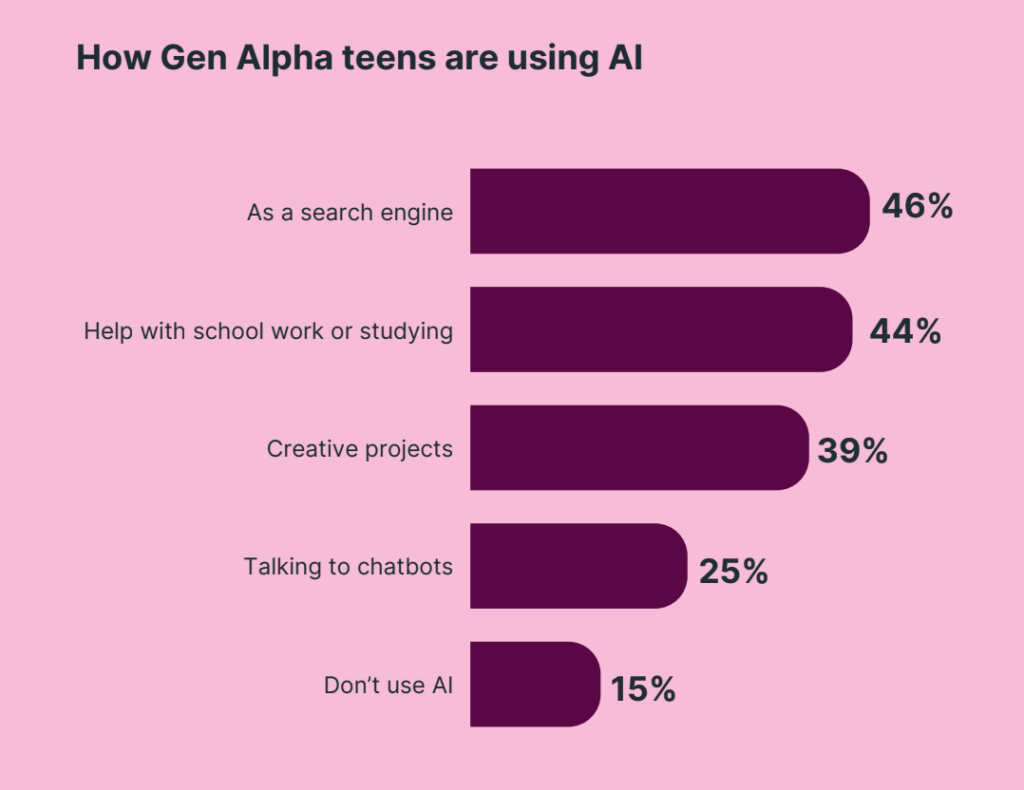
But Gen Alpha themselves are embracing AI with remarkable speed. Almost half (46%) are already using it as a search engine, adopting conversational queries and expecting nuanced, context-rich responses. A similar share (44%) turn to AI for help with schoolwork, appreciating its instant, judgment-free support and the immense access to knowledge it offers (although this also raises concerns about over-reliance on AI, and the risks of misinformation).
Importantly, Gen Alpha isn’t just consuming AI; they’re creating with it. Over a third (39%) are experimenting with AI-generated images and videos, or even building websites and apps. This democratization of creativity is giving teens new ways to explore and express themselves without traditional barriers.
Perhaps most strikingly, some are engaging with AI on a personal level. One in four parents say their teen regularly chats with AI, often for advice, companionship, or emotional support. While these interactions can provide a safe, judgment-free space, they also introduce risks, from dependency and blurred boundaries, to exposure to harmful content.
For brands, this behavior creates both opportunity and responsibility. Gen Alpha’s engagement with AI opens new ways to connect meaningfully, whether through educational tools, creative platforms, or supportive experiences. The challenge will be to innovate in ways that empower this generation while safeguarding their well-being and privacy.
24/7 connectivity
Unlike their parents, who most likely acquired their first cell phones in their mid to late teens and were well into their 20s before smartphones became commonplace, Gen Alpha has been immersed in technology from birth. They are a fully tech-enabled generation, with access to a plethora of devices.
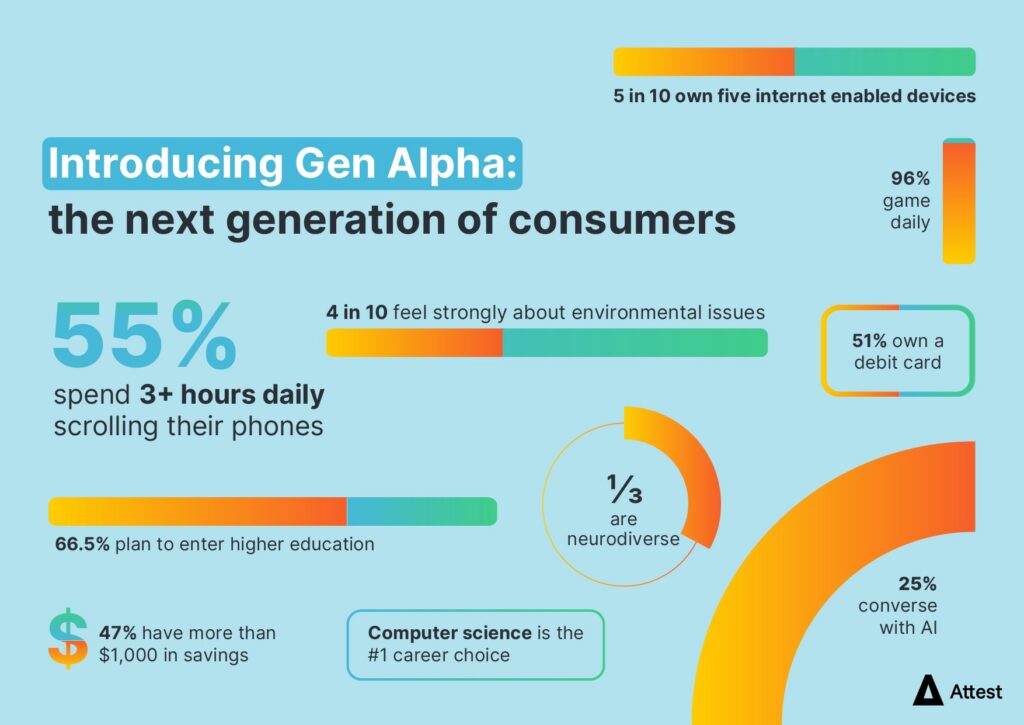
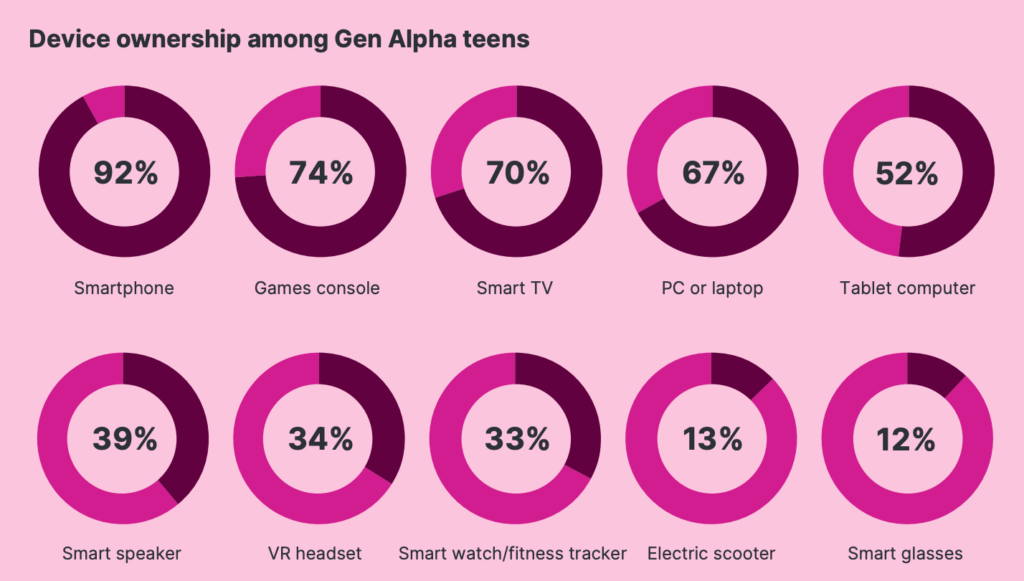
Highlighting the scale of this connectivity, a massive 92% of 15- to 16-year-olds own a smartphone, making it the central hub for communication, entertainment, and information. Unsurprisingly, it’s rarely out of their hands, with the majority scrolling their phones for more than three hours a day.
The next most-owned device is a games console. Just over 74% have one, showing the near-universal popularity of gaming among Gen Alpha teens, regardless of gender or background. In 2015, Pew found boys were 42% more likely than girls to play video games, but our research uncovers that, today, gaming has become a key way for teens to socialize with peers, and is no longer heavily gendered.
Looking at ownership of other devices, 70% of Gen Alpha teens have a smart TV, 67% have a PC or laptop, and 52% have a tablet computer. With over half of American teens juggling five internet-enabled devices, they are essentially always “online.” This constant connectivity shapes how they learn, play, and socialize and underscores the importance of digital well-being. For brands, understanding this environment is key to engaging responsibly with a generation for whom the digital world is inseparable from everyday life.
Many within this youngest generation of consumers are also engaging with other IoT devices, with nearly 40% using smart speakers, and a third using smart watches/fitness trackers, as well as VR headsets. A further 12% own smart glasses. However, ownership of wearables is significantly more common among higher income households, highlighting a tech divide that could have wider implications – something we’ll explore in the next section.
Careers in computer science are the top choice
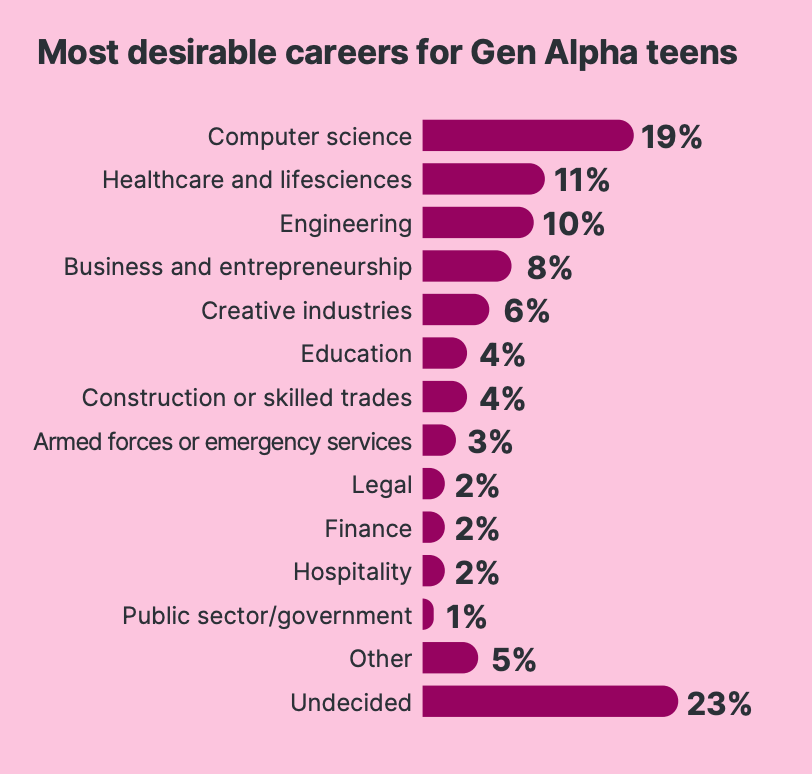
With AI posing a threat to many jobs, pursuing a career in computer science appears to be a safe bet for this Autonomous Generation. It’s the top choice for Gen Alpha teens, 19% of whom say they want to study the subject or work in the sector.
It’s a clear step-change from 2020, when half of 15-year-olds expected to embrace one of 10 traditional career roles – such as a doctor, teacher, lawyer, vet, or police officer [source: OECD]. This change demonstrates the differing outlooks of Gen Z and Gen Alpha, the latter being true AI natives who are intent on building their own digital future.
With that said, the data shows that interest in computer science is strongly linked to household income. Nearly a third of 15- and 16-year-olds from homes earning over $100k per annum are interested in this field, in comparison to just 6% of those from households earning less than $50k.
Teens from lower income households are more likely to favor careers in healthcare and life sciences (11%). However, the majority don’t know what sector they want to work in: 37% are undecided. That’s in contrast to just 13% of Gen Alpha teens from higher income homes.
This disparity appears to relate to how much teens are influenced by career guidance. Whereas 44% of Gen Alpha teens from higher socioeconomic backgrounds are steered by teachers and mentors in regards to their futures, only 27% of their peers from lower-income backgrounds are influenced by them (the same applies to advice from parents: 55% versus 37%). Lower-income teens are also less likely to consider job market opportunities in their decision-making, with 18% factoring this in, compared to 34% of higher-income peers.
Despite these differences, the majority of Gen Alpha teens from lower income homes (57%) do plan on going to college, while 18% intend to get a job after high school. Gen Alpha teens from higher socioeconomic backgrounds are extremely likely to go on to higher education (73%, with only 12% planning to directly enter the workforce).
Overall, 67% of the demographic plan to enter higher education, potentially making Gen Alpha more highly educated than their Gen Z predecessors. Approximately 52% of Gen Z over the age of 18 have some college education or are currently in college [source: U.S. Census Bureau].
What this means for brands
As architects of the digital future, Gen Alpha isn’t passively consuming content – they’re using AI to build, create, and even connect emotionally. This sets them apart from Gen Z, and it means they’ll expect very different kinds of brand interactions.
Gen Alpha is on-demand by nature. They want experiences that are instant, interactive, personalized, and available across multiple touchpoints. That requires a shift away from single-platform tactics toward an always-on, omnichannel approach. More importantly, it means moving beyond platforms to create owned communities where consumers don’t just engage, but co-create and sustain the ecosystem. Integrating open technology – from open-source software to open-design systems and open innovation – will be key to elevating co-creation strategies with this autonomous audience.
Chapter 2: Wielders of purchasing power
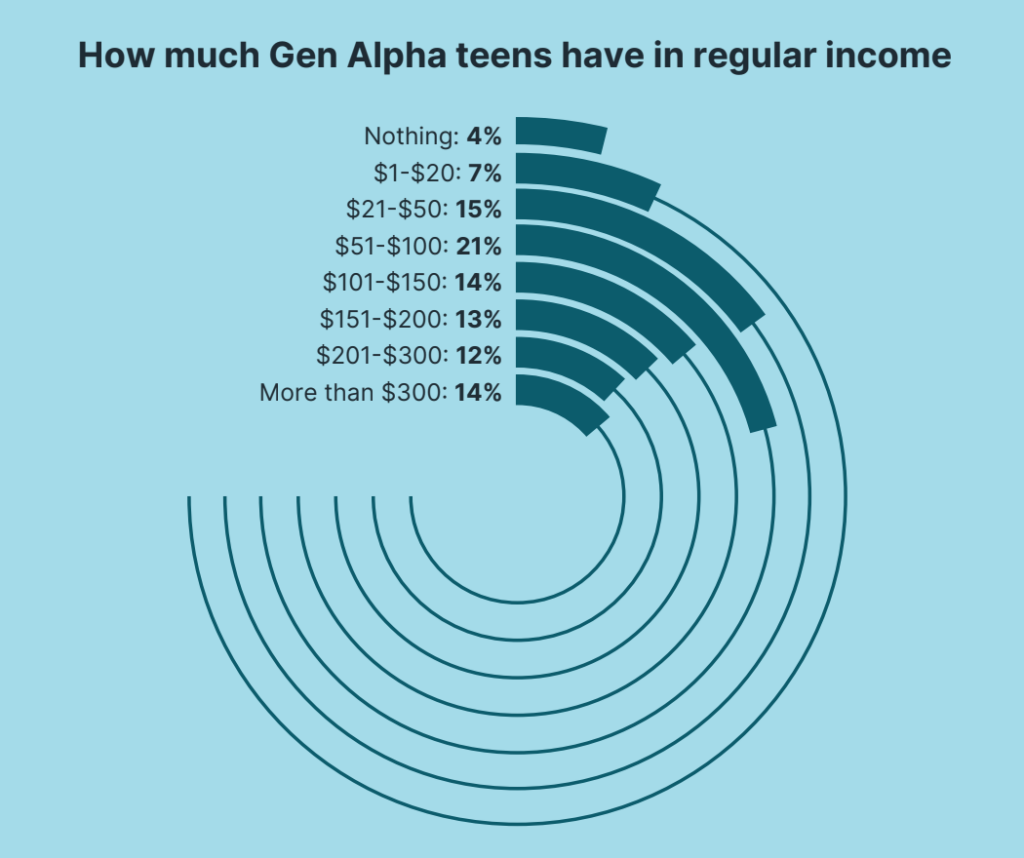
When it comes to spending power, Gen Alpha isn’t waiting until adulthood. More than half (53%) of teens receive over $100 a month, with many already earning their own money through part-time jobs. This early financial independence plays a powerful role in Gen Alpha’s growing sense of autonomy, shaping how they make choices, express their identity, and engage with brands.
The most common amount received is $51–$100 per month (21%), though the spread is wide. Nearly 14% of teens receive more than $300 monthly, while 12% get up to $300, and 13% up to $200. Another 14% fall into the $101–$150 range. Just 7% receive under $20, and only 4% have no funds at all.
This income comes from a mix of sources: 26% of Gen Alpha teens have part-time jobs, 20% earn through tasks like babysitting or dog walking, 58% still receive parental allowances, and nearly half are paid for chores. Teens from higher socioeconomic backgrounds are far more likely to make money through tutoring: 13% from households earning $100k+ compared with just 1% from those under $50k.
Among teens earning independently, a quarter are bringing in more than $300 per month, with a further 17% earning $201–$300. For many in this age group, who typically don’t yet face major financial responsibilities, this represents significant spending power.
Gen Alpha’s early embrace of earning and managing money could signal a new wave of micro-entrepreneurs. For brands, the opportunity lies in creating safe, tailored platforms that help teens monetize their skills, grow their finances, and flex their independence.
Strong purchasing patterns
Gen Alpha’s financial autonomy means they’re already a valuable consumer group, with disposable income they’re eager to spend, both online and in store.
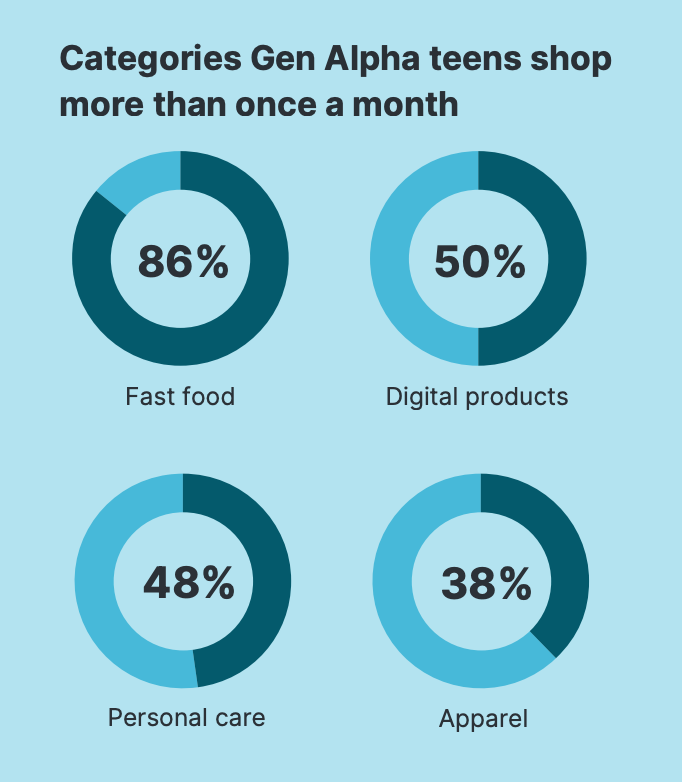
Fast food tops the list for Gen Alpha spending: 28% of 15- to 16-year-olds eat at fast food outlets or order takeout multiple times a week, while another 28% do so weekly. These purchases reflect a high level of independence, with many meals funded by teens themselves and consumed outside the home.
Digital products are another key area of spend. More than one in five (21%) make in-game purchases, buy apps, or download games weekly. A further 30% purchase digital items a few times a month, and 18% buy monthly. Unlike previous generations, Gen Alpha sees little difference between digital and physical goods when it comes to value.
Personal care and cosmetics are also popular: 18% shop weekly in this category, 30% multiple times a month, and 25% once a month. These small but regular purchases appear to help teens assert independence and shape their autonomous identities through brand choices.
Apparel is bought slightly less frequently, with 13% shopping weekly for clothing and shoes, 25% a few times a month, and 21% monthly. Taken together, the data shows that Gen Alpha is an active consumer group, making consistent purchases across a wide range of categories.
Crucially, these aren’t just transactions. Whether they’re buying snacks, digital items, or beauty products, Gen Alpha teens are making autonomous choices – building financial confidence, honing decision-making skills, and expressing who they are.
A helping hand from mom and pop
Gen Alpha’s autonomy doesn’t mean they’re going it alone. In fact, our data shows that while teens are taking early steps toward independence – from managing their own money to planning their futures – parental support still plays a critical role, particularly around big milestones like college, driving, and moving out.
This likely reflects the realities of a tough economic climate, where family support has become an essential springboard. The result is an interesting duality: Gen Alpha is both the most self-directed generation yet, and one that can realistically lean on a safety net, freeing up their disposable income and decision-making capacity to shape their own priorities.
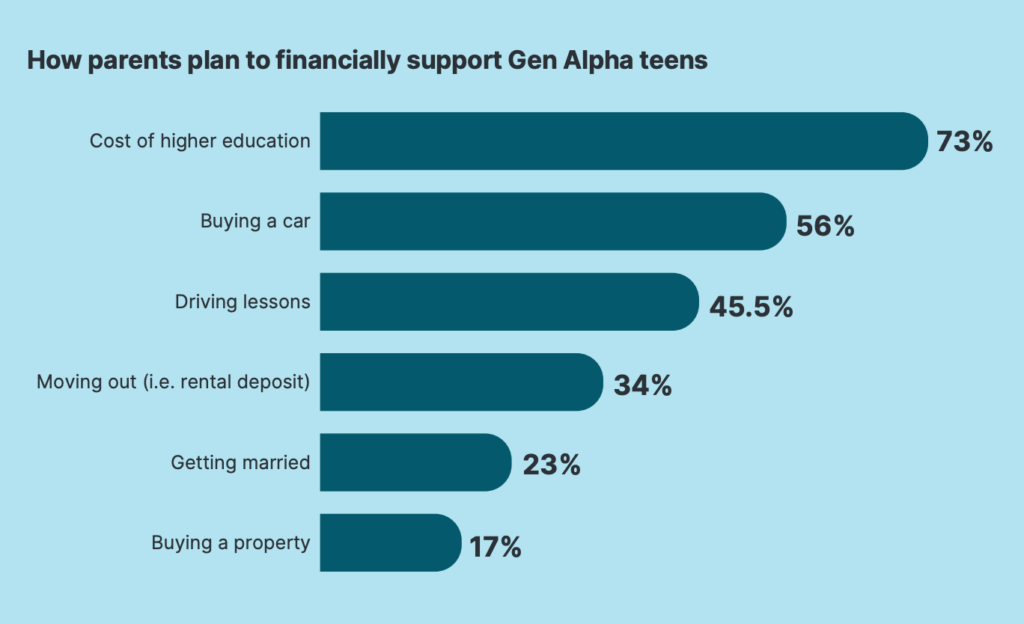
So what does this support look like? Funding college is something most parents plan to help with – although only 13% of teens will receive money from a dedicated education fund (such as a 529 or Coverdell ESA). Overall, 73% say they’ll contribute to the cost of higher education, rising to 83% among higher-income parents and 62.5% among lower-income families.
Cars remain a classic symbol of independence, and this Autonomous Generation looks set to follow in the footsteps of Gen Z when it comes to hitting the road – despite long-term declines in teen licensing since the 1980s. Nearly half (46%) of parents plan to help pay for driving lessons, while 56% will help fund a car purchase.
When it comes to home ownership, however, support drops sharply. Just 17% of parents intend to help their teen buy a property, with only a small advantage for more affluent families (21% versus 14%). Renting is more accessible: 34% of parents say they’ll help cover moving costs for teens who choose to rent.
For those who stay at home, the picture is even more favorable. A third of parents won’t charge their working children any rent at all, while 46% will only ask them to contribute to bills. Just 20% will be expected to pay rent, and of those, 12.5% will also cover household expenses.
Importantly, these patterns don’t vary much by income, meaning the majority of Gen Alpha teens will have the opportunity to save by living at home longer, leaving them with more disposable income for things like eating out, entertainment, and travel.
What this means for brands
Tapping into Gen Alpha’s purchasing power – both now and as they grow into adulthood – depends on understanding their deep sense of independence, individuality, and identity. Even as teens, the Autonomous Generation has begun to establish strong shopping habits. And with increasing financial freedom, they can make deliberate brand choices that reflect who they are and what they stand for.
This is a formative stage for identity and peer belonging, which means brands that embody clear values or lifestyle ideals will be best placed to capture their imagination. Looking ahead, success will come from enabling Gen Alpha’s autonomy, even while many in the cohort continue to live at home. That could mean tailoring products for multigenerational households or developing financial tools that support their path to independence, from their first big purchases to future home ownership.
Chapter 3: Masters of money
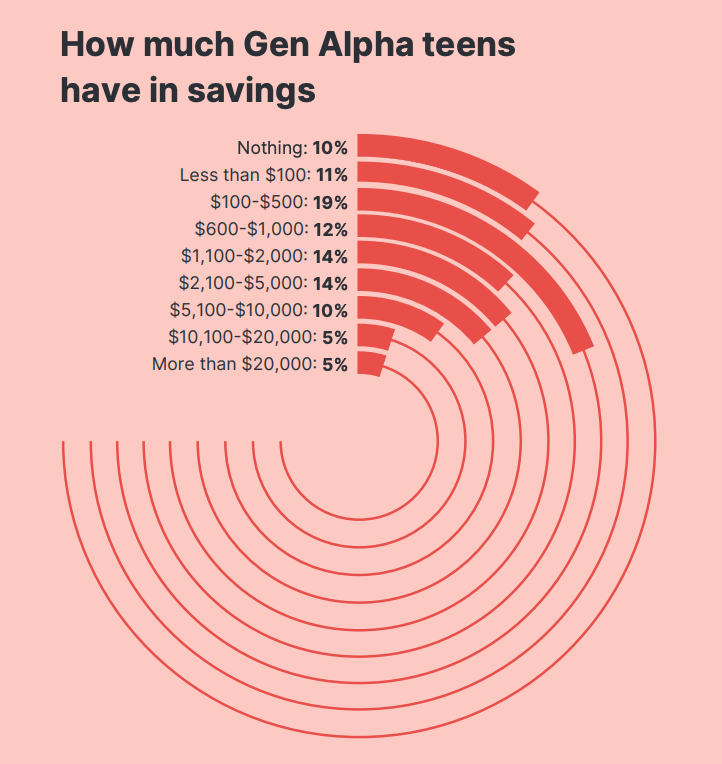
On the whole, Gen Alpha teens are entering adulthood on a strong financial footing: 48% have more than $1,000 in savings behind them. This suggests they could be more financially switched on than their Gen Z predecessors, only 31% of whom had more than $1,000 saved up at a similar age in 2017 [source: Ipsos].
Appearing to be a generation of savvy savers, their attitude to money could be shaped in part by their parents, who are typically Millennials or at the bottom end of Gen X. This cohort of parents has lived through multiple economic crises, and understand the importance of financial security. Either way, it bodes well for the future of Gen Alpha: a University of Kansas study found that saving from an early age often leads to broader asset-building, including stocks and retirement accounts.
At the top end of the savings scale, 10% of 15- and 16-year-olds are sitting on a pot of more than $10,000, which includes money that is held by a parent, or in trust until adulthood. Only 10% have not amassed any savings, with the single largest percentage (19%) having saved up between $100-$500.
As expected, household income makes a clear difference: teens from homes earning $100k plus are nearly 4x as likely to have savings over $10k as those from households netting less than $50k (15% versus 4%).
Similarly, the $5,100-$10,000 bracket is dominated by teens from higher income households (16% versus 3%). Overall, Gen Alpha teens from higher socioeconomic backgrounds are most likely to have savings of $2,100-$5,000 (19%), while those from lower income households are most likely to have a savings pot of $100-$500 (25.5%).
Teens from lower income homes are considerably more likely to not have any savings (19% versus 3%), or have less than $100 in savings (19% versus 3%). They’re also less likely to have access to children’s savings products – a gap we’ll explore further in the next section.
Gaining an early introduction to banking
The majority of Gen Alpha teens already have their own bank account, which is good news for their financial literacy. Having a bank account helps transform abstract financial concepts – like budgeting, saving, and compounding interest – into real-world practice. As such, schools across 36 US states now mandate financial literacy for graduation.
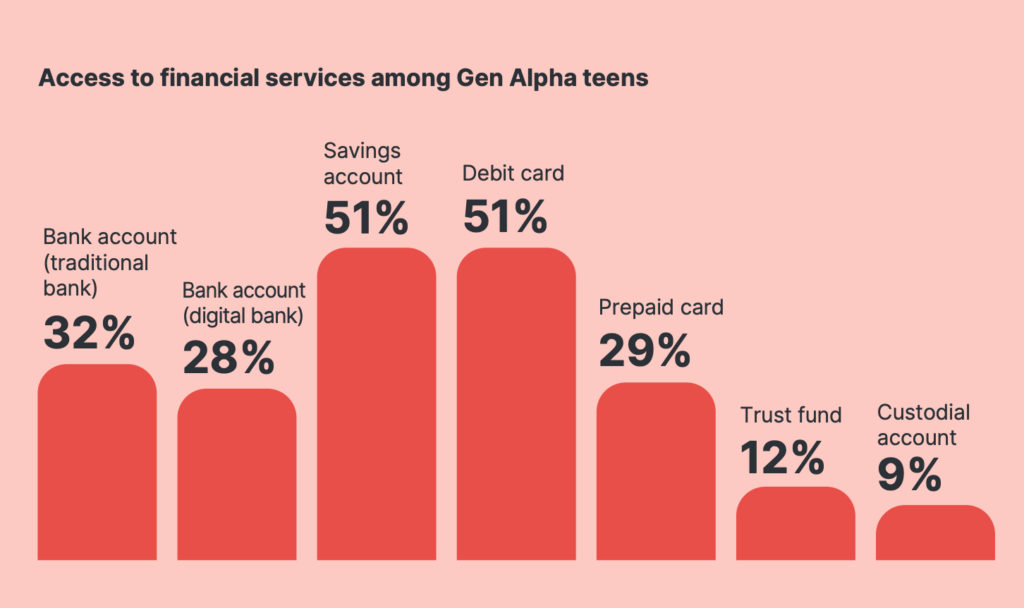
Nearly a third of Gen Alpha teens have an account at a traditional bank, while 28% have a digital account, and 51% have a dedicated savings account. Just over half (51%) own debit cards, giving them free access to their money, while 29% have pre-paid cards allowing them to spend up to an agreed limit.
Although access to financial services is reasonably strong among 15- and 16-year-olds as a whole, the data does highlight disparities between socioeconomic groups. Teens from homes earning more than $100k are more likely to have bank accounts: 39.5% have an account at a brick and mortar bank versus 22.5% of teens from households earning less than $50k, while 33% have a digital account (versus 23%).
Correspondingly, debit card access is also lower among teens from less affluent households: 45% have them, in comparison to 54% of those from higher income households. But the largest gap can be seen when it comes to savings accounts: only 35% of teens from lower socioeconomic backgrounds have one versus 64% of teens from higher ones.
The most popular savings vehicle behind a savings account is a trust fund, which 12% of 15- to 16-year-olds will have access to once they reach the age of majority. Again, teens from higher income families are significantly more likely to have a trust fund than their peers from lower income households (17% versus 7%).
What this means for brands
Brands have a clear opportunity to build on Gen Alpha’s growing financial literacy by offering tools and initiatives that help deepen these skills. With many already saving for the future, products that support budgeting, investing, and goal tracking will resonate strongly. And this isn’t just the domain of fintechs and banks; any brand can play a role in financial education, especially through partnerships with schools, platforms, and financial providers.
By aligning brand value with financial empowerment, companies can do more than sell – they can equip Gen Alpha for the future, earning long-term trust in the process. And because financial independence is closely tied to mental and emotional well-being, supporting financial literacy also means helping this generation build resilience – a theme we’ll explore further in this report.
Chapter 4: Developing an independent worldview
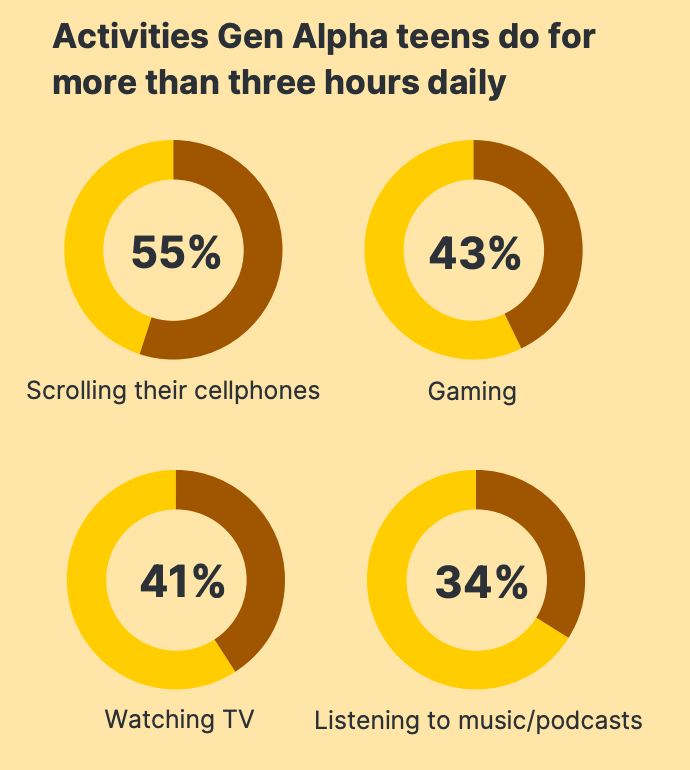
Gen Alpha teens spend more time scrolling their phones than on any other leisure activity. More than half (55%) spend over three hours a day on social apps like TikTok, YouTube, and Snapchat – and that’s just what parents estimate.
The sheer volume of content they consume exposes them to a broader spectrum of ideas, cultures, and lifestyles than previous generations encountered at the same age. They can instantly access news and commentary from around the world, and hear directly from independent creators, activists, and niche communities.
By providing a window beyond mainstream narratives, social media helps this Autonomous Generation form their own independent worldview. It means they’re not only more socially aware, but also more empowered to spread ideas, start trends, and shape cultural conversations – in ways that were once the domain of mainstream media. However, this constant connectivity also has some negative effects, which we’ll look at shortly.
Our data breaks down exactly how much time 15- and 16-year-olds spend online: 29% spend 1–2 hours on social media daily, 28% spend 3–4 hours, and 27% spend more than four hours. Only 13% spend less than an hour a day, and just 2% say they don’t use social media at all.
Much of their remaining leisure time is spent on other digital activities. Gaming comes next, with 43% spending more than three hours a day playing – including 20% who game for over four hours. Another third spend a more moderate 1–2 hours. But gaming is more than entertainment; it’s also a social lifeline, connecting teens with peers and players worldwide.
TV still plays a role, though less dominant than for older cohorts. Among Gen Alpha, 39% watch 1–2 hours per day, 27% watch 3–4 hours, and 14% watch more than four hours. By comparison, Gen Z are heavier binge-watchers, with 23% spending 4+ hours daily streaming TV [Attest Media Consumption Tracker].
Listening to music and podcasts is also common, but less time-intensive. The largest share (39%) listen for 1–2 hours a day, 20% listen for 3–4 hours, and 14% for more than four.
Passionate about the animals and the environment
Gen Alpha’s use of social media strongly shapes both their awareness of social issues and their level of political engagement. Algorithms and search functions make it easier to follow topics that interest them, while social media lowers barriers to political participation.
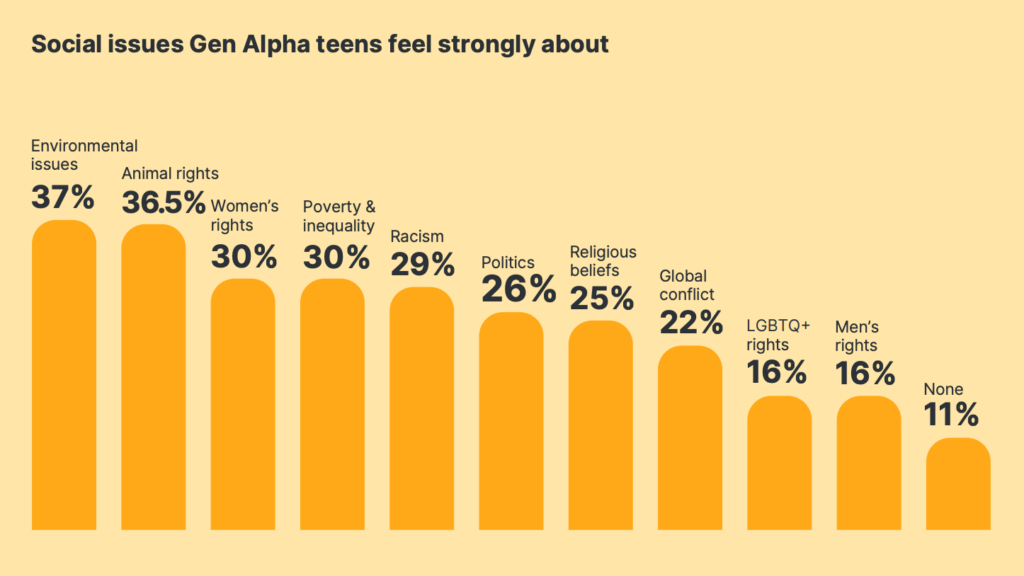
Thanks to this, Gen Alpha teens are engaging in digital activism by signing petitions, sharing posts, donating to causes, and joining online campaigns – all before they’re old enough to vote. Our data shows that 15- and 16-year-olds are rapidly adopting causes they care about. Only 11% of parents selected ‘none’ when we asked them what issues interest their teen.
By contrast, nearly 37% of Gen Alpha teens are said to care deeply about environmental issues and animal welfare, the two leading causes. This interest is easy to understand: they’re growing up against the backdrop of climate change, with wildfires, floods, and droughts often appearing in their feeds – and sometimes in their own communities. It figures that environmental action feels like a survival issue, not a distant concern.
Other issues also resonate. Around 30% of Gen Alpha teens feel strongly about women’s rights, poverty and inequality, and racism. Social media acts as an amplifier here, giving teens unfiltered access to the lived experiences of women, marginalized groups, and those facing hardship.
Beyond this, 26% show interest in politics more broadly, 25% in religion, and 22% in global conflict. Engagement with LGBTQ+ rights is lower than might be expected, with 16% highly engaged. The same proportion (16%) express interest in men’s rights – a complex area that spans both legitimate issues affecting boys and men, and more controversial associations with the manosphere and polarizing figures like Andrew Tate. Further research is needed to understand which concerns matter most to this cohort.
Vulnerable to misinformation
Gen Alpha’s high digital engagement fuels independent thinking, but it also comes with risks, particularly around misinformation.
The speed and scale of social media means that teens can encounter dozens of posts on a single topic within minutes, with little time for fact-checking before content is consumed or shared. And because social platforms flatten hierarchies, expert sources and unqualified opinions often appear side by side with equal weight.
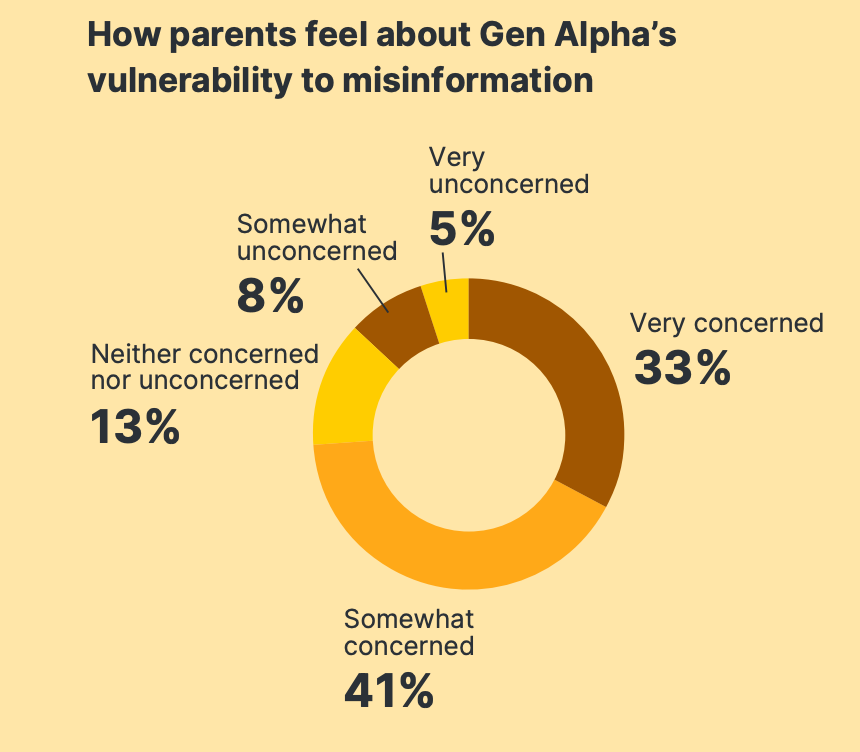
It’s no surprise, then, that parents are worried: 71% say they’re concerned about their teen’s vulnerability to online misinformation, including a third who are “very concerned.”
For brands, this vulnerability has direct consequences. False claims about a product’s safety, ethics, or ownership can spread rapidly – especially in easily shareable visual formats – and can spark boycotts or backlash if not addressed quickly. Partnerships add further risk: if an influencer is linked to misinformation, even unrelated to your brand, teens may still perceive an association. Brand safety now requires assessing not just audience reach but also reputational risk.
Repeated exposure to misinformation can also erode trust more broadly, making Gen Alpha more skeptical of brands. To counter this, companies need to demonstrate transparency and credibility, showing how products are made, sourcing verified data, and responding swiftly to false claims. In doing so, brands can position themselves as reliable voices in a noisy, often misleading digital landscape.
What this means for brands
Gen Alpha’s independent worldview means they might be more skeptical of corporate or top-down messaging, or more inclined to trust independent voices and grassroots movements. As this Autonomous Generation prefers to form their own conclusions rather than be told what to think, brands should focus on presenting balanced information and choices – rather than delivering one-way messages.
Organizations working in areas such as youth mental health, education, or online well-being should dive deeper into the nuances of how Gen Alpha engages with complex social issues. Understanding the subtle patterns behind interests in topics like men’s rights, global conflicts, or social justice allows brands to design interventions and communications that are both effective and responsible.
Chapter 5: Champions of diverse thinking
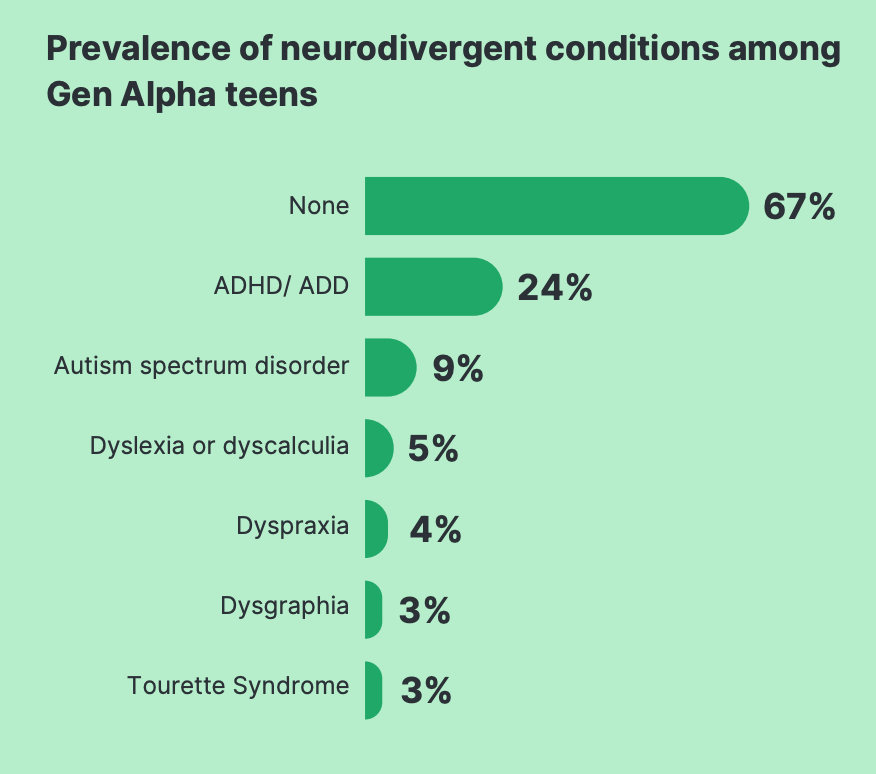
It’s estimated that 10–20% of the global population is neurodiverse [Deloitte], yet the share appears significantly higher among Gen Alpha. In our survey, one in three parents said their teen has either been diagnosed with a neurodiverse condition or is being assessed.
This rise is likely linked to greater awareness. Today’s 15- and 16-year-olds are far better informed about neurodiversity than previous generations, thanks in large part to social media. Teens regularly encounter firsthand accounts of life with ADHD, autism, dyslexia, and other conditions. Short-form content in particular makes everyday experiences – from struggles with focus to sensory overload – relatable and digestible, helping teens both empathize with others and recognize traits in themselves.
The openness of influencers and creators discussing their own diagnoses has also reduced stigma, enabling neurodiversity to be recognised as part of the spectrum of human experience. This visibility makes it easier for teens to seek support, share their stories, and be open with peers.
According to our data, ADHD/ADD is the most common form of neurodiversity among Gen Alpha: 24% of parents report their teen has it. Autism is the next most-named condition, with 9% of respondents saying their teen is on the Autism spectrum. Other conditions are less common, with dyslexia and dyscalculia affecting around 5% of teens.
These findings highlight just how widespread neurodivergence is among today’s youth. With one in three parents reporting a confirmed or suspected neurodivergence, it’s clear that differences in how young people think, learn, and process information are more recognized than in previous generations . For educators, policymakers, and brands, this is a call to action: neurodiverse perspectives are becoming central to teen culture and experience, and inclusivity must be built in.
A focus on mental health
Just as social media has increased awareness of neurodiversity, it has also opened up conversations around mental health. As a result, Gen Alpha teens are more willing to acknowledge and talk about their struggles than older generations were at the same age.
It’s also important to remember the lasting impact of COVID-19. This portion of Gen Alpha were just 10–11 when the pandemic began, hitting them at a formative stage of adolescence. The disruption has left long-term marks on their education, social development, worldview, and, crucially, their mental health.
Research has uncovered spikes in adolescent anxiety, loneliness, and depression since the pandemic – effects that many teens are still grappling with. Added to this, problematic social media use (cyberbullying, comparison culture, and information overload) is strongly linked to higher rates of anxiety, depression, and low self-esteem.
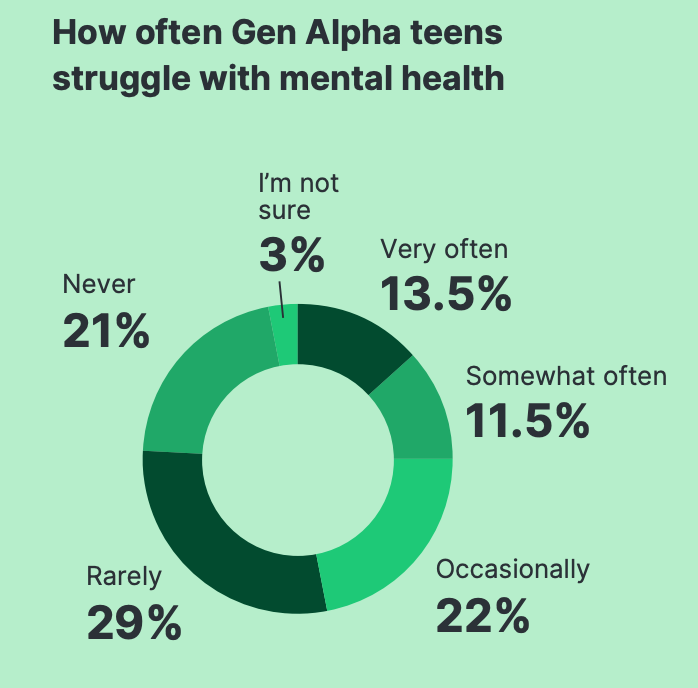
Our data reflects these challenges: a quarter of Gen Alpha teens often struggle with their mental health, with 13.5% struggling “very often” and 11.5% “somewhat often.” A further 22% “occasionally” experience poor mental health, meaning nearly half of this cohort faces mental health challenges to some degree. Only 21% have “never” struggled, while 3% of parents say they don’t know if their teen has faced problems.
Strikingly, income plays a role. Teens from households earning over $100k are more than twice as likely to struggle “very often” with mental health compared to those from families earning under $50k (19% vs. 9%).
For brands, these heightened needs demand empathy, authenticity, and responsibility at every touchpoint. Gen Alpha expects brands to genuinely care about well-being – not just sell products. In advertising, that means showing real, unfiltered content that normalizes struggle, rather than glossy portrayals of “perfect lives.”
A new take on socializing and having fun
When it comes to unhealthy lifestyle choices such as drinking and drug taking, early evidence suggests this generation is extending – and perhaps accelerating – the moderation trend already seen in Gen Z. For today’s teens, well-being, control, and online connection seem to matter more than the risky experimentation that once defined youth culture.
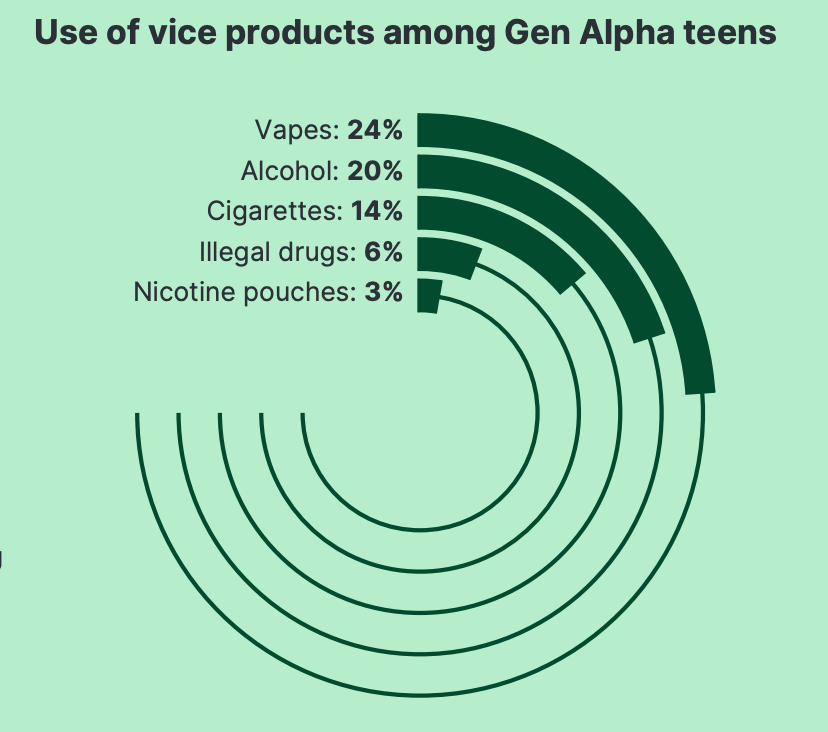
According to parents, one in five 15- and 16-year-olds (20%) have tried alcohol – a sharp contrast with older generations at the same age. In 2000, for example, 71% of 10th graders had tried alcohol but that figure has been steadily declining since [source: Monitoring the Future].
Meanwhile, just 14% of teens have tried cigarettes, compared with 55% of 10th graders in 2000. Vaping stands out as the most common vice among Gen Alpha teens, with nearly a quarter having tried it. This may reflect vaping’s accessibility and its positioning as a fashionable, discreet, and tech-enabled alternative to cigarettes.
Illicit drug use, however, remains minimal among this age group, with 6% of parents reporting that their teen has tried drugs (for reference, 44% of 10th graders in 2000 had tried marijuana). This lower figure reinforces the idea that experimentation with substances is no longer central to teenage identity or socialising.
Although Gen Alpha teens are still under the legal age to purchase alcohol and tobacco, these figures point to a deeper cultural shift rather than just legal restriction. Unlike their parents’ generation, they do not view drinking and smoking as essential to fitting in. Instead, Gen Alpha teens are finding digital-first ways to connect and bond: multiplayer gaming, streaming platforms, and social media communities have become the new “social lubricants,” providing shared excitement and status without the risks tied to alcohol or cigarettes.
What this means for brands
Gen Alpha is coming of age with a fundamentally different set of social habits, values and priorities. Their reduced interest in drinking and smoking is not just about risk aversion, it’s about a preference for finding connection, identity, and rebellion in digital spaces instead. It also reflects their understanding of the importance for self-care, which results from higher awareness of mental health and neurodivergence.
To better align with Gen Alpha’s values, products and campaigns should emphasise health, balance, and authenticity. Bands that facilitate digital-first bonding – whether that’s collaborative gaming, meme culture, or influencer-led communities – will be more relevant. However, given that too much time spent online does have associated risk factors, digital well-being should be a huge consideration. Brands have both an opportunity and a responsibility to shape healthier digital habits.
Conclusion
Gen Alpha isn’t just Gen Z 2.0 – they’re the Autonomous Generation, charting their own path and rewriting the rulebook in their own way. From architecting the digital future, to cultivating financial literacy, wielding purchasing power, developing independent worldviews, and thinking differently, this cohort is defining what it means to grow up in a hyper-digital, AI-native world.
That’s why brands can’t afford to simply repurpose strategies that worked for the last generation. What resonates with Gen Z won’t automatically click with Gen Alpha, who are more likely to see themselves as creators and collaborators than just consumers.
But while this report provides a snapshot of Gen Alpha today, the story is far from fixed. Their values, priorities, and behaviors will continue to evolve as they move through education, enter the workforce, and gain greater financial independence.
Ongoing research is essential to keep a pulse on this generation as they mature. Attitudes toward technology, money, well-being, and identity are all shifting at speed – and what resonates with a 16-year-old in 2026 may not resonate with a 20-year-old in 2030. For brands, this means building agility into their strategy: listening often, testing assumptions, and adapting as new signals emerge.
The biggest risk for researchers is treating Gen Alpha as a fixed stereotype rather than a dynamic, diverse group of individuals. Assumptions can lead to missteps, missed opportunities, and even broken trust. By committing to rapid, yet continuous insight gathering, brands can ensure they’re not just keeping up with Gen Alpha, but building the kind of authentic, lasting relationships that will stand the test of time.