
Achieving product-market fit in food and beverage means navigating a landscape where trends shift overnight. Gut health goes from niche to mainstream in months. Functional beverages explode while traditional sodas decline. Non-alcoholic drinks surge. What consumers wanted last year might not be what they want today.
Add fierce competition into the mix — private label sales hit $271 billion in 2024 and grew 3.9% while national brands managed just 1% — and differentiation becomes about survival, not just strategy. And products that don’t resonate with their target audience disappear fast.
The brands that succeed understand their consumers deeply, test constantly, and iterate based on real, actionable feedback. In this article, we’ll explore how you can achieve product-market fit (PMF) in F&B by following eight simple steps. You’ll learn what PMF looks like, why it matters, and how consumer insight helped one brand go from farmers market to a $1.95 billion acquisition.
TL;DR
In this article, you’ll learn how to:
- Define your specific target consumer to understand their behaviors, motivations, and unmet needs beyond basic demographics
- Validate your product idea through consumer research before investing heavily in production or distribution
- Test flavors, claims, and packaging with real consumers to understand what drives preference and purchase intent
- Use pricing research to find the balance between perceived value and what consumers are willing to pay
- Analyze actual purchase intent and demand signals, not just awareness or concept interest
- Iterate continuously based on consumer feedback as preferences shift and markets evolve
What is food and beverage product-market fit?
Product-market fit in the food and beverage industry is when a product consistently satisfies a clearly defined consumer need, and its concept, flavors, packaging, and price resonate enough to drive repeat purchases and sustained demand.
For a broader framework beyond the F&B category, you can also explore how to test product-market fit using consumer research, demand signals and feedback loops.
Why product-market fit matters in F&B?
Product market-fit is the foundation for sustainable business growth. It’s what determines whether a brand thrives or disappears. It matters in F&B because it’s an industry where consumers decide with their taste buds, wallets, and habits in seconds.
Here’s why product-market fit matters for F&B brands:
- It validates differentiation. PMF confirms that your product offers something consumers want that competitors aren’t delivering. Products without clear differentiation lose ground fast.
- It increases retailer acceptance. Retailers stock products that move. When you demonstrate strong consumer demand through purchase intent data and early velocity metrics, buyers take you seriously.
- It reduces the risk of failure. Testing concepts, flavors, and pricing with consumers before launch reveals what works and what doesn’t. Validating the PMF early helps you avoid costly mistakes, such as launching the wrong flavor profile or missing the price-value sweet spot.
- It improves budget allocation. When you know your product resonates, you can invest marketing dollars with confidence. PMF keeps spending focused on scaling what’s working, rather than trying to force demand for something consumers don’t want.
- It drives loyalty and repeat purchases. Products with genuine PMF create fans and advocates, not just one-time buyers. When consumers find a food or beverage that they enjoy and delivers on their expectations, they keep coming back.
How to achieve F&B product market fit step-by-step
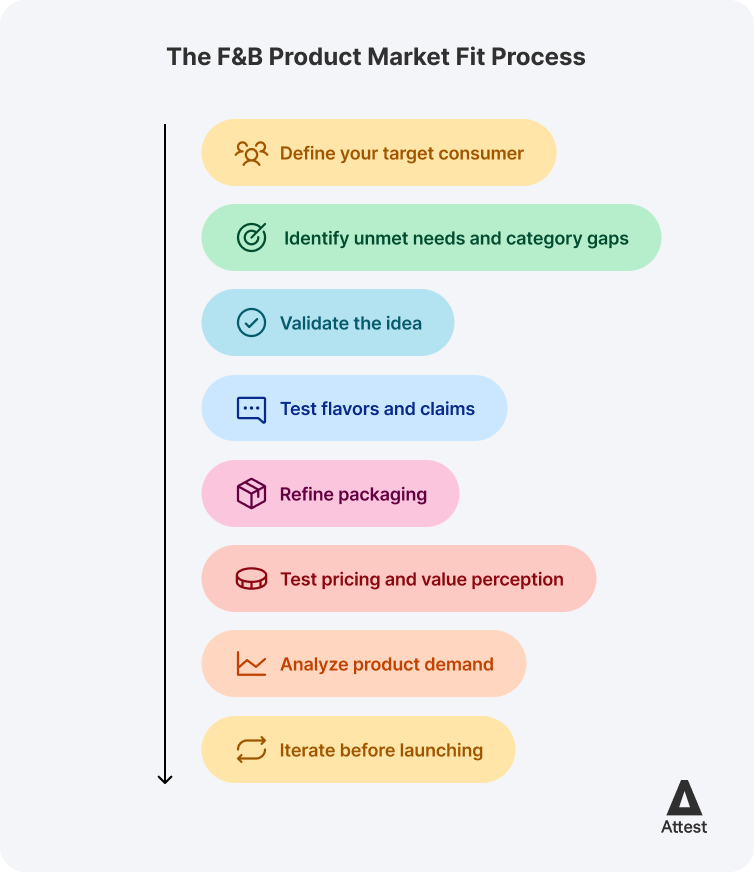
Achieving PMF isn’t guesswork — it’s a data-driven, systematic process that follows these steps:
- Define your target consumer
- Identify unmet needs and category gaps
- Validate the idea
- Test flavors and claims
- Refine packaging
- Test pricing and value perception
- Analyze product demand
- Iterate before launching
Now, let’s talk about how to execute each one.
1. Define your target consumer
To define your target consumer, use surveys, interviews, and behavioral research to understand their decision-making triggers. The more specific you are about who you’re serving, the easier it becomes to design and deliver a food or beverage product that solves a specific problem better than anything else. This is consumer profiling.
Consumer profiling goes beyond demographics to psychographics. What frustrates your target about current food and beverage options? When and where do they consume products in your category? What would make them switch from their current choice? What are they willing to pay more for?
Take Poppi, for example. The founders didn’t just target “health-conscious consumers”; they specifically targeted people who had to cut out soda due to health concerns. People who wanted prebiotic benefits without sacrificing enjoyment.
That precision mattered. By 2024, Poppi generated $500 million in revenue, and PepsiCo acquired the brand for $1.95 billion in March 2025.
“More than ever, consumers are looking for convenient and great-tasting options that fit their lifestyles and respond to their growing interest in health and wellness.” — Ramon Laguarta, Chairman and CEO, PepsiCo.
2. Identify unmet needs and category gaps
Once you know your target consumer, it’s time to spot what’s missing in the market. This isn’t necessarily about creating needs — it’s about finding ones that already exist but aren’t being addressed.
Start by running a market opportunity analysis to look for tensions between what consumers want and what’s currently available. Maybe they want convenience. Maybe they want healthier ingredients. Maybe they want authentic flavors in new formats.
For example, beverages that do more than quench thirst are on the rise. These drinks not only refresh but also offer “health benefits ranging from improved digestion to enhanced cognitive function.” As consumers have become increasingly health-conscious, the functional beverage market has increased in value, with the exponential growth revealing a market gap.
For your own food and beverage products, use consumer insights and research to validate gaps. Run surveys asking about pain points with current options, conduct focus groups to understand emotional drivers, and analyze data to see what people want but can’t find.
3. Validate the idea
After identifying your target customers and market gap, you have to prove your idea will actually drive sales. This is where F&B brands often waste money — they skip validation and go straight to production.
Test the concept through consumer research first. Describe your product idea without producing it to gauge interest, purchase intent, and price sensitivity. Does the concept resonate with your audience? Are people willing to pay what you need to charge?
Running F&B consumer testing at this stage helps teams understand whether the product idea, price point and positioning resonate with the people they actually want to reach.
For example, Liquid Death created its first commercial before even having the product, spending just $1,500 to make a video that gained over 3 million views within four months, and $3000 on Facebook ads to gauge demand. The video proved there was demand for the product long before heavy investment. When they launched in January 2019, the brand became Whole Foods’ fastest-selling water.
4. Test flavors and claims
Even if your core concept is sound, execution matters just as much — and there are nuances to what delights customers.
A ginger-turmeric wellness shot might work brilliantly, but a berry-mint flavor might fail. A marketing claim for “gut health” might resonate, but fall flat as “digestive support.”
Test variations with your target customers in focus groups, not internal teams. Use research methods to understand which specific flavors, formats, and messages work best and drive both interest and purchase intent.
A structured approach to testing food and beverage products can help teams compare flavors, packaging, claims and purchase intent before choosing what to launch.
Prebiotic brand Olipop studied flavor trends, tested small batches, and listened to their audience before introducing new flavors like Banana Cream and Lemon Lime. When their limited-edition Peaches and Cream flavor debuted as part of a Barbie collaboration, overwhelming demand made it permanent.
For functional claims, test believability and motivation. The same benefit framed differently can produce very different results. Test messaging in realistic contexts. Give people products to take home and use, then track their responses and satisfaction.
5. Refine packaging
Packaging needs to stand out, communicate what the product is, and justify the price. Miss any of these, and your F&B PMF suffers.
Test packaging aesthetic and comprehension with your target consumers. Show your product on the shelf with competitor products. Can they quickly identify your product and explain its benefits?
In 2024, Hostess conducted multiple rounds of consumer testing for their packaging redesign, using virtual store shelves to measure how the new packaging would stand out in retail environments. The testing revealed opportunities to modernize the look while strengthening the brand’s connection with younger customers.
Run shelf tests against competitors at different price points. Track purchase intent to see where packaging changes support cost without going too far. Premium packaging signals a premium product, but there has to be a balance.
6. Test pricing and value perception
Pricing isn’t just about covering costs. It’s also about finding what consumers perceive as fair or good value for the food and beverage you offer.
Use pricing research to test your price against perceived value. Try presenting your product at different price points and measure purchase intent, perceived quality, and willingness to recommend. You’re looking for a price that maximizes both volume and margin without eroding perceived value.
Oatly, the world’s first and largest oat drink company, positioned itself as a premium product with pricing that reflects both higher production cost and the brand’s sustainability emphasis.
On average, plant-based milks are more expensive than dairy, but Oatly’s premium is justified through the perceived value consumers place on health and environmental benefits.
7. Analyze product demand
Awareness and interest are nice to have, but purchase behavior is what matters.
Who’s most likely to buy? How often would they purchase? Are they switching from specific competitors? You can use consumer surveys to analyze product demand and understand purchase drivers and barriers.
Coca-Cola’s Freestyle machines can see which drinks are poured most often, what time of the day they are consumed, and how they vary by location.
With more than 50,000 in circulation, analyzing consumer purchase habits, the data often reveals opportunities to bring a popular beverage mix from the Freestyle machine to the store shelf. By collecting data from these self-service machines, Coca-Cola has since launched Orange and Vanilla Coke to meet consumer demand.
Taking the above into consideration, monitor repeat purchase intent by consumer segment. Understanding patterns among your customer base helps you to optimize product spending and forecast sustainable demand beyond initial trial.
8. Iterate and refine
PMF isn’t one-and-done — it keeps evolving. Markets shift, competitors adapt, and consumer preferences change.
To stay ahead, build feedback loops into operations by tracking customer reviews, social mentions, and support inquiries, and run regular consumer research. Refine products based on testing and insights.
For example, in September 2025, Starbucks unveiled several new protein beverages as part of its menu modernization strategy. Catching on to America’s growing demand for protein, the brand started testing protein beverages through the Starting 5 innovation program, gathering feedback from customers and baristas alike before innovating on their products.
Use consumer insight to determine what needs refining. If flavor testing shows your sweetness level is off, adjust it. If packaging testing reveals confusion about claims, simplify.
Category expansion and new product lines require just as much effort as the original launch. Just because your first SKU achieved PMF doesn’t mean that the rest will.
How to tell if your F&B product is finding market fit
Product-market fit doesn’t happen instantly. It happens in stages. Watch these early indicators to know whether or not your product is starting to resonate:
Strong flavor or format acceptance. When consumers consistently prefer your flavor profile or format over alternatives in blind tests, you’re onto a winner. Track scores, but also preference against competitors, likelihood of repeat purchase, and intent to switch.
Consumer insight research will reveal why they prefer it — whether it’s taste, texture, format, price, or a combination, so you can double down on what’s working.
Growing consumer demand. Purchase intent increases as awareness builds, and repeat purchasers build advocacy. You’re not getting one-time trials driven by curiosity or promotions anymore. People are coming back.
Track cohort behavior to see if month-one buyers are still interested three or five months later. Use consumer surveys to understand what’s driving repeat purchase and whether that’s strong enough to sustain without drastic changes.
Positive price-value alignment. Consumers believe and say your product is worth the price you’re charging, and price sensitivity remains low when you test price increases. If people continue buying, they’re interested in the benefits.
Use consumer insights to understand which specific benefits people are interested in — from functional claims and ingredient quality to convenience or taste.
High claims resonance. Your functional or experimental messaging resonates with consumers and drives purchase decisions. When you test different narratives, some outperform others.
Consumer research can identify which claims matter most to each customer segment, helping you to prioritize messaging and see how your positioning influences behavior.
Repeat purchase intent. Repeat purchases are vital to long-term brand growth because they foster customer loyalty, reduce new customer acquisition costs (easier to retain than acquire new ones), and increase customer lifetime value.
By surveying customers, you can identify the likelihood of repeat purchase intent before it shows up in sales data, and the variables that contribute to it.
From farmers market to $1.95 billion: How Poppi used consumer insight at every step
Poppi is a perfect example of what happens when brands use consumer insight to drive every action, and is one of the most compelling stories in American business.
Founded in 2016, Allison and Stephen Elsworth created a fruit-juice, sparkling-water, and apple-cider-vinegar drink in their kitchen to improve gut health. They began selling it at farmers’ markets before appearing on Shark Tank in 2018 and securing funding.
Allison and Stephen then rebranded from “Mother Beverage” to Poppi based on feedback — the name came off as medicinal and harsh — and repositioned the brand as a fun, healthy, and low-sugar prebiotic soda. They also leveraged social media marketing to match their audience’s playful tone, appearing on TikTok, creating founder-led videos, and collaborating with influencers.
Flavor development followed consumer preference data closely. Strawberry Lemon, Classic Cola, Root Beer, Orange Cream. All flavors consumers know and love, but with gut-health benefits.
Packaging was also updated to be more vibrant and colorful.
And it paid off. By 2020, they hit $13 million in revenue, and in 2025, the brand was acquired by PepsiCo for $2 billion.
While options from larger brands have continued to grow, smaller brands and private labels like Poppi have moved to meet evolving demand faster and position themselves at the forefront of consumer trends and needs.
They’ve surfaced critical consumer insights to create fresh products people love and are willing to pay more for. That’s product-market fit.
Achieving F&B product-market fit starts with reliable insights
The brands that achieve PMF don’t guess. They test concepts before production, validate claims with real consumers, understand price-value perception, and iterate based on feedback. They use consumer insights to make confident decisions rather than costly assumptions.
Attest helps F&B brands achieve product-market fit by providing fast, reliable consumer insights. Test product concepts, measure purchase intent, validate flavor preferences, understand pricing sensitivity, and analyze demand—all with access to real consumers who match your target audience.
Whether you’re validating a new product idea, refining an existing formula, or testing packaging variations, Attest gives you the insights to move forward confidently. Because the difference between products that achieve PMF and those that don’t often comes down to asking the right questions at the right time.
Starting with the right new product survey questions helps teams collect clearer feedback on taste, pricing, packaging, claims and likelihood to buy.