Millennials are often talked about as the generation caught in the middle, too old for TikTok trends, too young to have fully aged into traditional media habits. The data tells a different story. This is a generation still checking Facebook out of habit, still tuning into the radio on the way to work, and still reaching for a physical book at night, while also spending more combined time on social video than almost anyone else surveyed. Rather than picking a side between old and new media, Millennials have simply kept both.
This piece breaks that split-loyalty media day down medium by medium, drawing on further analysis of the underlying data behind Attest’s 2026 media consumption report. From live TV and streaming through to books, radio, podcasts and every major social platform, it shows what actually holds Millennials’ attention and how much advertising they’ll tolerate before switching off, the complete picture a brand needs before building a Millennial strategy.
TL:DR
- Millennials stream TV for around 2 hours a day, Netflix leads both organic and ad-tier use.
- Facebook, not YouTube or TikTok, is Millennials’ most-used daily social platform in both markets.
- Most Millennials multitask while watching TV rather than giving it full attention, primarily by scrolling social media.
- Social video still claims real time among viewers, running closer to 3-4 hours a day.
- More than half of Millennials listen to podcasts, with strong genre preferences spanning comedy, true crime and sport.
- The majority spend time reading each day, and physical books still outperform digital ones.
- Too many ads and repetitive ads are Millennials’ biggest turn-offs; AI-generated ads bother them far less by comparison.
A typical day in Millennials’ media diet
| Activity | US: time / reach | UK: time / reach |
|---|---|---|
| Live TV | 2h 00m / 76% | 1h 37m / 78% |
| Streaming service | 2h 24m / 83% | 1h 55m / 91% |
| YouTube | 2h 05m / 92% | 1h 30m / 91% |
| TikTok | 1h 25m / 66% | 1h 27m / 61% |
| Facebook/Instagram video | 1h 35m / 87% | 1h 17m / 86% |
| News sites/apps | 56m / 69% | 38m / 76% |
| Physical newspaper | 51m / 36% | 38m / 38% |
| Digital book | 1h 02m / 41% | 59m / 40% |
| Physical book | 1h 03m / 58% | 1h 04m / 64% |
| Radio | 1h 09m / 68% | 1h 14m / 70% |
| Music streaming | 1h 15m / 76% | 1h 11m / 80% |
| Podcast | 1h 10m / 60% | 1h 04m / 57% |
| Audiobook | 59m / 39% | 1h 01m / 37% |
Time shown is the average among people who actually use each format, not the whole population, reach shows what share of Millennials that is.

Streamed TV
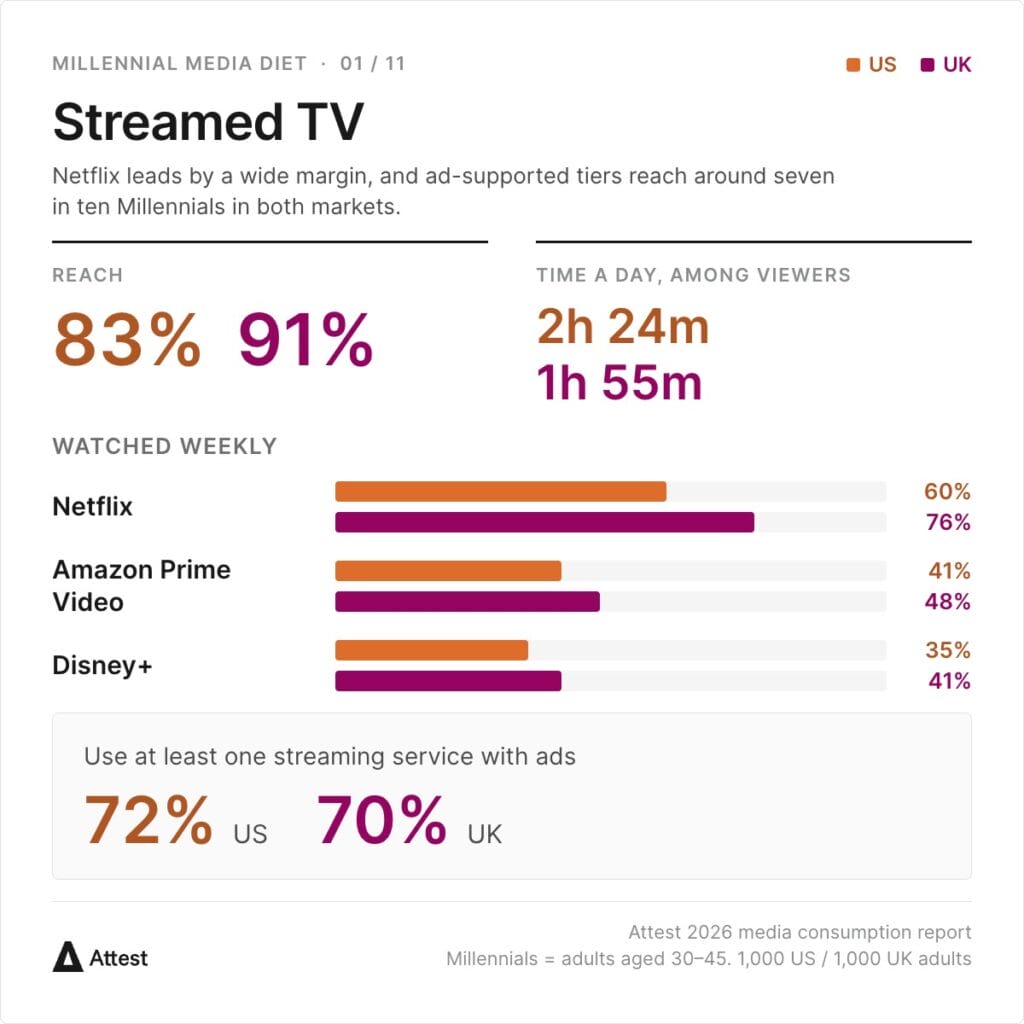
Eighty-three percent of US Millennials and 91% of UK Millennials use a subscription streaming service on a typical weekday, and among those who do, it claims 2 hours 24 minutes a day in the US and 1 hour 55 minutes in the UK. Streaming TV is a sticky habit, with 50% of US Millennials and 43% of UK Millennials saying they have trouble stopping once they start.
In terms of platforms, Netflix leads by a wide margin, watched weekly by 60% of US Millennials and 76% of UK Millennials. In the US, Amazon Prime and Hulu tie for second (41% each), with Disney+ close behind (35%). In the UK, Amazon Prime takes second (48%), followed by Disney+ (41%) and BBC iPlayer (36%).
Ad-supported tiers have real reach within this generation: 72% of US Millennials and 70% of UK Millennials use at least one streaming service with ads. Netflix’s ad tier leads in the US (41%), narrowly ahead of Amazon Prime (38%); in the UK, Netflix and Amazon Prime tie for the lead (43% each).
Given the choice, Millennials skip ads on streamed TV at a high rate: 62% always or usually do in the US, rising to 64% in the UK. The point at which advertising becomes excessive sits at roughly 14 to 15 minutes between ads in both markets.
Live TV
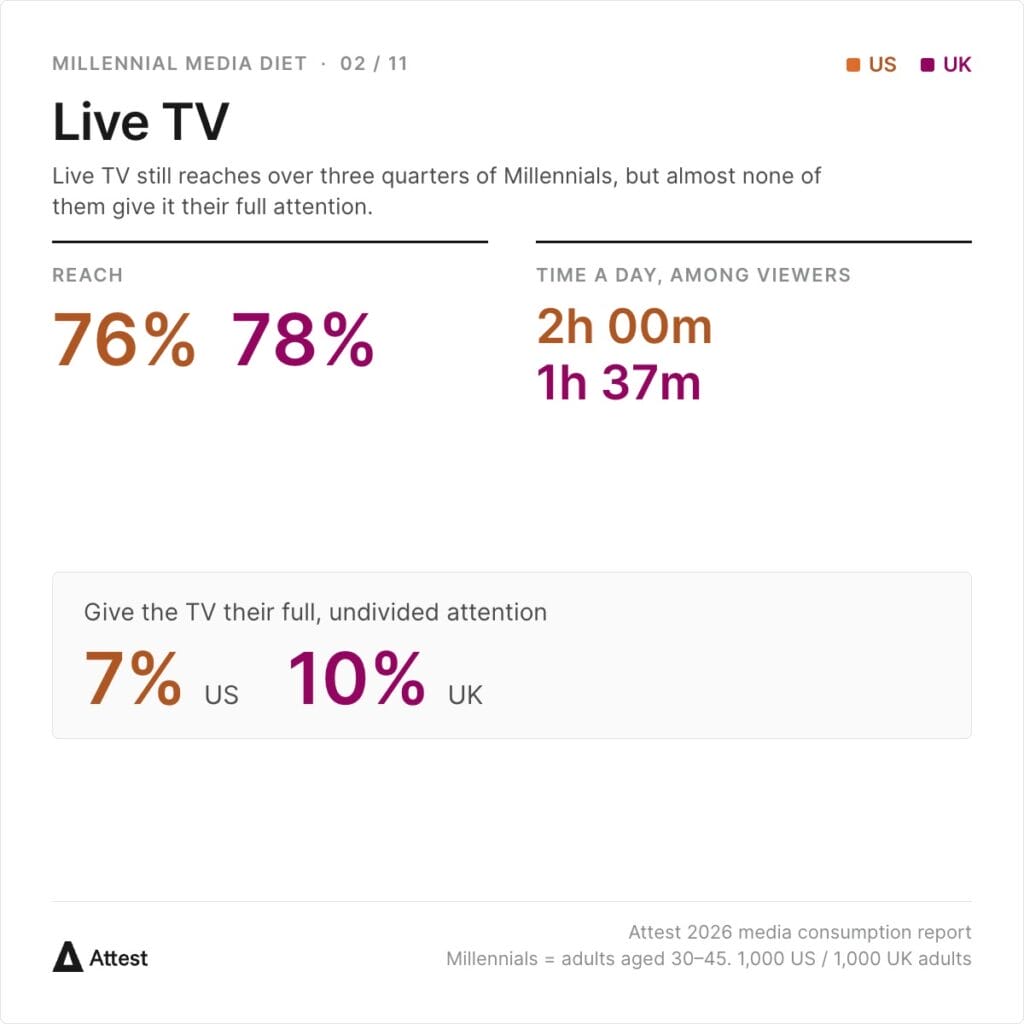
Live TV reaches 76% of US Millennials and 78% of UK Millennials, and among viewers, it claims 2 hours a day in the US and 1 hour 37 minutes in the UK.
However, when Millennials watch TV (whether that’s live or streamed) just 7% of US Millennials and 10% of UK Millennials give it their full, undivided attention. Scrolling social media is the most common accompanying activity in both markets. That’s a noticeably lower share than over-50s audiences, where full attention runs to 14% in the US and 18% in the UK, suggesting screen-splitting is much more of a Millennial and younger habit than an older one.
Social video
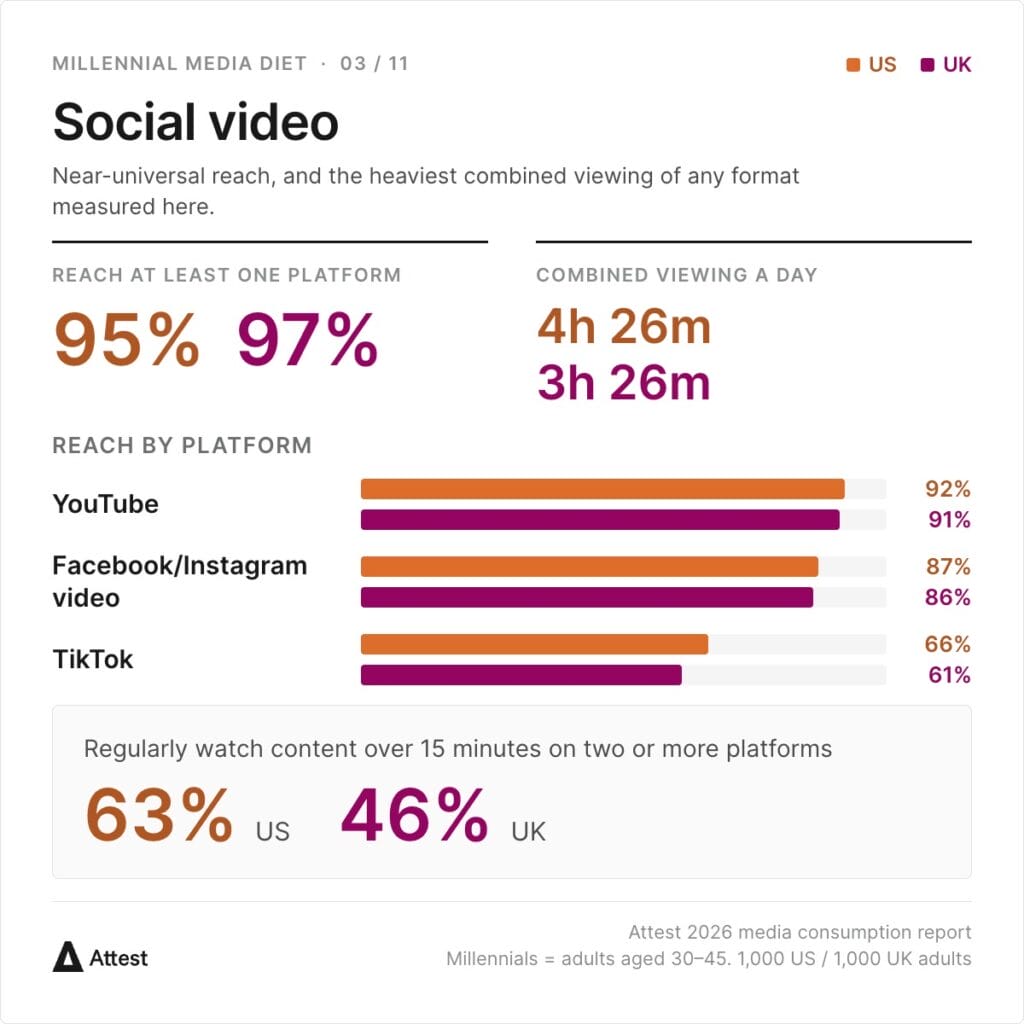
Taken together, social video reaches most of Millennials: 95% in the US and 97% in the UK use at least one of YouTube, TikTok or Facebook/Instagram video, and among that group, combined viewing runs to 4 hours 26 minutes a day in the US and 3 hours 26 minutes in the UK.
63% of US Millennials and 46% of UK Millennials regularly watch content longer than 15 minutes on at least two of these three platforms, and most of that viewing happens on a smartphone rather than a bigger screen.
Ad skip behavior sits high here too: 73% of US Millennials and 70% of UK Millennials always or usually skip ads when given the option, and the point advertising becomes excessive sits closer to 12 to 13 minutes between ads, tighter than the threshold for streamed TV.
Asked what makes them disengage from advertising generally, too many ads (43% US, 42% UK), repetitive ads (36% US, 38% UK) and long ads (35% US, 41% UK) top the list in both markets. AI-generated ads are a comparatively minor concern, cited by just 18% of US Millennials and 20% of UK Millennials, the smallest share of any driver tested, and roughly half the rate seen among Gen Z audiences, where AI-generated ads are a far bigger source of disengagement.
Social media
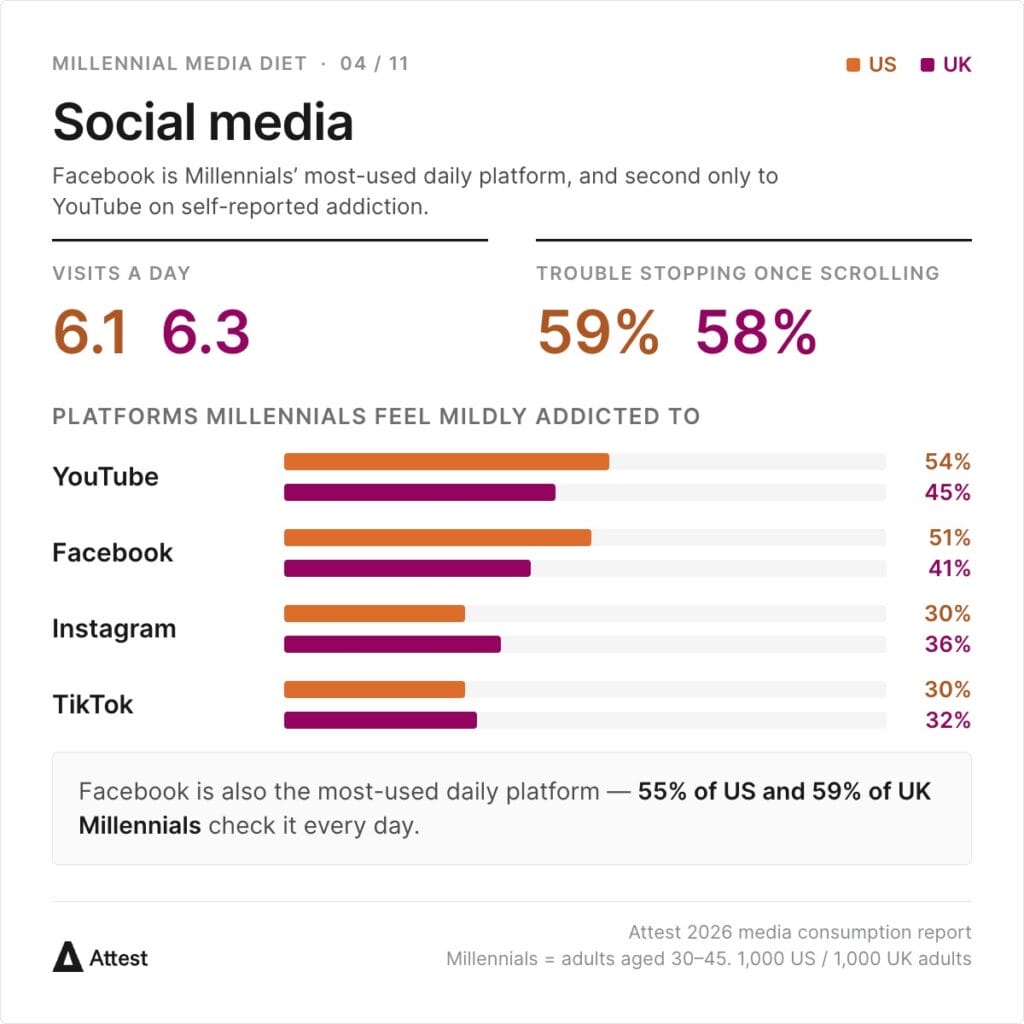
Millennials check social media an average of 6.1 times a day in the US and 6.3 times a day in the UK.
Among individual platforms, Facebook is actually Millennials’ most-used daily platform: 55% of US Millennials and 59% of UK Millennials check it daily, narrowly ahead of YouTube in the US (55%) and clearly ahead of it in the UK (45%), even though YouTube reaches slightly more people overall (94% in both markets, against 89% and 90% for Facebook).
Beyond the major video platforms, Snapchat reaches 57% of US Millennials and 55% of UK Millennials (21%/17% daily), Reddit reaches 53% in the US and 54% in the UK (15%/11% daily), and Pinterest reaches 53% in the US and 55% in the UK (11%/9% daily). X reaches around half of Millennials in each market, while LinkedIn and Threads sit further back.
Social media is a sticky habit for Millennials too: 59% of US Millennials and 58% of UK Millennials say they have trouble stopping once they start scrolling.
That stickiness shows up when Millennials are asked which platform they feel mildly addicted to. In the US, the ranking runs YouTube (54%), Facebook (51%), Instagram and TikTok (30% each), then Snapchat (19%) and X (14%). In the UK, the order is similar: YouTube (45%), Facebook (41%), Instagram (36%), TikTok (32%), X (14%) and Snapchat (11%). Facebook’s strong showing here stands out: on most other platforms tested elsewhere in this piece, daily use and reach skew younger, but Facebook does not.
Music streaming
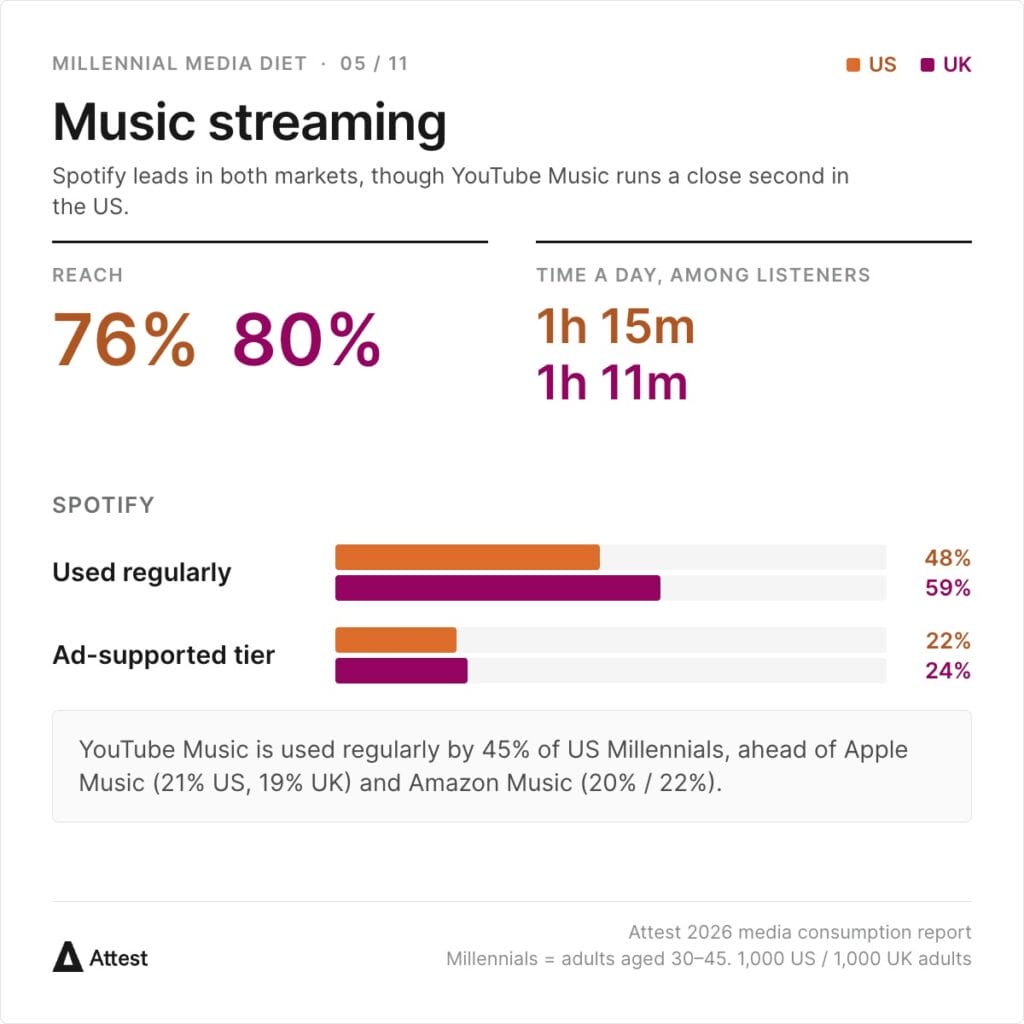
Music streaming reaches 76% of US Millennials and 80% of UK Millennials, and among listeners, it claims 1 hour 15 minutes a day in the US and 1 hour 11 minutes in the UK.
Spotify leads the category, used regularly by 48% of US Millennials and 59% of UK Millennials, though YouTube Music runs a close second in the US specifically (45%), ahead of Apple Music (21% US, 19% UK) and Amazon Music (20% US, 22% UK).
Spotify’s ad-supported tier reaches 22% of US Millennials and 24% of UK Millennials.
Radio
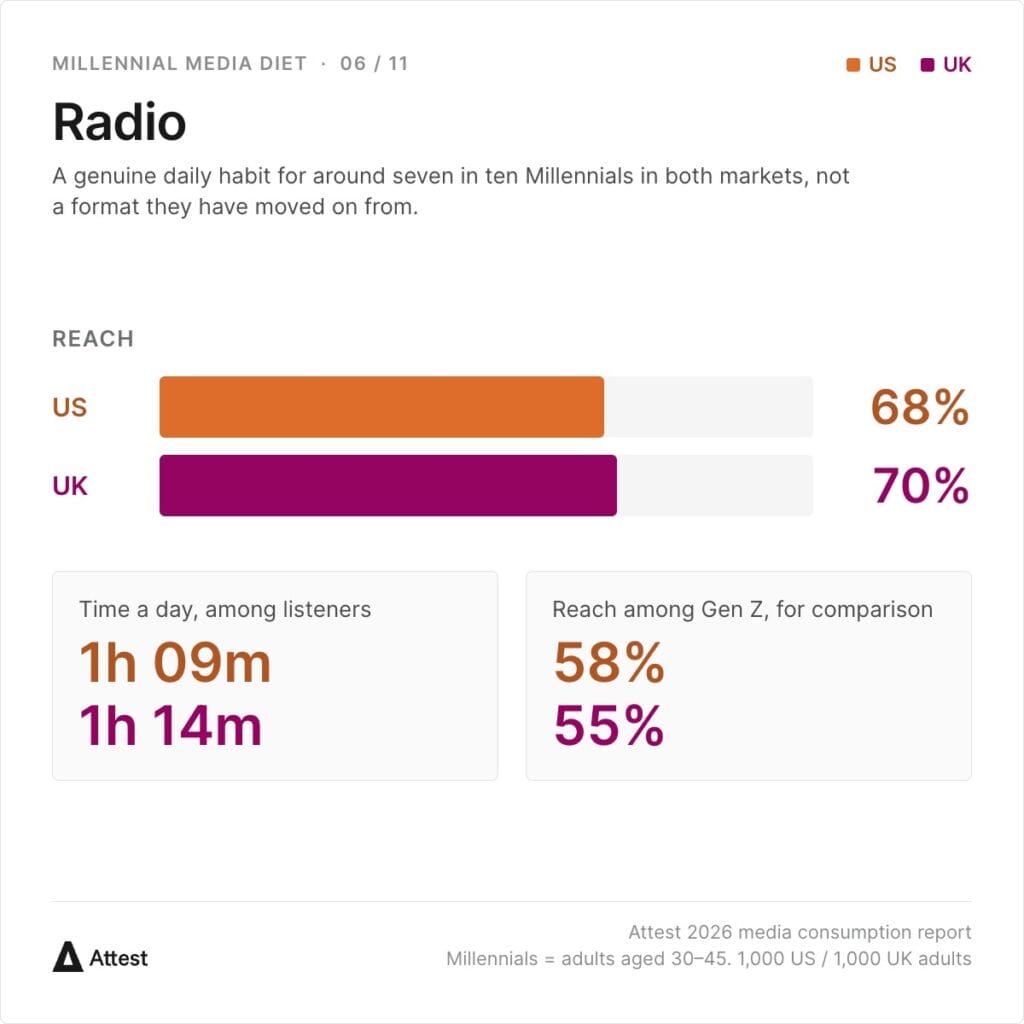
Radio reaches 68% of US Millennials and 70% of UK Millennials, and among listeners, it claims 1 hour 9 minutes a day in the US and 1 hour 14 minutes in the UK. Radio remains a genuine daily habit for the majority of Millennials in both markets, not a format they’ve moved on from.
For comparison, radio reaches a lesser 58% (US) and 55% (UK) of Gen Z, who also listen for a shorter duration: 1 hour 2 minutes a day in the US and 51 minutes in the UK.
Podcasts
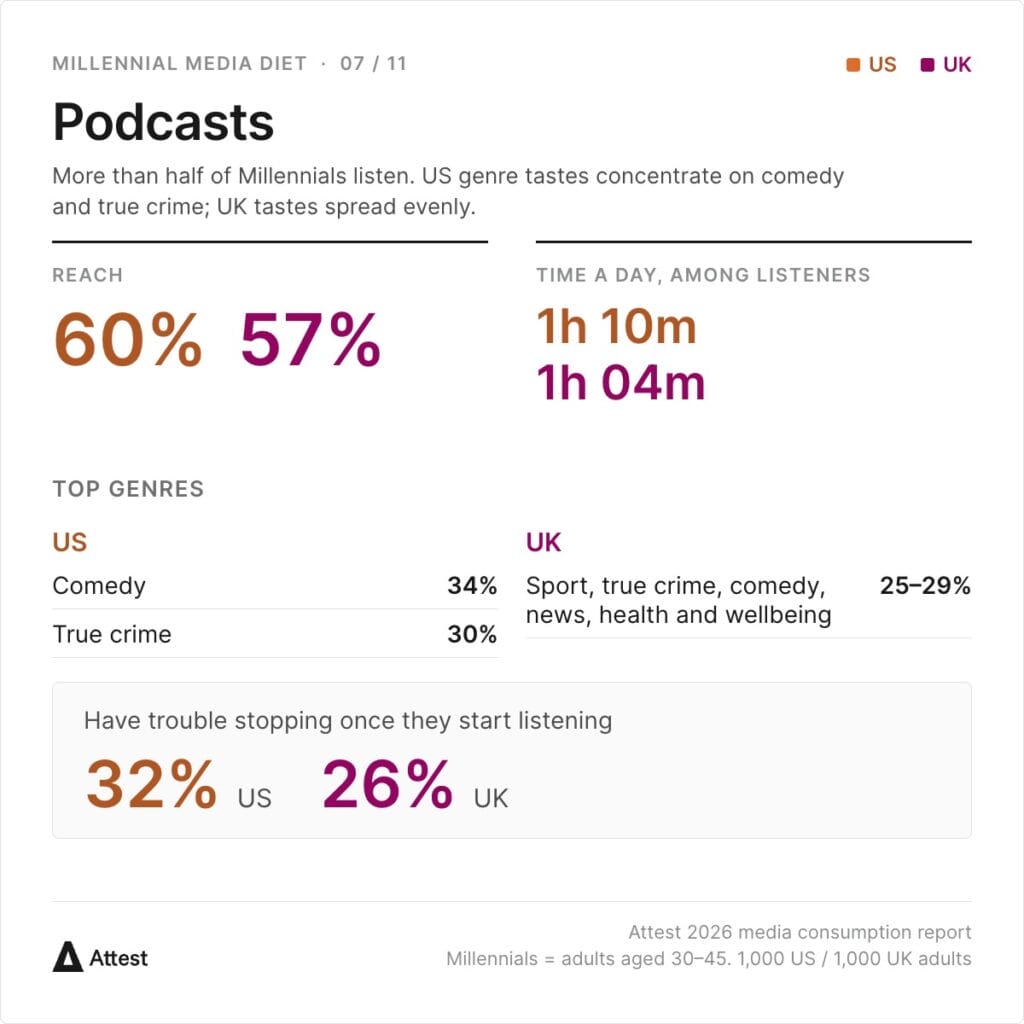
Podcasts are particularly popular among this generation, reaching 60% of US Millennials and 57% of UK Millennials. Listeners tune in for an average of 1 hour 10 minutes a day in the US and 1 hour 4 minutes in the UK.
Comedy and true crime lead in the US (34% and 30%), while UK Millennials spread their attention more evenly across sport, true crime, comedy, news/politics and health/wellbeing, all sitting at 25-29%. Sport stands out as a particularly strong genre in the UK specifically, useful territory for brands in sports, fitness and lifestyle categories.
Podcast listening is a comparatively calm habit for Millennials too: only 32% of US Millennials and 26% of UK Millennials say they have trouble stopping, well below social media.
Books and audiobooks
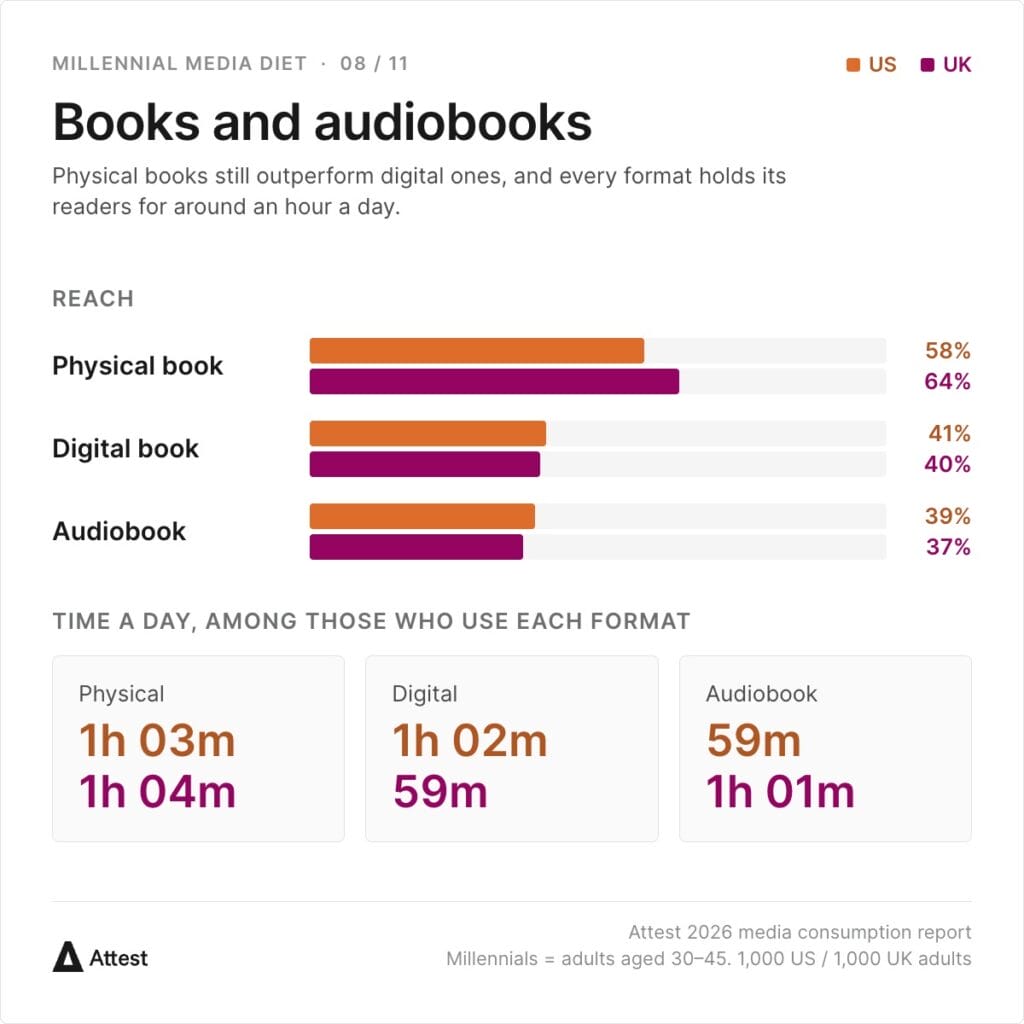
Physical books reach 58% of US Millennials and 64% of UK Millennials. Among readers, the average daily reading time is 1 hour 3 minutes in the US and 1 hour 4 minutes in the UK.
Digital books reach fewer; 41% in the US and 40% in the UK, claiming 1 hour 2 minutes and 59 minutes respectively among readers.
Audiobooks reach 39% in the US and 37% in the UK, but among listeners still claim 59 minutes and 1 hour 1 minute a day. Physical books remain Millennials’ preferred reading format, though digital and audio formats both hold a genuine, sizeable minority.
Newspapers and digital content
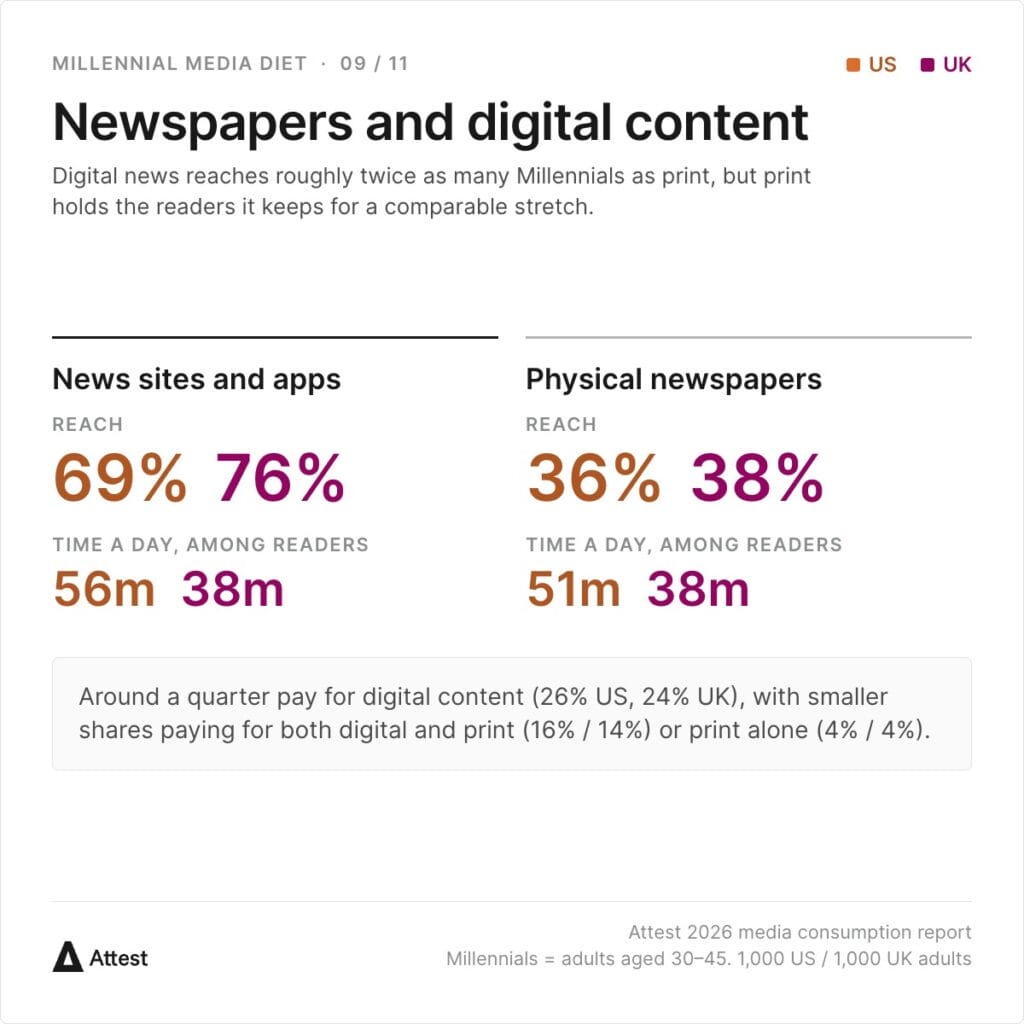
News websites and apps reach 69% of US Millennials and 76% of UK Millennials. Those who use them read for an average of 56 minutes a day in the US and 38 minutes in the UK. Physical newspapers reach far fewer; 36% in the US and 38% in the UK, though among the people who still read one, it claims a comparable 51 minutes in the US and 38 minutes in the UK.
On content subscriptions specifically, around a quarter of Millennials in each market pay for digital content (26% US, 24% UK), with smaller shares paying for both digital and print (16% US, 14% UK) or print alone (4% US, 4% UK).
Search
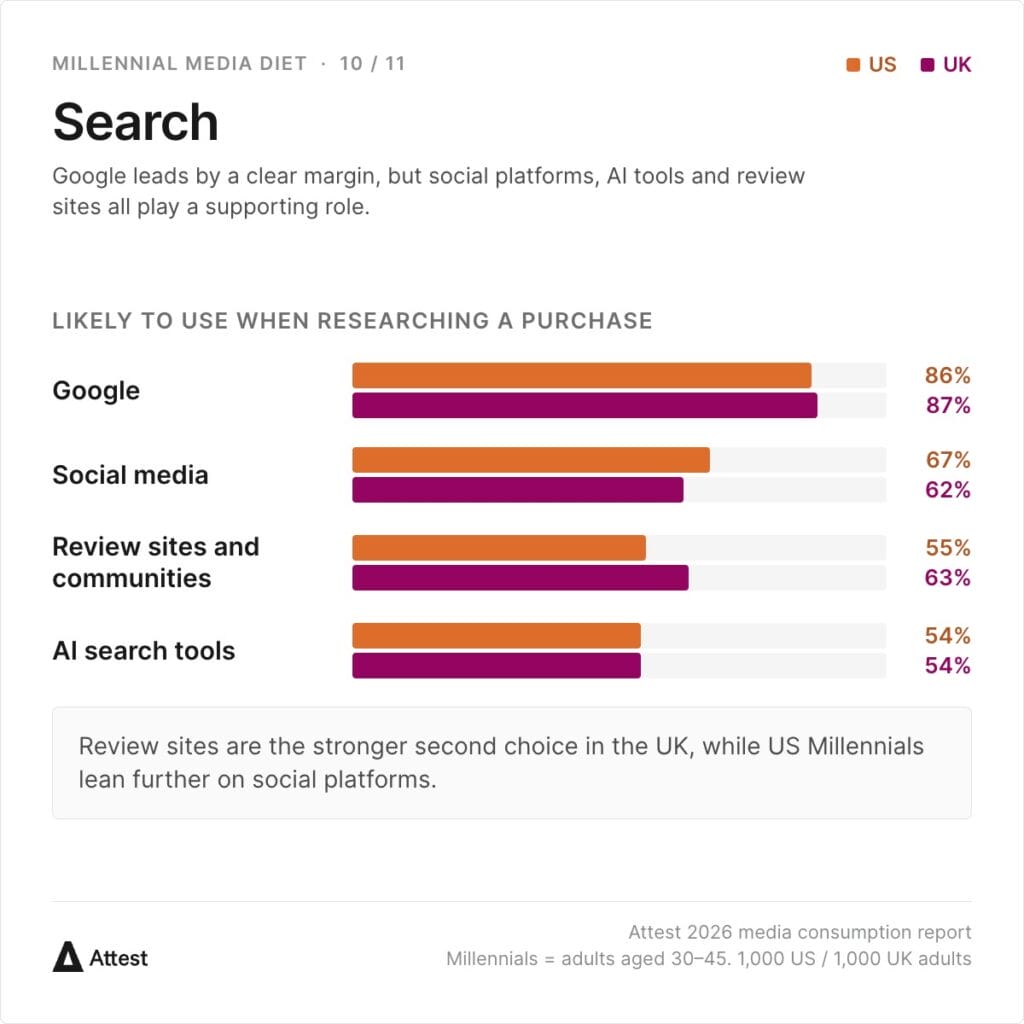
Google remains the most-used search tool for Millennials in both markets (86% US, 87% UK). Social media search sits well behind although still very influential: 67% of US Millennials and 62% of UK Millennials are likely to search social platforms before a purchase.
AI search engines or assistants sit at 54% in both markets, and review sites or communities (such as Reddit or TripAdvisor) reach 55% in the US and 63% in the UK. For Millennials, Google still leads by a clear margin, but social platforms, AI tools and review sites all play a meaningful supporting role in the decision.
Get more insight into Millennials and other generations
Download Attest’s 2026 Media consumption report for even more insight into Millennials’ media habits, and what they mean for brands trying to reach them. You can also get the low-down on other generations, from Gen Z to over-50s, for the full picture on generational attention, ad tolerance and discovery habits.

Methodology
These findings draw on a nationally representative survey of 1,000 US and 1,000 UK adults fielded in June 2026, supplemented by Attest’s media habits tracker, surveying 1,000 adults in each market quarterly since 2022.
Millennials refers to 30 to 45-year-olds throughout, and all differences reported as significant have been tested at the standard 95% confidence level. All time figures in this piece, in the diet chart and within each medium’s section, reflect the average among people who actually use that format, so that reach and engaged time can be read together; non-users are excluded rather than counted as zero. For reference, the population-wide daily total across all formats tested, including non-users, is 12 hours 51 minutes in the US and 11 hours 11 minutes in the UK.