
U.S. organic food sales reached $76.6 billion in 2025, with an annual growth rate of 6.8% — double that of the comparable marketplace. This marks the third consecutive year that organic foods have outpaced the total food market, signaling a clear shift in consumer priorities rather than a temporary trend.
The organic food market isn’t just growing; it’s fundamentally changing. What started as a niche focused on avoiding pesticides has evolved into a complex category where consumers weigh health benefits against sustainability credentials, transparency against convenience, and premium pricing against nutritional value.
But this growth is driven by more than demand for chemical and cruelty-free products. Younger generations are redefining category expectations; transparency has become the baseline rather than an option; and environmental considerations now influence purchase decisions as much as food quality and health benefits.
These shifts also connect to wider food industry trends, where health, sustainability, transparency and convenience are reshaping what consumers expect from brands.
In this article, we’ll explore the trends defining organic food today and what they mean for brands operating in this ever-changing market.
TL;DR
In this article, you’ll learn:
- What’s driving organic food growth beyond basic health consciousness
- Why transparency matters more than ever for building trust
- How pricing dynamics are changing with consumers willing to pay a premium
- Why environmental sustainability has shifted from a nice-to-have to a purchase driver
- How nutrient density is emerging as the new variable for organic differentiation
- How brands can use consumer insights to position organic products effectively
What’s shaping organic food demand today
As consumers come to prioritize health, transparency, and convenience, organic food manufacturers are increasingly focused on sustainability, credibility, and innovation. In 2026, these interconnected drivers are redefining how consumers evaluate food choices.
- Health means functional benefits, not just chemical absence
Nowadays, it’s not just about avoiding harmful ingredients but about buying products that provide tangible health benefits. The shift from “food as fuel” to “food as medicine” has pushed organic food manufacturers to justify premium prices with nutritional benefits rather than just the absence of chemicals. Protein dominates the conversation, but fiber, probiotics, and functional ingredients are gaining ground. - Transparency requires official certifications
Consumers want to know where products are from, how they are produced, and whether or not they meet ethical and environmental standards. As a result, more consumers buy local or choose direct-from-producer options because it’s far easier to trace the supply chain. Generic claims from brands carry far less weight than official certifications and transparent sourcing information. - Sustainability is a baseline requirement
Consumers are more aware of the environmental impact of their food choices and actively seek products that minimize harm to the planet, particularly younger generations. What used to be a secondary consideration is now as paramount as quality. Consumers want to know about regenerative practices, carbon impact, and biodiversity protection, and the brands that clearly explain their efforts build trust and capture demand. - Price remains a significant barrier
Most consumers expect organic goods to cost more than conventional ones, and they’re willing to pay that premium for the categories that they prioritize. However, this doesn’t mean an indifference to cost — consumers are constantly evaluating whether premium pricing delivers proportional value. This is particularly evident amongst Gen Z, who rate price as their second-most important motivator for food choice.
Organic food trends
Five trends are reshaping the organic market in 2026. From transparency demands to shifts in purchasing behavior, these patterns reveal what’s driving organic food adoption, and what brands must focus on and deliver to capture market share.
Trend 1. Transparency as a primary trust signal for organic foods
While transparency has quickly become one of the most important purchase variables for organic food, most consumers lack the knowledge to properly evaluate the products they’re trusting.
According to a survey by the OTA, while consumers prioritize health-related claims over broader environmental benefits, their perceptions of certifications and claims don’t always align with their definitions or intended purposes. So while many are familiar with terms like “local”, “natural”, and “organic”, they place a higher value on “free-from”, “no added hormones”, and “raised without antibiotics”.
“Many consumers don’t realize that organic certification inherently meets these ‘free-from’ expectations,” says Tom Champman, co-executive officer of the OTA, Washington, DC.
“The challenge to the organic sector is to demonstrate the distinct value of the USDA organic label and break through the noise of all other health, nutrition, and sustainability claims in the marketplace.” – Food Business News
The USDA label bans toxic pesticides, synthetic nitrogen fertilizers, antibiotics, synthetic hormones, and GMOs.
What does this mean for brands?
Stop assuming consumers know what organic certification guarantees. Provide clear breakdowns of concrete benefits: no synthetic pesticides, no GMOs, no antibiotics, no growth hormones.
For example, Patagonia Provisions doesn’t say “sustainable farming”; they say “Regenerative Organic Certified Kernza”, a perennial grain that builds topsoil, on 1,426 acres of converted organic farmland. They co-founded the Regenerative Organic Alliance, which has certified over 20 million acres globally. The messaging works because it’s a named certification, a specific crop, measurable acreage, and a tangible environmental benefit.
Trend 2. Pricing and availability affect everyday organic food choices
According to The Packer’s Fresh Trends 2026, when considering organic produce purchases, price is a top factor for consumers: 59% say they prefer to buy healthy options when the price feels right, and 34% are willing to pay up to 10% more for the premiums.
Every transaction is now an evaluation, with the most important question being: Does the cost justify the value?
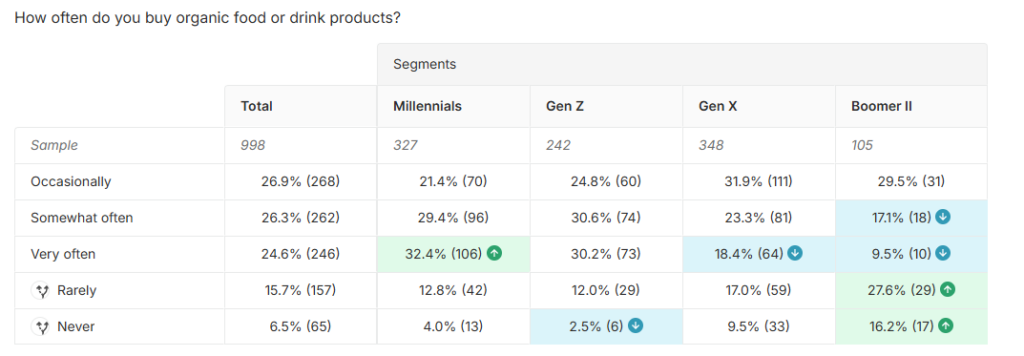
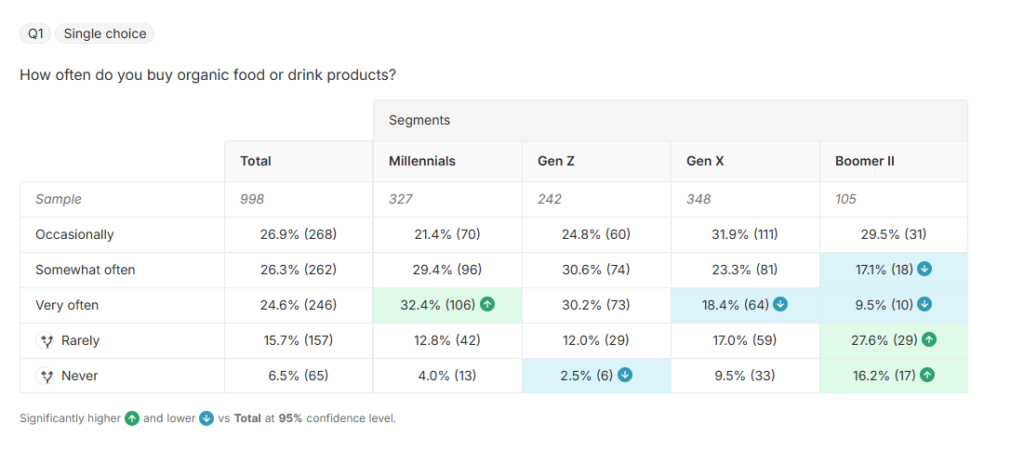
Younger generations prove it. We found that Gen Z and Millennials are much more likely to buy organic produce than older generations, with 32% of Millennials buying organic food “very often” and 30% of Gen Z, versus 18% of Gen X and 9.5% of Boomers.
What does this mean for brands?
Consumers demand very clear value articulation. What are the benefits? What are the nutritional advantages? Is it superior taste, environmental benefits, or production standards? Whatever the advantage, state it.
Category matters tremendously. Consumers prioritize organic items they perceive as most impactful to health or most likely to contain residues, e.g., fresh produce, dairy, eggs, meat, and baby food. Products in these categories can maintain higher premiums more easily than processed items where organic benefits feel less tangible.
Trend 3. Environmental sustainability is becoming more important in organic food choices
There’s a growing, fundamental belief that food choices should minimize environmental harm. Organic farming practices that focus on soil health, pesticide reduction, and biodiversity support align with how consumers increasingly evaluate product quality today, particularly younger cohorts.
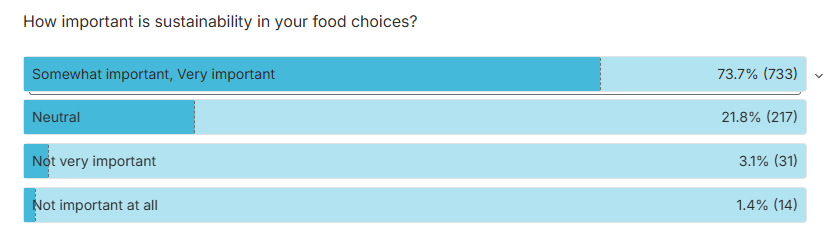
For example, among Gen Z, 74% value sustainability, and 62% say they’re willing to pay more for a product that is sustainable or ethically sourced, a clear signal that U.S. consumers are willing to change consumption habits to protect the planet.
What does this mean for brands?
Generic sustainability claims don’t work. Brands like Organic Valley, for example, set up an innovative Carbon Insetting Program to reduce farm emissions without carbon offsets. The program incentivizes and assists Organic Valley farmers in implementing regenerative, climate-smart farming practices.
Another example is Nature’s Path. Nature’s Path founded the Regenerative Organic Oats Program, a $300,000 investment now in its third year, supporting oat farmers in accessing personalized training around best regenerative organic practices in the field. The purpose? To improve resiliency against climate change.
Trend 4. Nutrient density is gaining attention in organic food
Fiber, vitamins, and minerals per calorie. Foods that deliver more nutrient density are rising to the top of shopping lists as consumers go health-first.
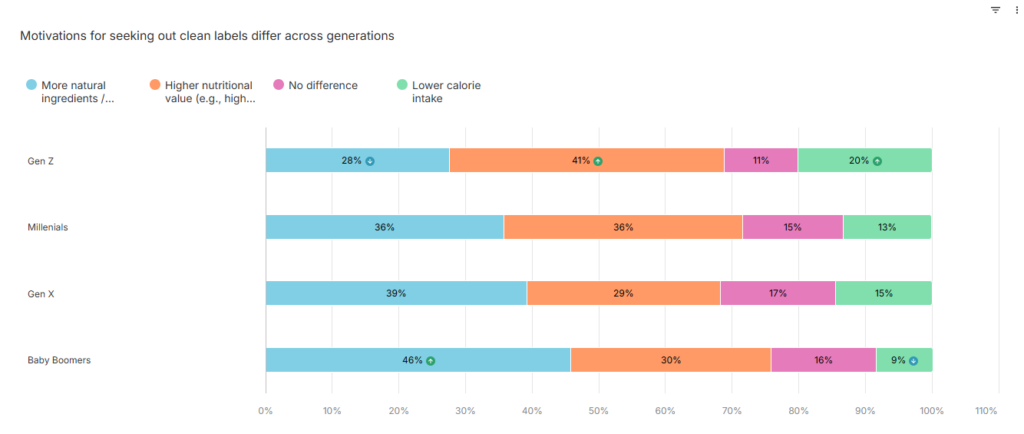
And this isn’t a fad — every generation is seeking out more nutrient-dense food, with Gen Z leading the charge (41%), followed by Millennials (36%), Baby Boomers (30%), and Gen X (29%).
Mardy Purdy, managing director of the Nutrient Density Initiative, said in 2026 that “food is medicine” organizations will not only be embarking on their own testing, but also conducting clinical trials to determine the relationship between nutrient-dense foods and human health outcomes.
What does this mean for brands?
Organic certification alone isn’t enough to differentiate. Products that combine organic purity with functional benefits (e.g., high protein, enhanced nutrition, specific vitamins) create stronger value propositions.
For example, messaging like “organic eggs with 6g protein”, resonates far stronger than “organic eggs with no hormones”. Product development should prioritize ingredients that stack multiple benefits, and messaging should reflect that.
Trend 5. Younger consumers are a key driver of organic food demand
Younger consumers approach organic differently than previous generations. For them, organic isn’t a special-occasion choice: it’s their default when available and affordable. Claims like organic, vegan, and allergen-free matter more to them than to older demographics, and they’re willing to pay for them.
In 2026, 35% of Gen Z have tried dairy alternatives, 33% have tried local and organic foods or vegetables, and 31% have tried functional foods or drinks. They prioritize fresh categories:
- Produce (42% want to increase fruit and vegetable consumption)
- Meat
- Poultry
- Eggs
- Dairy
- Baby food where organic clearly signals quality differences
They’re also just behind Millennials for how often they buy organic food and drink products, with 32% of Millennials buying organic products “very often” versus 30% of Gen Z. Two generations that care deeply about sustainability and ethical sourcing.
And when we asked them whether they believe they have a greater concern about the healthfulness and nutrition of food choices than other generations, almost two-thirds (63%) of Gen Z said they do.
What does this mean for brands?
Younger consumers are driving organic food trends, particularly Gen Z. Brands should design products with younger consumer preferences in mind, as those trends are also affecting older consumers. Marketing channels are also incredibly important because younger consumers discover products on social media platforms rather than through traditional advertising.
What these organic food trends mean for F&B brands
Positioning requires understanding which organic attributes matter most
The trends show that different audiences prioritize different aspects; younger consumers balance health with sustainability, budget-conscious shoppers demand clear value justification, and health-focused buyers seek nutrient density alongside purity. Effective positioning focuses on the specific attributes that matter most to target consumers (e.g., USDA certification, sustainability messaging, health benefits) rather than treating “organic” as a one-size-fits-all benefit.
Product development should anticipate evolving consumer expectations
The best and most successful organic products don’t just meet purity or certification standards; they taste great, provide genuine nutritional advantages, come in convenient formats, and demonstrate clear environmental benefits (packaging, sourcing, recycling). By using consumer insights, brands can understand which product feature combinations generate the most appeal, and where gaps exist across current offerings that new products could fill.
For teams building new products, the food product development process should account for how organic claims, nutritional benefits, packaging and pricing work together in the final concept.
Pricing strategies need validation before market entry
Consumers accept and expect reasonable premiums for organic goods, but price remains a strong deciding factor in purchase decisions. Testing perceived value at different price points with target consumers prevents overpricing, which limits adoption, and underpricing, which leaves money on the table or signals lower quality.
Messaging should bridge the knowledge gap to build trust
Consumer expectations for transparency revealed that most shoppers don’t understand what organic certification guarantees. Brands that clearly explain standards can build trust and justify premiums more effectively than those that assume consumers already know. Updated messaging should educate while demonstrating value, connecting already-held certifications to concrete, tangible benefits that consumers care about.
Strong food branding can help brands turn certifications, sourcing practices and sustainability commitments into a clearer story that consumers understand and trust.
The role of consumer insights in validating organic food strategies
Before launching any organic product or repositioning existing ones, test concepts, pricing, messaging, and feature sets with target consumers.
A structured approach to testing organic F&B products can help teams validate whether claims, packaging, taste, pricing and perceived value are strong enough before launch.
Consumer insights reveal whether your positioning resonates, your pricing aligns with perceived value, your educational messaging is clear and transparent, or your product benefits match what consumers actually want. Ultimately, they reduce risk and ensure you focus resources on strategies backed by real consumer feedback rather than on assumptions about market opportunities.
Conclusion
The continued growth of the organic food market reflects a fundamental shift in how consumers evaluate food purchases, and these trends are at the heart of it.
Whether it’s prioritizing sustainability or transparency, seeking nutrient-dense options over simple purity claims, or navigating price premiums that vary by category — consumers now evaluate organic through multiple lenses simultaneously.
The brands winning in organic test before they launch. They validate whether sustainability messaging resonates with their audience, if pricing matches perceived value, and what certifications are relevant to their audience. Testing transforms market trends into specific strategies that work for your brand, category, and audience.
Attest gives you those answers. Survey target consumers. Test positioning and pricing. Validate concepts. Move forward with confidence. You bring the question about organic food strategy, and we’ll deliver you answers that stand up.