Frozen food is one of the most established categories in grocery retail. Consumers have relied on it for decades, and for good reason. But “established” doesn’t mean static. Right now, the frozen aisle is in the middle of a quiet but significant re-evaluation.
Shifting attitudes around health, quality, and value are changing how consumers think about frozen food. What was once associated with compromise (processed ingredients, inferior taste, stripped-out nutrition) is increasingly being seen through a different lens. Convenience still matters, but it’s no longer the whole story. Consumers are asking more of frozen food, and the brands that understand those expectations are finding new opportunities to grow.
This article covers the key frozen food trends shaping consumer demand today, what the consumer perceptions and preferences behind them look like, and what that means for F&B brands trying to stay ahead.
TL;DR
- Consumer perceptions of frozen food are shifting — health, quality, and premiumization are now as important as convenience and price.
- Attest research found that while many consumers still believe frozen food tastes worse than fresh, a significant proportion say there’s no difference — suggesting messaging can move the needle on perception.
- Value remains a genuine strength: over 58% of US consumers and 68% of UK consumers say frozen food is better than fresh on cost.
- Portion flexibility is gaining traction, with smaller pack sizes ranking as the top factor that would encourage more frozen food purchases.
- Younger consumers, particularly Gen Z and Millennials, are driving demand for bolder flavors, global cuisines, and health-forward options.
- Consumer insight is essential for understanding which trends are gaining traction in your specific category — and for validating product, positioning, and messaging decisions before going to market.
Why consumer insight matters in frozen food
Frozen food purchasing is driven by a combination of factors: convenience, value, quality, health, and taste perception. The challenge for brands is that these factors don’t operate in isolation and they don’t weigh equally for every consumer segment.
A shopper reaching for a frozen meal mid-week is probably prioritizing convenience. A parent comparing nutrition labels in the freezer aisle is thinking about quality and ingredients. A budget-conscious household is looking at cost-per-serving. The same product can satisfy all three, but the messaging that reaches each of them is different.
Consumer insights give brands the visibility to understand how these decision drivers play out across their target audiences — and to identify where perceptions are holding them back or where there’s an unmet need to address. In a category that’s actively being re-evaluated by shoppers, that kind of clarity is increasingly hard to operate without.
Frozen food trends
The frozen food category is evolving on multiple fronts simultaneously. Here are the key trends shaping consumer demand right now:
- Health perceptions are reshaping frozen food demand
- Convenience remains a key driver in frozen food choices
- Premiumization is redefining category perception
- Portion flexibility is on the rise in frozen food
- Bolder flavors are gaining popularity
Health perceptions are reshaping frozen food demand
For a long time, “frozen” and “healthy” felt like a contradiction in terms to many shoppers. That perception is starting to loosen, but it hasn’t disappeared.
Attest research found that 39% of US consumers and 34% of UK consumers said they avoid frozen products because they want to avoid processed foods. Yet the majority of US shoppers believe frozen and fresh foods are on a par for nutritional content (40% say it’s the same, 25% say frozen is better). In the UK, nearly half of consumers say nutritional value is comparable between fresh and frozen — with 29% saying frozen is actually better.
View full UK data
UK shoppers
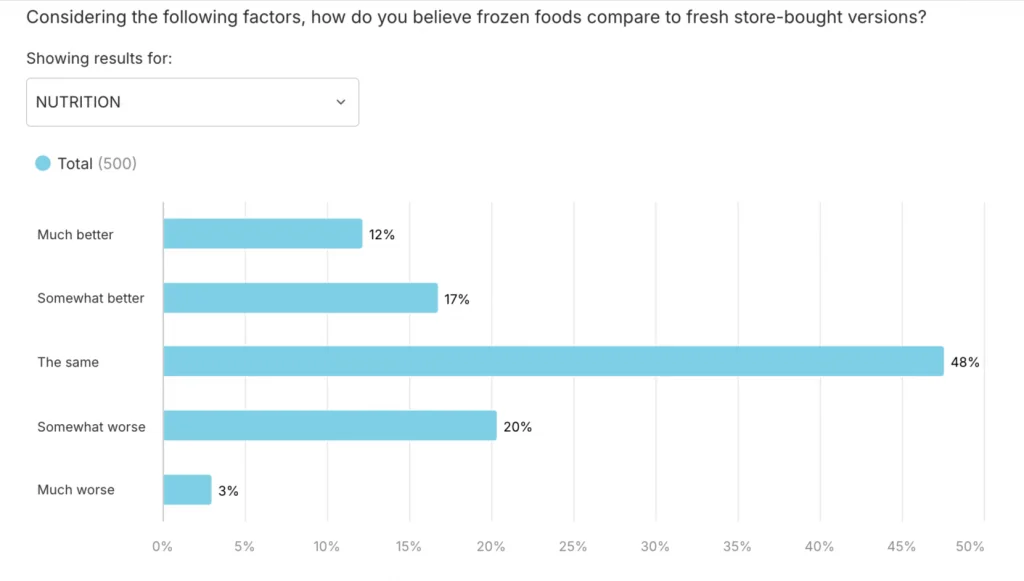
The gap, then, isn’t necessarily in the product, it’s in the perception. Consumers aren’t fully connecting the dots between what freezing actually does (locking in nutrients at peak freshness) and their assumptions about what “frozen” means.
This shift is reinforced by category-level data: frozen foods with probiotics and gut-friendly ingredients have grown 33% over the past three years, according to Conagra’s Future of Frozen Food 2025 report. The rise of GLP-1 medications has also created demand for portion-controlled, nutrient-dense frozen options that fit new dietary frameworks.
For brands, the implication is straightforward: where the product genuinely supports a health claim — no artificial preservatives, frozen at peak ripeness, high-protein, gut-friendly — that needs to be front and center. Educating consumers about the nutritional reality of frozen food isn’t just good PR; it’s a genuine commercial opportunity. Brands investing in wellness foods positioning are well placed to capitalize on this.
Example: Healthy Choice Power Bowls position explicitly around protein and vegetable content, with on-pack claims highlighting all-natural protein, fiber, and low net carbs. The range is built around health credentials as much as convenience, directly addressing the consumers who would otherwise avoid frozen food over concerns about processing and nutrition.
Convenience remains a key driver in frozen food choices
Convenience has always been the bedrock of frozen food. That hasn’t changed, but the context around it has.
According to Innova Market Insights, 42% of consumers globally cite convenience as an important factor when consuming food and beverages at home. And per Conagra’s Future of Frozen Food 2025 report, Millennials and Gen Z entering family formation years are driving a 54% increase in spending on frozen foods. The push and pull of busy schedules, budget constraints, and the desire to cook at home is converging on the frozen aisle. The push and pull of busy schedules, budget constraints, and the desire to cook at home is converging on the frozen aisle.
What’s shifting is the expectation of what “convenient” means. It’s no longer enough to just be quick. Consumers want convenient options that also taste good, contain recognizable ingredients, and fit their dietary preferences. Frozen cooking solutions are increasingly being positioned not as shortcuts, but as ways to enhance home dining and get a quality result without the full time investment.
For brands, convenience is still the hook, but it can’t be the whole story. Products that layer quality, taste, and ease together are better positioned than those that lead on speed alone.
Example: Birds Eye has moved its positioning firmly beyond speed, launching a campaign framing frozen food as a nutritious and sustainable choice for family mealtimes, with marketing director Claire Sutton explicitly stating the brand is no longer “just about convenience.” In the UK, the Waitrose Food & Drink Report 2025 noted that shoppers are increasingly treating the freezer as an extension of the pantry, a place for premium shortcuts rather than a fallback option, with strong growth in premium frozen items including specialist pastries up 322% year-on-year.
Premiumization is redefining category perception
One of the most significant shifts in frozen food is the upward movement in quality expectations. A segment of consumers is no longer treating the frozen aisle as a budget fallback. They’re looking for genuinely premium options.
This aligns with broader market trends: consumers are spending more time at home, eating in more, and increasingly treating that as an opportunity rather than a compromise. Conagra’s Future of Frozen Food 2025 report identified “elevated in-home dining experiences” as one of the key trends reshaping the frozen category, with consumers seeking restaurant-quality results from their own kitchens.
Attest research supports this from the perception side: while negative views about frozen food’s taste and texture persist (40% of US consumers and 31% of UK consumers believe frozen food tastes worse than fresh) a meaningful proportion say there’s no difference. And a quarter of consumers in both markets say frozen actually has better taste and texture. That’s not a small group to ignore.
The “no additives or preservatives” claim is now the most common positioning seen on new frozen food launches globally, per Innova Market Insights. Brands leaning into clean-label credentials, premium ingredients, and elevated packaging are signaling to consumers that frozen can mean quality, not compromise.
Example: Brands like Trader Joe’s and M&S have built category-level credibility around premium frozen ranges that blur the line between frozen convenience and aspirational home cooking.
Portion flexibility is on the rise in frozen food
When Attest asked consumers what would encourage them to buy more frozen food, the top answer in both the US and UK was the same: smaller pack sizes. Specifically, 35% of UK shoppers and 32% of US shoppers cited this as a purchase driver.
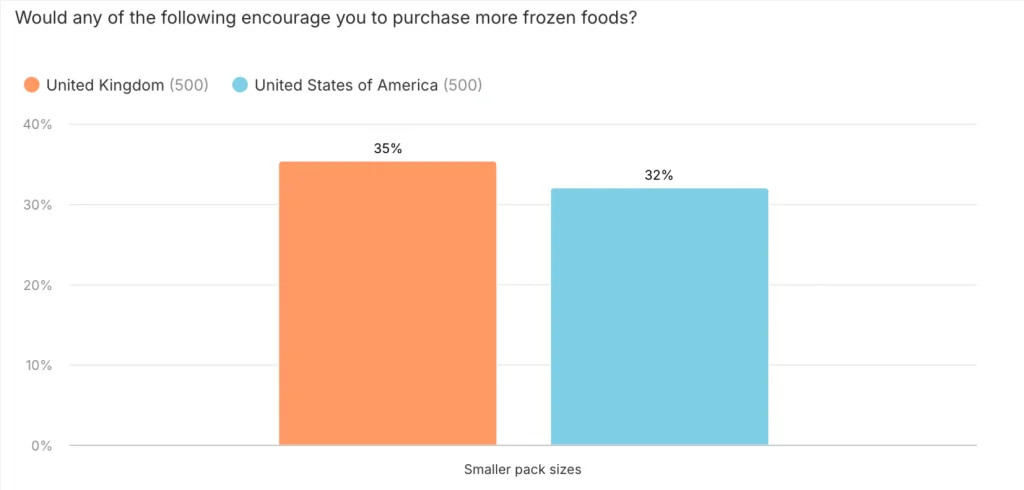
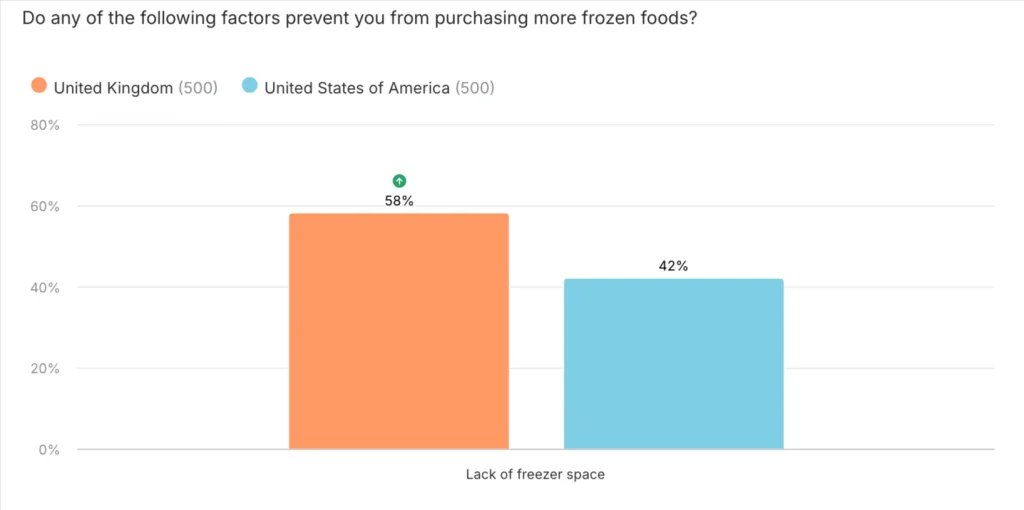
The context matters here. The biggest barrier to buying frozen food that Attest found wasn’t price or taste. It was lack of freezer space. 58% of UK consumers and 42% of US consumers said their freezer simply isn’t big enough. Smaller formats address this directly.
There’s a second dimension to this trend beyond freezer space. Consumer snacking and eating behaviors are changing. Conagra’s research found that bite-sized and mini frozen formats have reached $2.4 billion in US sales, with a 31% year-on-year increase in consumption. Critically, 84% of those mini formats are now being eaten as meals, not just appetizers, signaling a genuine shift in how consumers are using these products.
For brands, the opportunity is to rethink SKU architecture. Single-serve formats, resealable packaging, and portion-controlled options all reduce the friction around committing to a full pack and make frozen food easier to integrate into varied household dynamics.
Example: Some UK retailers are experimenting with “scoop your own” frozen food sections, allowing customers to take exactly the quantity they need, a model Attest data suggests 21% of UK shoppers would find appealing.
Bolder flavors are gaining popularity
The flavor landscape in frozen food is getting more adventurous. Younger consumers, particularly Gen Z and Millennials, are driving demand for spicier, globally-inspired, and more complex flavor profiles, and the numbers back it up.
Conagra’s report found that spicy frozen foods have surpassed $2.0 billion in US sales. Gen Z is 48% more likely to buy spicy frozen meals, and younger consumers are 24% more likely to purchase globally inspired frozen products. Global street food as a frozen category hit over $543 million in sales, with Indian and Japanese-inspired flavors leading growth.
Innova Market Insights also notes the influence of global cuisines on frozen product launches, with plant-based options and internationally-inspired ranges growing rapidly.
This isn’t just a flavor preference. It’s a cultural one. Consumers are using food as a way to explore global cuisines and experiences from home, and frozen is increasingly a vehicle for that. For brands and innovation teams, the implication is to look beyond safe, familiar flavor territories when developing new SKUs. Authenticity matters here: consumers are knowledgeable enough to notice when global flavor inspiration is surface-level.
Example: Frontera (owned by Conagra) has built a successful frozen range around Mexican flavors developed by chef Rick Bayless — a model that leads with culinary credibility, not just convenience.
What these frozen food trends mean for brands
Taken together, these trends describe a category that’s being held to higher expectations: health, quality, flavor, and flexibility. That’s a challenge for brands that have historically relied on convenience as their primary positioning, but it’s a significant opportunity for those willing to re-examine how they show up.
Product positioning needs to reflect the evolving expectations of the category. A product positioned purely on speed or price is competing in an increasingly narrow space. Brands that can credibly layer in quality signals (clean-label credentials, premium ingredients, culinary inspiration, health benefits) have a bigger addressable audience. Product positioning decisions should be grounded in consumer data, not assumptions about what shoppers want.
Messaging needs to work harder on perception. Attest’s research shows that a large portion of consumers still hold outdated beliefs about frozen food’s nutritional value, freshness, and quality. The gap between what the product actually delivers and what consumers believe it delivers is a messaging opportunity. Brands that can close that gap through clear, specific, evidence-based claims rather than vague “quality” language will make more headway.
Innovation should be tracking where demand is building, not where it’s already saturated. The growth signals are clear: health-forward formats, globally-inspired flavors, portion-flexible SKUs, and premium positioning in previously commodity segments. But not every trend translates equally across markets, segments, or categories. Consumer insight is what tells you which opportunities are real for your specific brand and audience.
The underlying principle across all of this is the same: the brands that win in a re-evaluated category are the ones that understand their consumers well enough to get ahead of what they want next, not just respond to what they’re already buying.
Conclusion
The frozen food category is in the middle of a meaningful shift. Convenience still matters, but it’s no longer sufficient on its own. Consumers are bringing higher expectations around health, quality, flavor, and flexibility, and those shifts are creating both pressure and opportunity for brands.
Understanding these trends is one thing. Knowing how they apply to your brand, your category, and your consumers is another. That’s where consumer insight becomes indispensable: not just to stay informed about the direction of the market, but to test ideas, validate assumptions, and make decisions with confidence.
Attest gives F&B brands the tools to do exactly that: run research with real consumers, understand what’s driving perceptions and preferences, and bring those insights directly into product, positioning, and messaging decisions.