Our data suggests they shouldn’t breathe a sigh of relief just yet. Concern about data privacy is so high among today’s consumers that they’re changing their online behavior. As a result, the type of invasive advertising associated with third-party cookies is simply becoming less effective.
Cookies, or no cookies, a new approach is still required. In this report, we explore the opportunity for brands to transform their marketing strategy. We’ll show you how you can use an alternative data source, zero-party data, to continue to reach your target audience, regain their trust, and create ads that are persuasive instead of invasive.
Jeremy King, CEO, Attest
Survey Sample The data in this report comes from two nationally representative surveys (answered by a total of 1,500 working age US consumers), conducted on the Attest platform during December 2023.
What is consumer privacy? Consumer privacy refers to the handling and protection of consumers’ personal information and data collected by businesses. Calls for businesses to increase visibility into the use of consumer data have led to new consumer privacy laws and the tightening of industry standards, making this an important issue for marketers.
What are third-party cookies? Third-party cookies are little snippets of code that are placed on a user’s device allowing companies to track their browsing habits across the web. They can record all of a user’s online activity, building up a thorough profile of that individual. Although the user will not be identified by name, their IP address will be held. The data can be used to target consumers very specifically with advertising and create retargeting lists.
What are first-party cookies? First-party cookies are placed on a user’s device to connect them to a single website or app. There are different types of first-party cookies – functional ones that do things like remember passwords, settings and preferences, and analytics ones that gather data about a visitor’s on-site behavior. Website and app owners can use the data from this second type of cookie to develop marketing strategies. For example, tailoring the content individual visitors see or serving personalized offers.
The problem: consumers don’t trust you
From eavesdropping smart speakers to trackers that spy on emails, ad companies have picked up a bad rap, and rightly so. Intrusive data gathering – and disconcertingly personal advertisements – have continually eroded consumer trust.
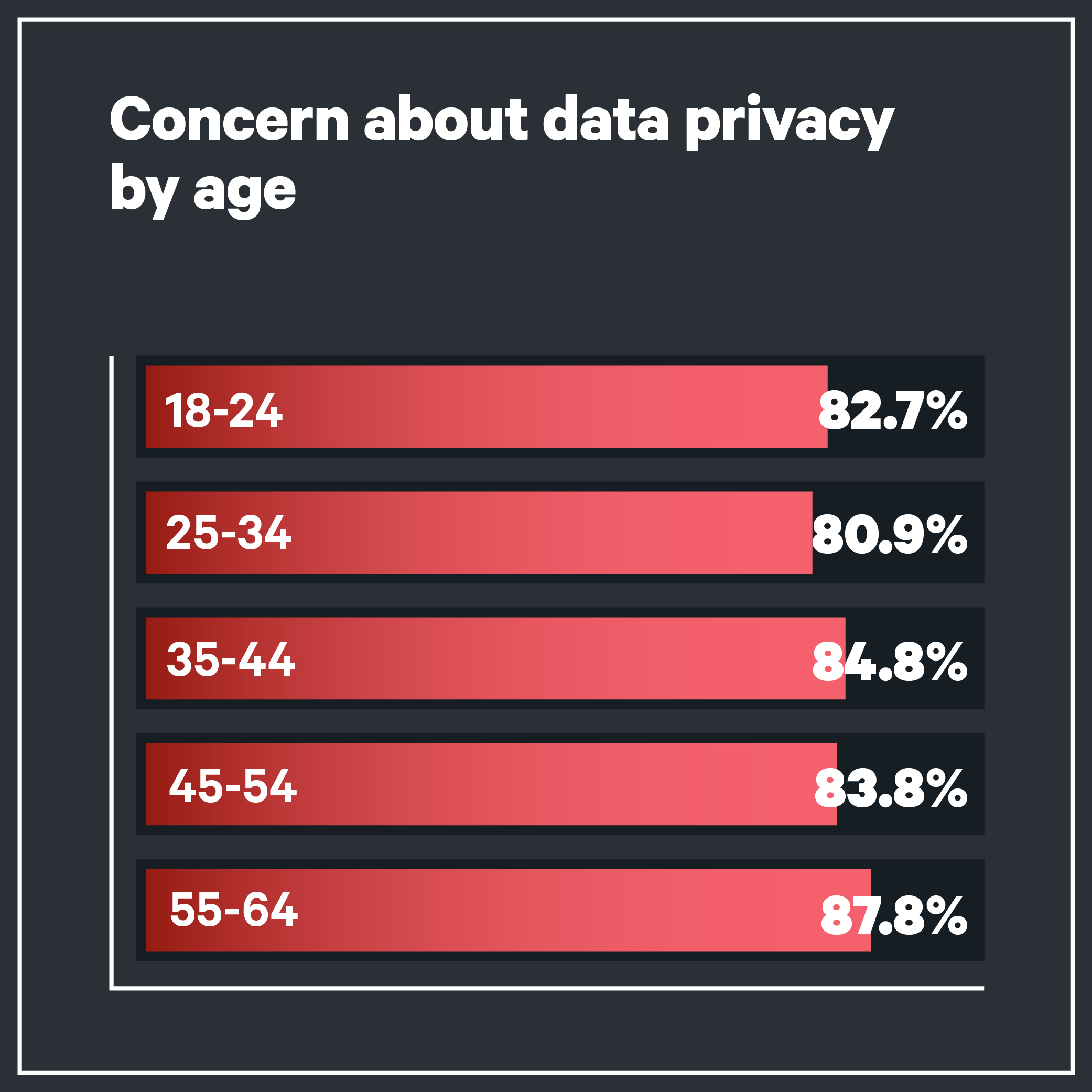
We found that 84.1% of consumers are concerned about data privacy when interacting with brands online (including 41.2% who are ‘very concerned’). Older consumers have higher levels of caution (they’re more likely to say they’re very concerned), but there’s still widespread concern among young consumers. Nearly 83% of Gen Z worry about data privacy showing that it’s a universal issue.
Consumers are pulling back what they share
The general mistrust of brands, and the daily deluge of marketing that most consumers receive, has led to a growing unwillingness to share personal data. Handing over one’s email address for marketing purposes is something that’s carefully considered.
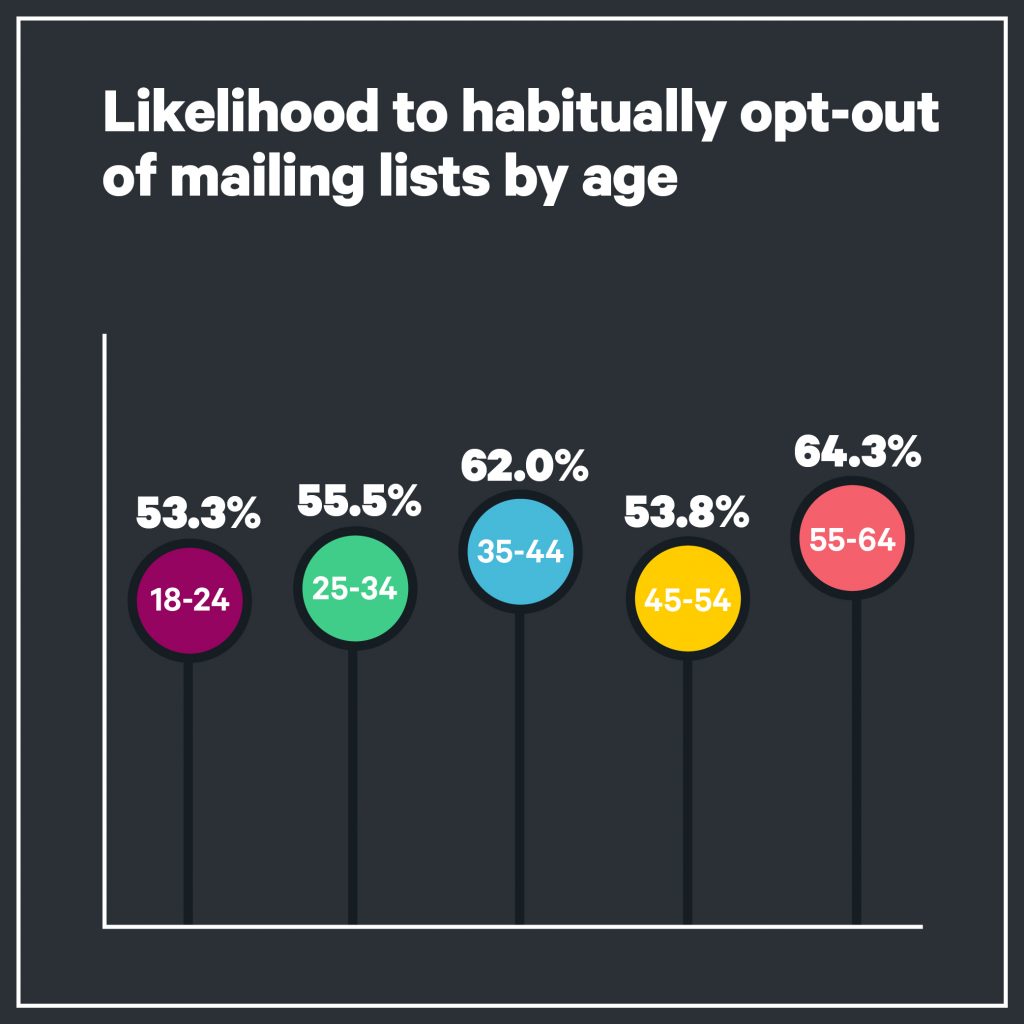
Just over 85% of consumers opt-out of being added to a company’s mailing list at least some of the time, while 58.0% say they do it habitually (opting out ‘always’ or ‘most of the time’). Older consumers are the most likely to refuse email marketing, with more than 64% of respondents in the 55-64 age range usually opting-out.
Meanwhile, 89.0% of Gen Z decline emails at least some of the time – this demographic prefers consuming content on social media (around 7 in 10 engage with brands on Instagram and TikTok).
You can’t rely solely on first-party data
First-party cookies let you track how users interact with your website or app. While they can provide a valuable source of behavioral and transactional data, the law increasingly requires visitors to give their permission for you to collect this data.
Statues inspired by the EU’s General Data Protection Regulation (GDPR) are starting to spread across the States (California, Colorado, Connecticut, Utah, Virginia, Iowa, Indiana, Tennessee, Montana, Florida, Texas, Oregon, Delaware, and New Jersey have all signed data protection laws). They not only apply to companies based in those states, but also to companies that sell goods or services to consumers from those states (while GDPR applies if you have customers from European countries).
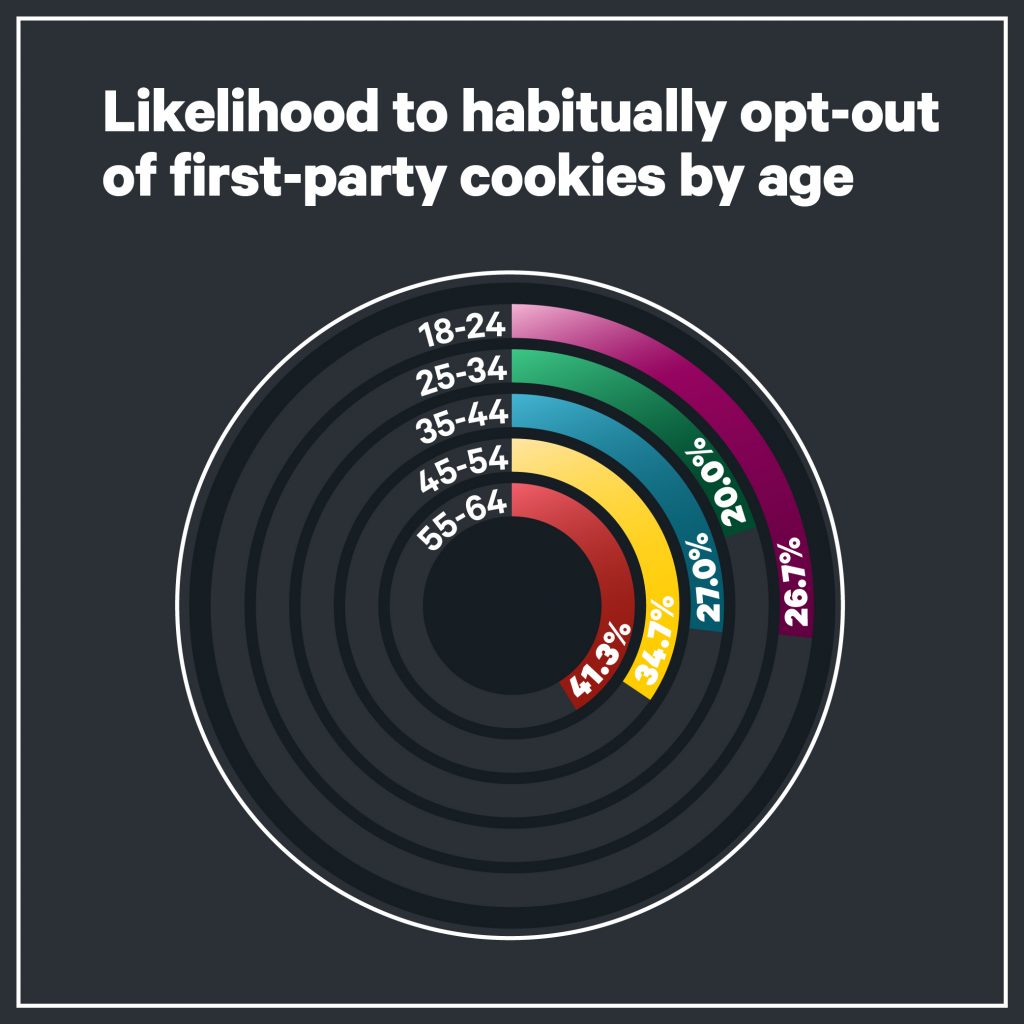
Our data shows that nearly 31% of consumers would be likely to decline non-essential cookies if asked by a website (and, as you’ll see in the next section, this percentage can be higher according to website type). Older consumers are least willing to give their permission: 41.3% are likely to opt-out of first-party cookies.
Consumer privacy concerns vary by website type
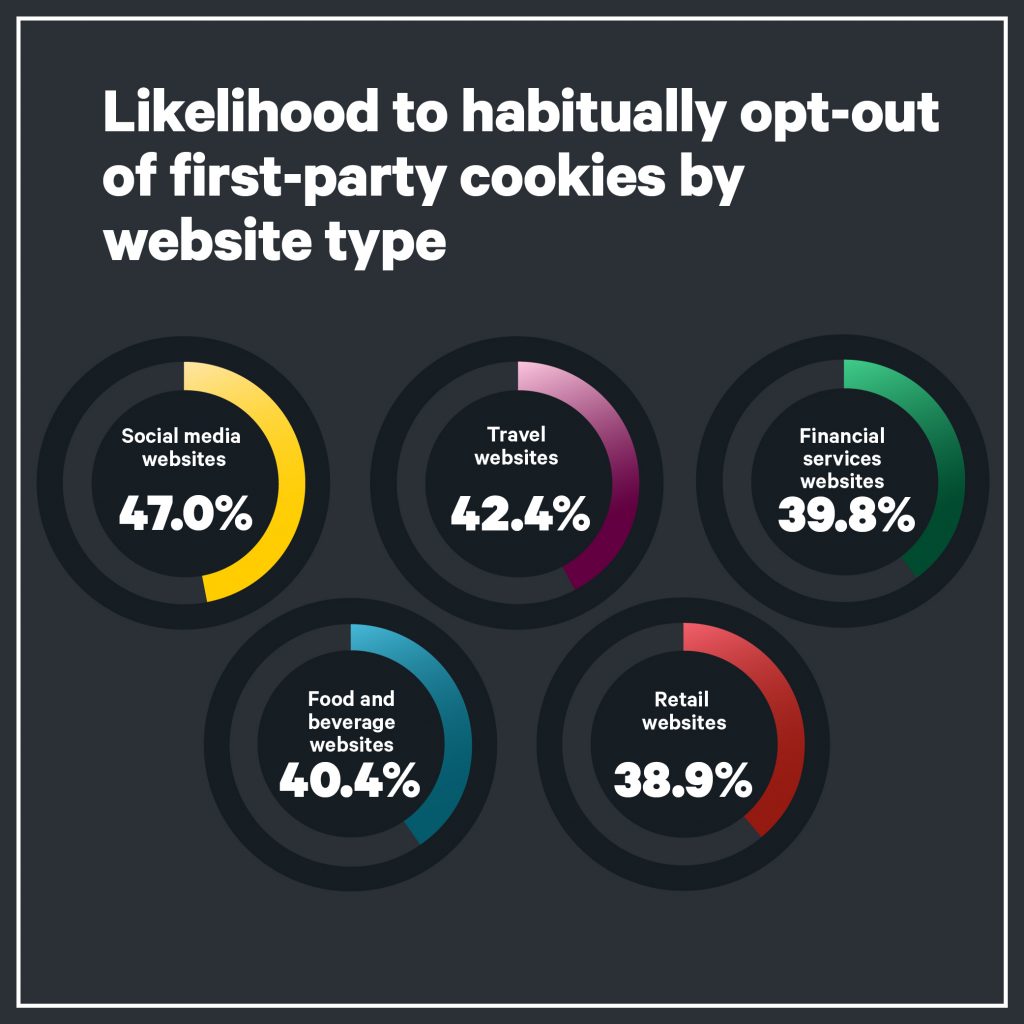
The nature of your business can have an impact on consumer willingness to share data via first-party cookies. For example, consumers are more likely to opt-out of cookies on social media websites (47.0%), probably because of the high level of advertising on these platforms and their reputation for poor data privacy.
Likewise, travel websites have lower opt-in rates, no doubt because consumers fear the data will be used against them the next time they visit, when the price of the flights they last looked at will have gone up. However, a reluctance to opt-in can affect all types of brands; nearly 39% of consumers say they’re likely to decline cookies on retail websites in general.
Consumers who decline cookies are most likely to do so because they don’t want to be targeted with advertising (36.6%) and because they don’t trust the website with their data (36.3%). Meanwhile, 27.1% have concerns about hackers stealing their data. Interestingly, Gen Z over-index for not trusting websites when it comes to data privacy (52.5%).
Reaching consumers will continue to get harder
While the death of third-party cookies might have been postponed, it will continue to get harder for marketers to reach their target customers as they demand greater data privacy.
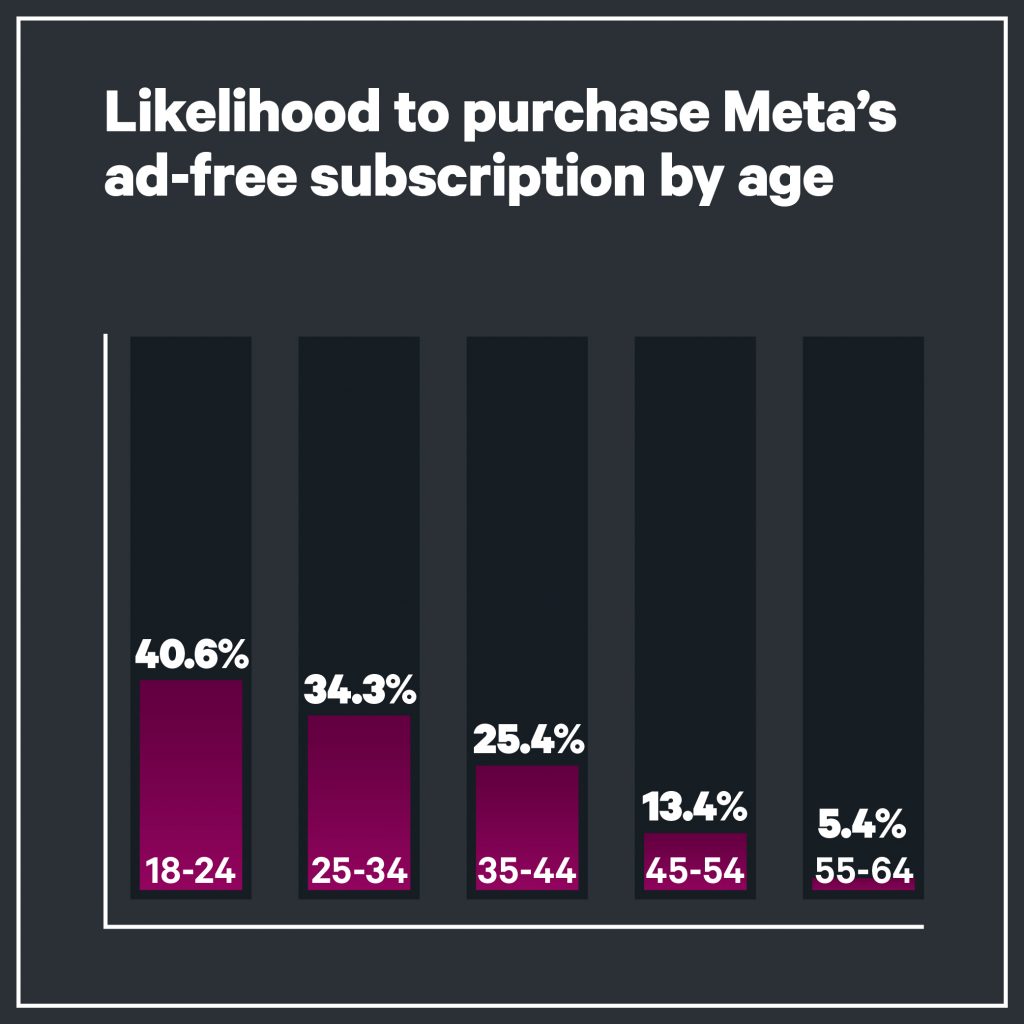
In an attempt to meet this demand, for example, Meta has introduced a premium ad-free subscription for Facebook and Instagram users. The subscription has been launched in Europe but could be extended to the US in the future. A poll we did of 500 US and UK consumers shows a reasonable amount of interest: 23% would be likely to subscribe (even at the high price of €12.99/$13.72 for one platform and €20.99/$22.46 for two).
Gen Z, in particular, show high intent to subscribe (40.6% of those aged 18-24), meaning advertisers would no longer be able to reach them on Instagram, one of this demographic’s most-used platforms.
At the same time, privacy-first tech companies like DuckDuckGo are launching their own initiatives, including disposable forwarding addresses that ensure emails are screened for trackers.
Ultimately, we’re looking at a future where the consumer calls the shots about how – or if – you can advertise to them. Brands that are unprepared are likely to experience serious losses in revenue. So how can marketers adapt their approach? In the next part, we’ll look at how you can tap into a rich new data source, how it will help rebuild consumer trust and make your marketing even more effective.
A solution: introducing zero-party data
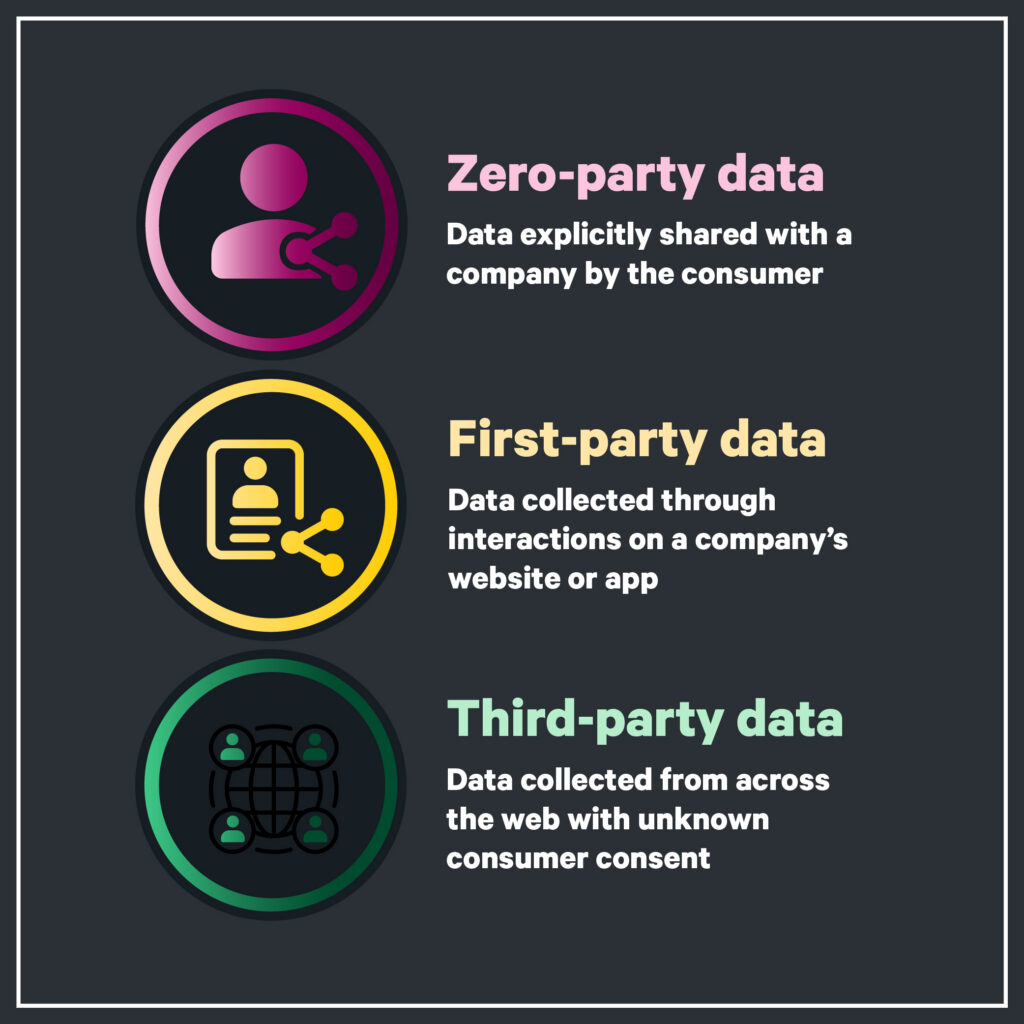
Zero-party data is an alternative data source that represents a big opportunity for marketers but is often underutilized. So what exactly is it? Zero-party data is information that consumers actively and willingly share to help brands shape their products and services.
It’s different to third-party and first-party data collection, which both rely on gathering information behind the scenes as consumers go about their online business. Even when users provide their permission for this, they’re not always actively aware of the data being gathered.
Zero-party data, on the other hand, involves explicitly asking consumers. This is typically done through interactive data collection methods such as consumer surveys. Forrester Research, which coined the term ‘zero-party data’ in 2020, defines it as data that a consumer “intentionally and proactively shares with a brand.”
And our research shows that zero-party data collection methods are among consumers’ favorite ways to share information – and actually help to build trust.
Zero-party data collection methods preferred way to share
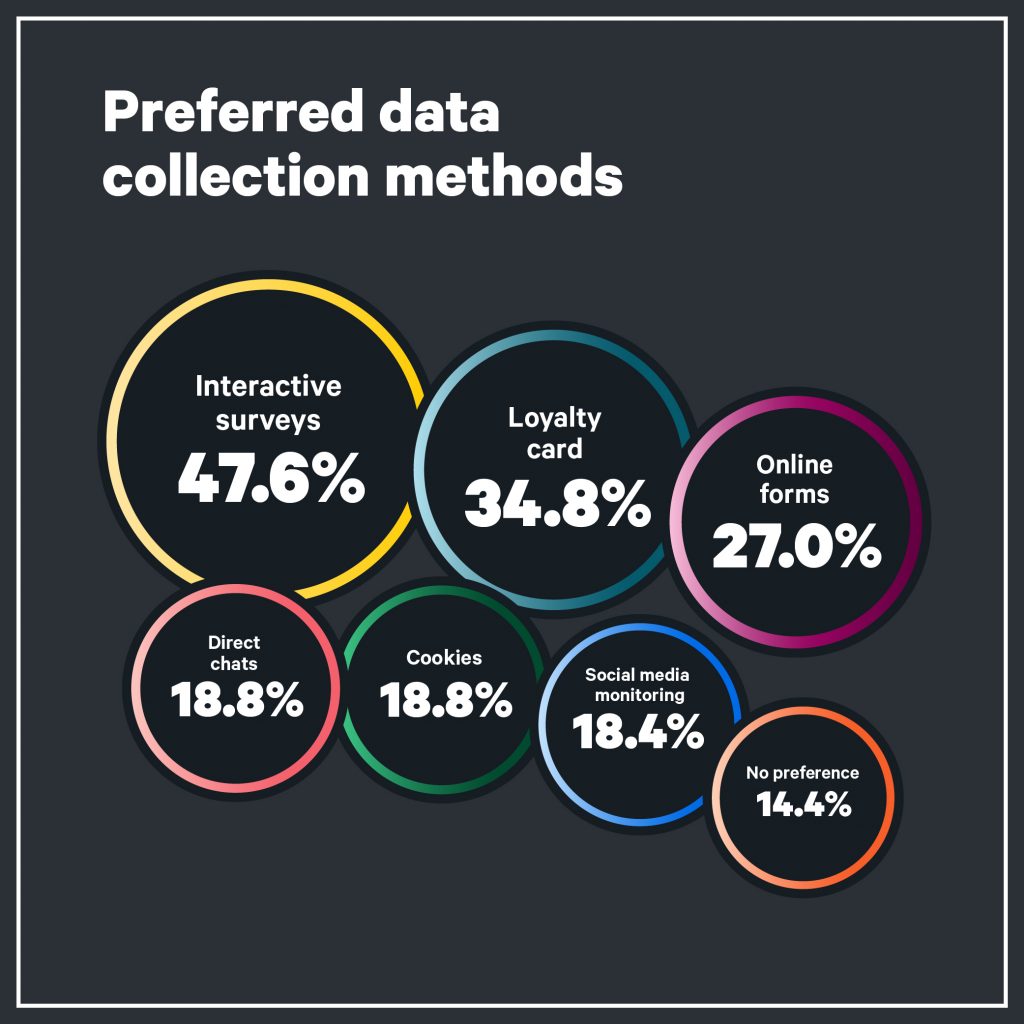
Nearly 48% of respondents say interactive surveys are their preferred way for a brand to capture data about them, while 27.0% like online forms. In comparison, only 18.8% prefer cookies, and 18.4% favor social media monitoring.
Consumer surveys are the most popular data collection method across all age groups; 66.7% of consumers aged 18-24 say they prefer them, as do 41.1% of those aged 55-64. Males show a slightly higher preference for surveys but they’re still a top choice with women: 49.9% versus 45.9%.
Zero-party data improves trust
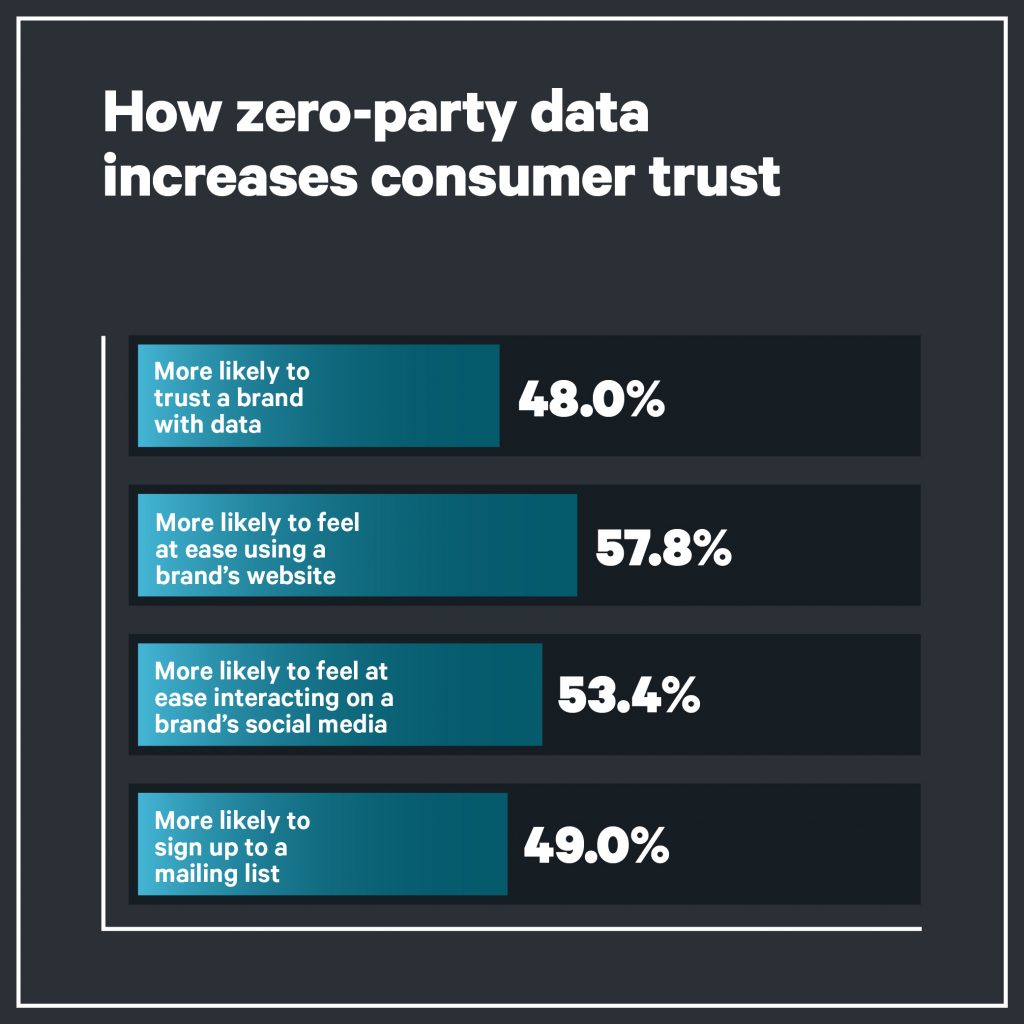
Beyond being a far richer source of information, collecting data via surveys actually helps to build consumer trust. When we asked respondents how they felt about brands seeking zero-party data (rather than using passive data collection methods) 48.0% said they would be more likely to trust those brands with their data.
What’s more, 57.8% would feel more at ease using the brand’s website and 53.4% would feel more at ease interacting with the brand on social media. This increased trust even translates into an increased likelihood to subscribe to a brand’s mailing list: 49.0% of consumers said they’d be more likely to do so.
Consumers in the 18-24 age bracket find overt data collection through things like surveys especially reassuring: 52.0% would trust a brand more with their data and 65.3% would feel more comfortable using a brand’s website.
The great thing about surveys is you can collect a much broader range of data. Rather than being confined to the information you can scrape from your website, you can ask consumers what you really want to know, letting you build out highly accurate customer profiles.
How can zero-party data support contextual advertising?
While it might be the biggest, Google Chrome isn’t the only web browser, and others including Mozilla’s Firefox and Apple’s Safari have already done away with third-party cookies. The main alternative these web browsers offer is contextual advertising.
Contextual advertising targets ads based on the content of the webpage rather than user behavior. For example, if someone is reading a cooking blog, they might be shown an ad for your cookware range. The ads assume that the user has an interest in the topic of the content and might therefore be interested in related products.
With this in mind, brands will need a better understanding of consumers’ interests and the buying behaviors around them – knowledge that can easily be obtained via zero-party data. Once you understand your consumers’ pain points, purchase drivers and shopping habits, you’ll be able to craft ads that resonate more widely without being hyper-targeted (or feeling creepy).
You can also use zero-party data to make sure the messages on your ads are the ones your target consumers are most likely to respond to (by testing campaign creative). So while moving away from third-party cookies might initially appear be a loss for marketers, there really is so much to be gained by tapping into zero-party data.
Loss
Gain
Ability to track users across the web gathering information about the sites they’ve visited and products they’ve looked at/bought.
Ability to ask consumers how often they shop for products, how they research purchases, their purchase drivers, barriers to purchase, awareness of your brand, preferred retailers, and much more.
Ability to serve hyper-targeted and persistent ads to consumers based on their online behavior.
Ability to design and serve highly relevant and persuasive ads based on consumers’ interests.
Ability to retarget your website visitors with ads on other websites.
Ability to enrich contextual ads on other websites with deep consumer insight.
Embracing the future with zero-party data
Arguably, zero-party data is superior to anything supplied by cookies, and making the shift now will set brands up to flourish in 2024 and beyond. The more you can amplify your owned data, the better prepared you will be for the future of digital advertising.
Thankfully, collecting zero-party data is easy with Attest. Using our intuitiveconsumer insights platform, anyone in your team can get hands-on creating and sending surveys. And the built-in analysis tools mean you don’t have to be a researcher to analyze the data.
Attest surveys can include a mix of question types – including open text and video responses – so you can actually hear the voice of the consumer. And we deliver results fast – you can get a treasure trove of zero-party data in a couple of days. With cookies you’d have to wait much longer for actionable insights.
Gathering zero-party data with Attest gives you the full picture, and doesn’t reduce your customer to the clicks they make online. As a result, you can create marketing with more emotional impact and the power to move consumers to action.